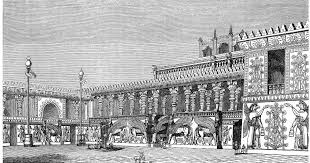
The Palace of Sargon II, located at Dur-Sharrukin (modern-day Khorsabad, Iraq), was the crowning achievement of the Neo-Assyrian Empire. Built between 717 and 706 BCE, it was a city-palace designed to project the absolute power of a king who styled himself "King of the World."
The site is a masterpiece of ancient urban planning, combining massive defensive fortifications with some of the most sophisticated stone reliefs and sculptures ever recovered from the ancient Near East.
1. Dur-Sharrukin: The "Fortress of Sargon"
Unlike many ancient cities that grew organically over centuries, Dur-Sharrukin was a "planned" capital. Sargon II ordered the city built from scratch on virgin soil to represent a fresh start for his dynasty.
The Layout: The city was a near-perfect square, surrounded by a massive wall with seven gates.
The Citadel: The royal palace was built on a giant artificial terrace, raised 15 meters above the city level to literally look down upon the subjects and protect the king from potential floods or uprisings.
The Scale: The palace complex itself contained over 200 courtyards and rooms, covering nearly 25 acres of the citadel.
2. The Lamassu: Celestial Guardians
The most iconic archaeological finds from Sargon’s palace are the Lamassu—colossal guardian figures that stood at the gateways of the palace.
Design: These statues possessed the head of a human (representing intelligence), the body of a bull or lion (strength), and the wings of an eagle (divinity/speed).
The Five-Legged Illusion: If you look at a Lamassu from the front, it appears to be standing still; from the side, it appears to be walking. To achieve this, Assyrian sculptors gave the creatures five legs, an early example of using perspective in monumental art to create a sense of motion.
Purpose: They were intended to "magically" protect the king and intimidate visiting dignitaries before they even entered the throne room.
3. The Throne Room and Propaganda in Stone
The heart of the palace was the royal throne room, which was accessed through a series of increasingly grand courtyards.
The Narrative Reliefs: The walls were lined with gypsum slabs carved in low relief. These weren't just art; they were state propaganda. They depicted Sargon’s military victories, the brutal treatment of captives, and the king hunting lions.
Psychological Warfare: By the time a foreign ambassador reached the King, they had walked past hundreds of meters of imagery showing exactly what happened to those who rebelled against Assyria.
Polychromy: While we see the stone as grey or white today, archaeology has found traces of vibrant pigments—blues, reds, and yellows—proving the palace was once a riot of color.
4. The Ziggurat: Reaching for the Heavens
Attached to the palace was a religious complex featuring a Ziggurat, a stepped pyramid common in Mesopotamian architecture.
The Spiral Ascent: Sargon’s ziggurat was unique because it featured a continuous spiral ramp winding around the exterior to the summit, rather than the traditional staircases.
Symbolism: Each level was likely painted a different color to represent various celestial bodies or deities, serving as a physical link between the King’s palace and the gods of the Assyrian pantheon.
5. Archaeology and the Tragedy of 1853
Much of what we know about the palace comes from early French excavations led by Paul-Émile Botta and Victor Place.
The Sinking of the Rafts: In 1853, a massive collection of artifacts, including hundreds of relief slabs and several Lamassu, was being transported down the Tigris River to the Persian Gulf. Arab tribes attacked the convoy, and the heavy rafts (called keleks) capsized.
Lost Treasures: Over 200 crates of Sargon's treasures sank to the bottom of the river. They have never been recovered and remain buried in the silt of the Tigris, while the pieces that survived are now the centerpieces of the Louvre and the British Museum.
6. The Short Life of a Capital
The grandeur of Dur-Sharrukin was remarkably short-lived. Sargon II died in battle in 705 BCE, just one year after the palace was completed.
The Abandonment: His son, Sennacherib, viewed his father’s death on the battlefield as a bad omen. He immediately abandoned Dur-Sharrukin and moved the capital to Nineveh.
Preservation through Neglect: Because the city was abandoned so quickly and never re-inhabited, the layout of the palace remained largely undisturbed by later civilizations, providing archaeologists with a "frozen" snapshot of Neo-Assyrian life at its peak.