Introduction
Coastal floodplains have supported human settlement for thousands of years. Their fertile soils, access to waterways, and proximity to marine resources made them attractive places for villages, farms, and trading communities. Yet these environments also presented a persistent challenge: seasonal flooding, shifting channels, waterlogged ground, and unstable sediments.
One architectural response was the use of timber frames and wooden foundation systems. Instead of relying entirely on heavy stone or masonry, builders could use posts, beams, platforms, and interlocking wooden elements to distribute structural weight across soft ground.
Archaeological evidence for these foundations is often difficult to identify because wood normally decays. In waterlogged environments, however, the absence of oxygen can preserve timber for centuries or even millennia.
Why Coastal Floodplains Required Special Foundations
Floodplain environments are geologically dynamic. Rivers deposit layers of silt and clay, while tides and storm surges can introduce sand and marine sediments. These processes continually alter ground conditions.
Buildings constructed directly on soft sediment may settle unevenly or become unstable. Timber foundations offered several possible solutions.
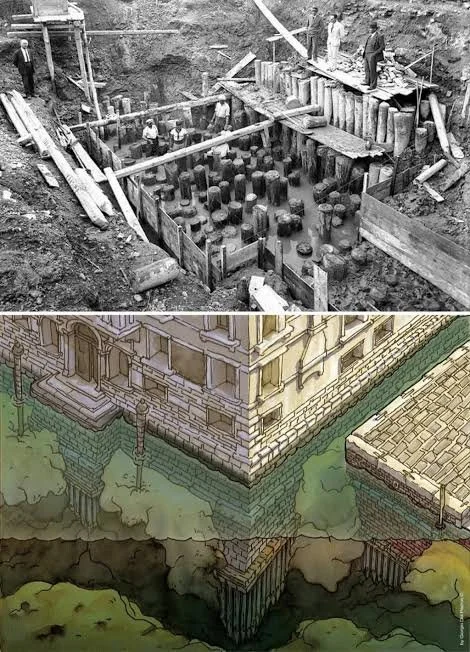
Builders could drive wooden piles into deeper, firmer layers, construct horizontal platforms, or connect vertical posts with beams. These arrangements helped distribute the weight of buildings and provided a more stable base.
The precise construction method depended on local materials, water depth, soil conditions, and the intended use of the structure.
Types of Timber Foundation Systems
Archaeologists distinguish several forms of wooden foundation construction.
Pile foundations consist of vertical timbers driven into the ground. They can support buildings above soft or saturated sediment.
Timber grillages use intersecting horizontal beams to spread structural loads over a wider area. They may be placed above piles or directly over prepared ground.
Post-and-beam foundations use upright timbers connected by horizontal members. In some settings, these elements also form part of the building's visible structural frame.
Wooden platforms can provide raised surfaces for houses, storage areas, or working spaces. Their construction may overlap with the broader category of pile-supported architecture.
Not every wooden post discovered in a floodplain represents a foundation. Posts may also belong to fences, docks, animal enclosures, or temporary structures.
Archaeological Preservation in Waterlogged Ground
Waterlogged conditions can preserve timber because microorganisms responsible for decay often require oxygen.
When wooden foundations become buried beneath saturated clay, peat, or fine sediment, decomposition may slow significantly.
Preserved timbers can retain tool marks, joints, growth rings, and traces of construction techniques. These details help researchers reconstruct how buildings were assembled.
However, preservation is uneven. Some timbers may survive while others disappear, leaving gaps that complicate interpretation.
Dating and Identifying Timber Structures
Radiocarbon dating can establish the approximate age of preserved wood, but it does not always identify the exact construction date. Reused timber may be older than the building in which it was installed.
Dendrochronology offers another method. By matching annual growth-ring patterns with established reference sequences, researchers may sometimes determine when a tree was cut.
The position of timbers within sediment layers is equally important. Their relationship to floors, walls, pottery, and other archaeological features helps establish whether they belong to one construction phase or several.
Flood Management and Settlement Design
Timber foundations were not necessarily designed to prevent flooding entirely.
Some raised buildings may have allowed water to pass beneath their floors. Others may have been positioned on prepared platforms to reduce exposure to shallow inundation.
Settlement layouts could also reflect flood awareness. Houses might occupy slightly elevated ground, while storage areas, paths, and working spaces were arranged around seasonal water movement.
These patterns reveal how communities adapted to environmental risks rather than simply attempting to eliminate them.
Reconstructing Ancient Construction Techniques
Archaeologists examine tool marks, timber dimensions, joints, and the arrangement of structural elements to understand building practices.
Experimental archaeology can help test how different foundation systems perform in soft sediment.
Researchers may reconstruct pile arrangements or timber platforms and measure their stability under simulated loads.
Such experiments are useful, but they cannot automatically establish that an ancient community used a particular design. Experimental results must be compared with actual archaeological evidence.
Environmental Change and Abandoned Settlements
Coastal floodplains can change dramatically over time.
River channels migrate, shorelines move, and sediment accumulates. A settlement that once stood beside a navigable waterway may eventually become inland or buried beneath later deposits.
Flooding, erosion, changing trade routes, and economic decline could all contribute to abandonment.
Timber foundations preserved beneath later sediment can therefore provide evidence for landscapes that no longer exist in their original form.
Conclusion
Ancient timber-frame foundations in coastal floodplains demonstrate the practical knowledge communities developed to build on unstable and waterlogged ground.
Piles, platforms, beams, and interconnected wooden structures offered different ways to distribute weight and adapt buildings to local conditions.
Their archaeological identification depends on careful excavation, environmental analysis, and reliable dating.
Although individual sites require their own evidence, preserved timber foundations offer an important record of how people engineered settlements in some of the most challenging landscapes of the ancient world.