Introduction
The floors of ancient houses were more than surfaces for walking and working. In many societies, domestic spaces also served as places of religious practice, family remembrance, protection, and symbolic communication.
Archaeologists sometimes discover objects deliberately placed beneath floors, inside foundation trenches, or within wall cavities. These deposits may include pottery, animal bones, beads, figurines, coins, food remains, or small metal objects.
Such discoveries are often described as foundation deposits or domestic offerings. Their interpretation raises an important question: did similar practices across different historical periods represent a continuous tradition, or did separate communities independently develop comparable rituals?
What Are Underfloor Offerings?
An underfloor offering is an object or group of materials intentionally deposited beneath a building floor or within a structural feature.
The location distinguishes these deposits from ordinary household rubbish.
Some offerings appear beneath thresholds, near hearths, beside walls, or at the corners of buildings. Others are associated with the construction of a new house or the renovation of an existing one.
Their contents vary widely. A small vessel might contain food, while a figurine or bead could have served as a symbolic protective object.
Not every object found beneath a floor was placed there deliberately. Archaeologists must establish whether its position reflects intentional deposition, accidental loss, or later disturbance.
Domestic Religion and the Household
Religious practice did not always take place in large temples or public sanctuaries.
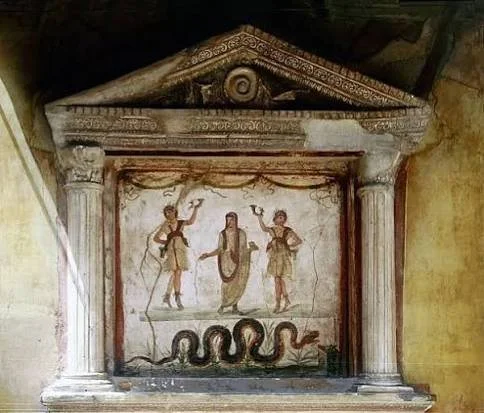
Households could contain small shrines, offering areas, sacred objects, and spaces associated with family ceremonies.
Domestic rituals might involve protection of residents, fertility, successful childbirth, agricultural prosperity, ancestral remembrance, or the well-being of animals.
The house itself could be understood as a place requiring symbolic protection.
Underfloor deposits may therefore have marked important moments in the life of a household, particularly construction, occupation, renovation, or abandonment.
Offerings in Ancient Archaeological Contexts
Foundation deposits are known from several ancient cultural settings, although their meanings differed.
In parts of the ancient Near East, objects and deposits were associated with the construction and dedication of buildings.
In ancient Egypt, foundation deposits could accompany temples and other important structures.
Across the Mediterranean, archaeological discoveries have included objects placed in domestic and architectural contexts that may have served ritual purposes.
These practices should not be treated as one universal tradition. Similar placement does not necessarily indicate shared beliefs or direct cultural transmission.
Objects and Their Possible Meanings
The materials selected for an offering can provide clues about its meaning.
Small vessels may have contained food, drink, oil, or other substances. Animal bones may represent a meal, sacrifice, or symbolic act. Figurines could have represented protective beings, deities, humans, or animals.
Coins and personal ornaments may have carried economic, social, or symbolic value.
The context is more important than the object alone. A figurine found beneath a threshold may have a different significance from an identical figurine discovered in a rubbish deposit.
Continuity Across Millennia
The idea of placing meaningful objects beneath a building has appeared in different societies and periods.
However, chronological similarity is not proof of uninterrupted cultural continuity.
A practice observed in a prehistoric settlement and another found in a medieval house may share a general purpose while having entirely different religious meanings.
To demonstrate continuity, researchers need evidence of intermediate practices, comparable ritual procedures, regional connections, and historical transmission.
Without this evidence, it is safer to describe recurring patterns rather than a single tradition surviving unchanged for thousands of years.
Scientific Analysis of Deposits
Modern archaeology can investigate underfloor offerings through several methods.
Microscopic soil analysis may reveal whether a deposit was placed in a prepared pit or entered the ground through natural processes.
Residue analysis can identify traces of fats, oils, plants, or other substances inside vessels.
Zooarchaeological examination can determine the species, age, and condition of animal remains.
Radiocarbon dating may establish the age of organic materials, while ceramic and stratigraphic analysis help connect the deposit to a particular building phase.
These methods are especially useful when a deposit contains several materials that may not have been placed at the same time.
Household Identity and Social Relationships
Domestic offerings may also reveal how families understood their place within a community.
A household with distinctive ritual objects might have followed a particular religious tradition or expressed its identity through family customs.
Differences between neighboring houses could indicate variation in wealth, social status, occupation, or household beliefs.
However, ritual deposits are not straightforward measures of personal faith. Archaeological evidence rarely reveals exactly what an individual believed.
Preservation and Interpretation Challenges
Underfloor deposits can be disturbed by later construction, repairs, animal activity, or natural processes.
Organic materials may disappear, leaving only pottery or stone objects.
In other cases, later occupants may unknowingly build over earlier ritual deposits.
Researchers must also avoid interpreting every unusual object as sacred. An object may have been stored, discarded, hidden, or accidentally trapped beneath a floor.
The strongest interpretations combine location, composition, chronology, and comparison with other examples.
Conclusion
Underfloor offerings provide a valuable window into the private and symbolic dimensions of ancient domestic life.
They show that houses could function as more than practical shelters: they could also be places where families expressed hopes, fears, identity, and relationships with the sacred.
Comparable deposits appear across widely separated periods, but their presence does not automatically demonstrate an uninterrupted ritual tradition.
By examining archaeological context and scientific evidence, researchers can distinguish genuine ritual deposits from ordinary household remains and better understand how domestic beliefs changed across generations.