Doggerland: A Submerged Prehistoric Heartland of Forests and Wildlife
A Lost Land Beneath the North Sea
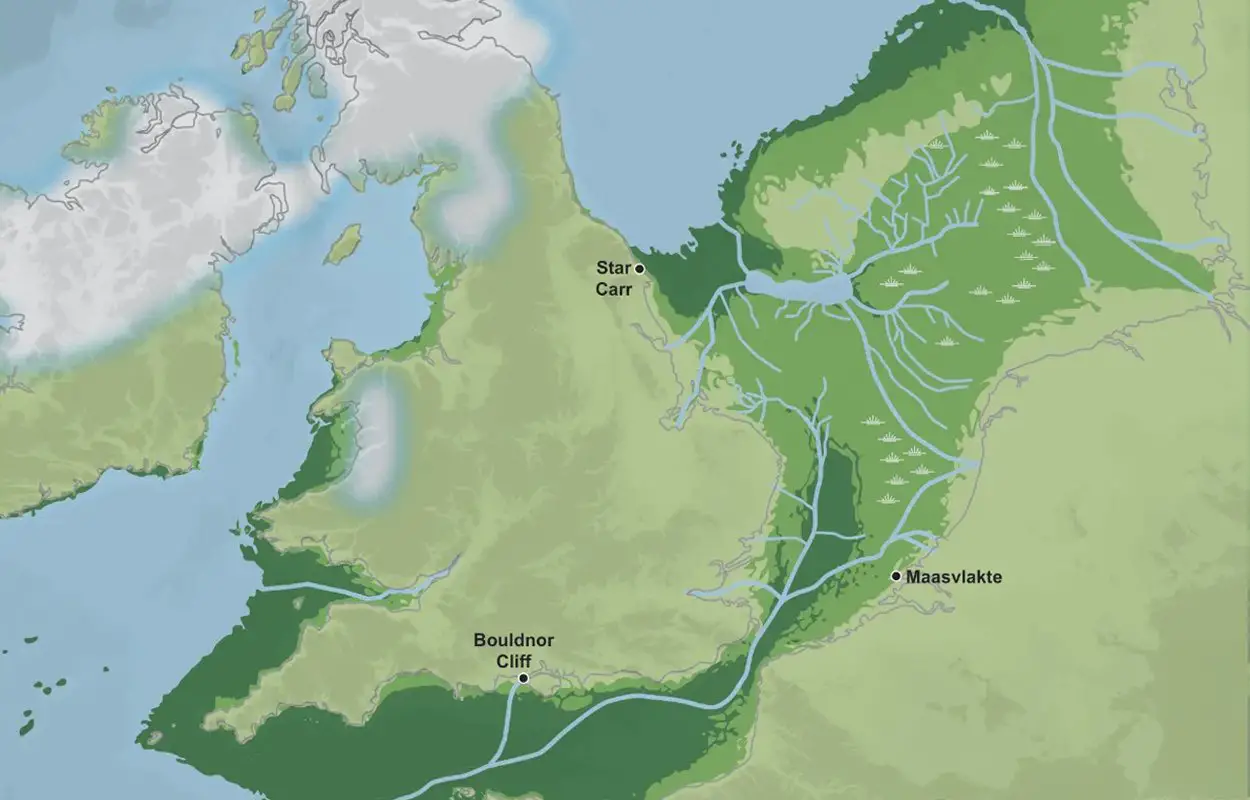
Long before rising seas created the modern North Sea, a vast landmass called Doggerland connected Britain to continental Europe. Traditionally thought to be a cold, barren Ice Age plain, new research suggests that parts of Doggerland were far more hospitable than previously believed—supporting forests, wildlife, and potentially early human communities thousands of years earlier than once assumed.
A study led by researchers at the University of Warwick, published in Proceedings of the National Academy of Sciences, provides the first detailed reconstruction of Doggerland’s ecology using sedimentary ancient DNA (sedaDNA) preserved in marine sediments.
Reconstructing the Ecological History
By analyzing DNA traces from sediments along a prehistoric river system in southern Doggerland, scientists were able to identify plant species that thrived from the end of the last Ice Age until the region was submerged by the North Sea.
The study examined 252 sediment samples from 41 marine cores, revealing that temperate woodland species such as oak, elm, and hazel were established more than 16,000 years ago—thousands of years earlier than pollen records from Britain suggested.
Surprisingly, the team also detected DNA from:
Tilia (lime trees): Appearing roughly 2,000 years before it shows up in Britain, indicating warmer conditions.
Pterocarya (walnut relative): Believed extinct in northwestern Europe 400,000 years ago, showing it survived in isolated refuges much longer.
These discoveries support the concept of microrefugia—small pockets where temperate plants endured harsh Ice Age conditions, helping explain Reid’s Paradox, or how trees recolonized northern Europe so quickly after glacial retreat.
Doggerland as a Refuge for Early Humans
Temperate forests in Doggerland would have offered abundant resources for both wildlife and humans. Woodland ecosystems likely supported animals such as wild boar and other game, providing food and materials for early Mesolithic communities.
“For many years, Doggerland was often described as a land bridge—only significant as a route for prehistoric settlement of the British Isles. Today, we understand that Doggerland was not only a heartland of early human settlement, but also a refuge for plants and animals, and a key factor in how prehistoric communities settled northern Europe,” said Professor Vincent Gaffney.
According to Professor Robin Allaby, the research shows that Doggerland’s wooded environment could have supported early human communities prior to flooding, helping explain why relatively little early Mesolithic evidence survives on mainland Britain.
A Landscape That Persisted Longer Than Expected
The DNA evidence also challenges previous assumptions about when Doggerland disappeared. Parts of the landmass appear to have survived major flooding events, including the Storegga tsunami around 8,150 years ago, and may have remained above water until roughly 7,000 years ago.
This prolonged existence would have allowed Doggerland to act as a critical ecological and human refuge, shaping settlement patterns across northern Europe long before the emergence of the Maglemosian culture around 10,300 years ago.
A Thriving Ice Age Ecosystem
The study positions Doggerland not merely as a migration corridor but as a thriving ecosystem that played a central role in the environmental and human history of Ice Age Europe. By revealing early forests, wildlife, and habitable landscapes, the research provides a richer understanding of how prehistoric humans interacted with and adapted to this now-submerged world.