Located in the volcanic Phlegraean Fields near Naples, Baiae was the absolute apex of luxury, hedonism, and political intrigue for the elite of the late Roman Republic and Empire. Emperors like Julius Caesar, Nero, Caligula, and Hadrian built sprawling, hyper-luxurious coastal villas that extended directly over the water.
However, Baiae sat on a volatile volcanic engine. A geological phenomenon known as bradyseism—the cyclical rising and falling of the earth's crust caused by the filling and emptying of underground magma chambers—permanently submerged the lower half of the resort city under six meters of water by the 4th century CE.
                         [ THE BRADYSEISMIC ENGINE ]
                                      │
         ┌────────────────────────────┴────────────────────────────┐
         ▼                                                         ▼
 [ THE PALATIAL SECTOR ]                                 [ THE THERMAL MATRIX ]
 Sunken marble nymphaeums, copyist statues               Integrated volcanic hypocaust networks
         │                                                         │
         └────────────────────────────┬────────────────────────────┘
                                      ▼
             [ UNDERWATER HIGHWAY: Via Herculanea Mosaic Grid ]
Today, the Submerged Archaeological Park of Baiae allows divers to explore intact Roman streets, imperial dining rooms, and private thermal baths that have been completely colonized by marine life.
The Imperial Nymphaeum of Emperor Claudius
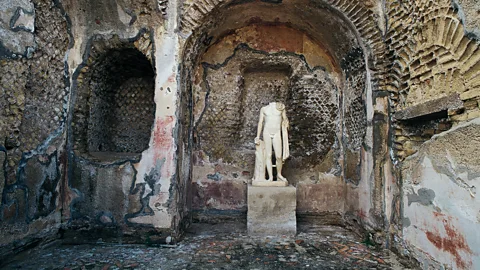
The absolute jewel of submerged Baiae is the Punta Epitaffio complex, an elite, semi-circular underwater dining hall (nymphaeum) belonging to Emperor Claudius.
The layout features a magnificent, flooded room lined with marble copyist statues of the imperial family, Dionysian figures, and scenes from Homer’s Odyssey, including a famous statue of Odysseus holding a wine cup.
The floor of this imperial chamber is a flawless matrix of multi-colored opus sectile marble tiles, which underwater conservators must systematically brush clean of marine algae to reveal their vibrant geometric colors.
The Architecture of Excess
Baiae was an engineering triumph of the ancient world. Roman architects utilized the region’s intense volcanic activity to revolutionize luxury living:
The Volcanic Hypocausts: Private villas were built directly over natural sulfur vents, channeling volcanic steam through hollow terracotta wall pipes to heat private infinity pools and saunas.
The Opus Signinum Wharves: Builders used volcanic ash (pozzolana) to create hydraulic concrete that hardened underwater, allowing them to construct massive concrete piers that jutted out into the sea, supporting private dining platforms where elite Romans engaged in legendary.