Known to the ancient Greeks as Heracleion and to the ancient Egyptians as Thonis, this magnificent metropolis sat at the mouth of the Canopic branch of the Nile River. It was Egypt's absolute premier international port of entry, controlling all European maritime trade before the founding of Alexandria in 331 BCE.
Around the 8th century CE, a catastrophic combination of liquefaction, severe Nile floods, and massive earthquakes caused the unstable clay foundations of the delta to collapse, dropping the entire city 30 feet into the Abu Qir Bay.
Rediscovered in 2000 by underwater archaeologist Franck Goddio, the excavation of Heracleion has yielded an unparalleled collection of monumental sculpture, religious treasures, and maritime architecture that has completely re-illuminated the Ptolemaic and Pharaonic relationship.
The Colossi of the Delta
Emerging from the dark marine silt are three colossal, 16-foot-tall statues carved out of pristine red granite. Depicting an Egyptian king, an anonymous queen, and the god Hapy (the personification of the Nile flood), these multi-ton statues once flanked the grand entrance of the Great Temple of Amun-Gereb.
The preservation of these figures is flawless:
The Ptolemaic Fusion: The artistic style displays a sophisticated blend of classical Greek anatomical realism and rigid, traditional Pharaonic iconography.
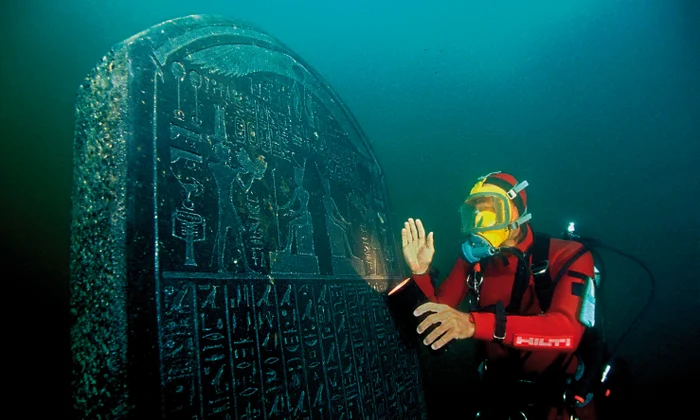
The Decree of Canopus: Archaeologists uncovered a massive, perfectly preserved black diorite stele inscribed with the Decree of Canopus (238 BCE), written in Hieroglyphic, Demotic, and Greek scripts, predating the Rosetta Stone and providing a direct match for linguistic decoding.
The Shipwreck Graveyard
Heracleion features the largest concentration of ancient shipwrecks ever found at a single site. Over 70 ancient vessels dating from the 6th to 2nd centuries BCE have been mapped within the sunken port canals.
Many of these ships were not sunk by accident; they were intentionally scuttled to form defensive underwater barricades or to block specialized custom tax channels. Inside these ships, divers recovered thousands of bronze coins, Athenian lead weights, and gold earrings, highlighting the intense, lucrative taxation system that filled the treasuries of the pharaohs with international gold.