During the late 17th century, Port Royal was the undisputed commercial and maritime hub of the Caribbean. Built on a precarious sand spit at the mouth of Kingston Harbour in Jamaica, it earned a reputation as the "Wickedest City on Earth." It was a chaotic haven for privateers, buccaneers, and outright pirates—including the legendary Sir Henry Morgan—who were actively financed by the British Crown to raid Spanish treasure fleets.
The city grew with frantic speed, cramming over 2,000 multi-story brick buildings, crowded taverns, brothels, and slave markets onto just 51 acres of premium coastal land. Because space was limited, builders ignored structural safety, erecting heavy, European-style brick structures directly onto uncompacted, water-logged marine sand.
   [ THE PRECARIOUS SAND SPIT ] ──► Heavy Brick Infrastructure Built on Marine Sand
                                               │
                                   (The June 7, 1692 Cataclysm)
                                               │
                                               ▼
   [ SOIL LIQUEFACTION ] ◄─────── 33 Acres of Urban Grid Slide Into the Sea
The June 7, 1692 Cataclysm
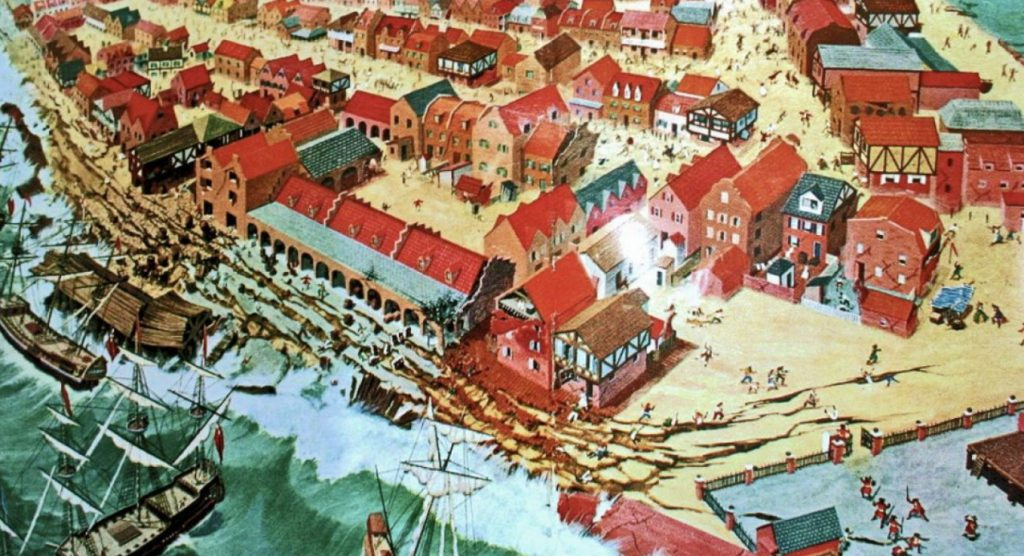
At approximately 11:43 AM on June 7, 1692, a massive earthquake, estimated at a magnitude of 7.5, struck the island of Jamaica. The impact on Port Royal was instantaneous and catastrophic due to a devastating geological phenomenon known as soil liquefaction:
The Quicksand Effect: The violent seismic waves destabilized the loose, water-saturated sand of the spit. The friction between the sand grains collapsed, causing the entire peninsula to instantly take on the properties of a liquid.
The Structural Slide: Entire streets of heavy brick houses sank vertically into the earth or slid horizontally into the deep waters of the harbor. People walking down the street were instantly swallowed up by closing fissures in the ground.
The Tsunami Wake: Seconds after the earth shook, a massive tsunami swamped the remaining remnants of the town, lifting large naval vessels over the tops of sunken houses and dropping them directly into the destroyed urban center.
When the dust settled, over 33 acres—two-thirds of the entire city—had permanently vanished beneath the waves of the harbor, killing over 2,000 citizens in a matter of minutes.
The Underwater Time Capsule
Because the city sank so rapidly, it created one of the most pristine underwater historical sites in the Western Hemisphere. Unlike land sites that suffer from continuous rebuilding, looting, and decay, Port Royal was frozen in time at exactly 11:43 AM. This exact time was verified when underwater archaeologists excavated a silver pocket watch crafted by French maker Paul Blondel, its gears permanently frozen by salt water at the precise moment of the disaster.
Extensive underwater excavations led by the Institute of Maritime History and Texas A&M University have mapped intact brick walls, fully stocked kitchens, and shipwright workshops resting in less than 40 feet of water.
Divers have recovered thousands of everyday artifacts that have redefined our understanding of colonial life, including pewter mugs still crusted with tobacco ash, intact crates of fine Chinese porcelain, thousands of clay pipes, and stacks of silver Spanish pieces of eight. Port Royal stands as an uncompromised, underwater monument to the volatile, gold-obsessed maritime frontier of the golden age of piracy.