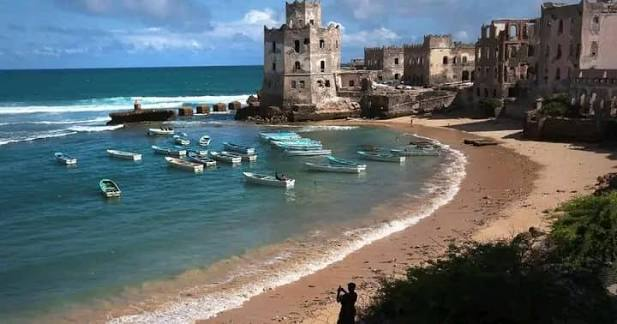
The name Bender Cassim is historically associated with the port of Bosaso on the Gulf of Aden, in the broader Somali coastal region. The claim that the settlement contained a substantial Portuguese fort requires careful qualification.
Portuguese naval activity certainly affected the western Indian Ocean during the sixteenth century, but archaeological evidence for Portuguese fortifications must be distinguished from later local, Ottoman, or other structures.
The subject nevertheless provides an excellent opportunity to examine the dramatic changes that occurred along the Somali coast when Portuguese naval power entered the Indian Ocean.
Portuguese Expansion Into the Indian Ocean
Portugal entered the Indian Ocean at the end of the fifteenth century following Vasco da Gama's voyages.
The Portuguese sought to control maritime commerce by establishing:
fortified ports;
naval patrols;
trading agreements;
and strategic alliances.
Their objectives included gaining access to the lucrative trade in spices and other goods.
The Gulf of Aden
The Gulf of Aden was strategically crucial.
It provided access to:
the Red Sea;
Arabian ports;
East Africa;
and Indian Ocean routes.
Control of this region could influence trade between the Indian Ocean and Mediterranean markets.
Somali Coastal Communities
The Portuguese encountered established Muslim trading communities along the Somali coast.
These communities already possessed:
ships;
commercial networks;
Islamic institutions;
and connections with Arabia and the Red Sea.
Portuguese arrival therefore did not introduce maritime commerce to the region.
Instead, it inserted a new military power into an existing network.
Fortifications
Portuguese strategy often relied on fortified positions.
A fort could provide:
protection;
artillery platforms;
storage;
military headquarters;
and control over a harbor.
However, not every coastal ruin described as Portuguese can be securely attributed to Portugal.
Archaeological dating is essential.
The Adal-Portuguese Conflict
The Portuguese became involved in conflicts surrounding the Adal Sultanate and the Ethiopian Empire.
Portuguese forces supported the Ethiopian side at important moments.
These conflicts connected the Horn of Africa to the larger military competition of the Indian Ocean.
Firearms
Portuguese naval power depended heavily on artillery.
Their ships carried:
cannons;
firearms;
and other weapons.
This created a new military dimension in coastal politics.
Local Resistance
Portuguese control was never absolute.
Local rulers, merchants, and Muslim states resisted Portuguese attempts to dominate trade.
The Portuguese faced competition from:
Ottoman forces;
regional Muslim states;
Arab merchants;
and local coastal authorities.
Ottoman-Portuguese Rivalry
The Ottoman Empire also became involved in the Indian Ocean.
Ottoman support for Muslim powers in the Red Sea and Horn of Africa created a larger geopolitical struggle.
The Gulf of Aden therefore became part of a confrontation involving several major powers.
Why Bender Cassim Matters
Whether or not a specific surviving structure can securely be identified as a Portuguese fort, the Bender Cassim region belongs to a historically important coastal zone where European, Ottoman, Arabian, and African powers interacted.
Conclusion
The story associated with Bender Cassim illustrates the dramatic transformation of Indian Ocean politics after Portuguese expansion.
The Somali coast already possessed sophisticated maritime networks when the Portuguese arrived.
Rather than creating those networks, Portugal attempted to control them.
The resulting conflicts reshaped trade and military power throughout the Gulf of Aden and western Indian Ocean.