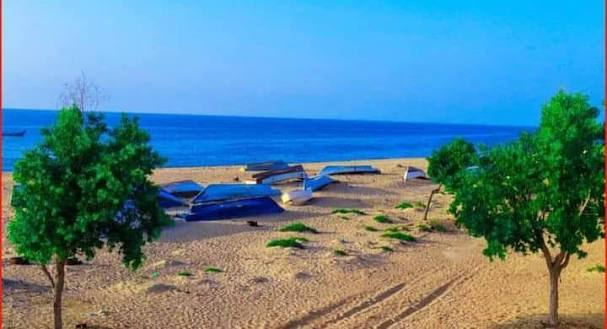
Las Khorey, also known as Laasqoray, is a historic coastal settlement in the Sanaag region of Somaliland. Situated along the Gulf of Aden, the town developed within a landscape where marine resources, salt production, pastoralism, and maritime trade intersected.
Its archaeological and historical importance comes from the combination of coastal ruins, traditional salt production, fishing, and its position within the wider trading network of the Horn of Africa.
The settlement demonstrates how communities adapted to one of the world's most challenging environments while taking advantage of the resources offered by the sea.
A Coastal Settlement in Sanaag
Las Khorey lies along a rugged section of Somaliland's northern coastline.
The region contains:
rocky shorelines;
beaches;
tidal areas;
marine resources;
and nearby desert and pastoral landscapes.
This combination created opportunities for both coastal and inland economic activities.
Salt Production
Salt has been one of the most important mineral resources available to coastal communities.
Sea water contains dissolved salts, primarily sodium chloride.
Traditional salt production generally depends on allowing seawater to evaporate.
As water disappears, salt crystals remain behind.
In suitable coastal environments, natural evaporation can make salt production relatively straightforward.
Why Salt Was Valuable
Before modern industrial salt production, salt was an important commodity.
It could be used for:
food preservation;
seasoning;
animal husbandry;
leather processing;
and certain industrial or craft activities.
Salt was particularly valuable in regions where natural sources were limited.
Salt and Caravan Trade
Salt could be transported inland through caravan networks.
Camel caravans were particularly useful because they could carry substantial loads across arid landscapes.
A coastal salt-producing settlement could therefore participate in a larger economic system connecting:
sea → coastal settlement → caravan route → inland market.
Fishing and Marine Resources
Salt was only one resource available at Las Khorey.
The Gulf of Aden provided:
fish;
shellfish;
and other marine resources.
Fishing could supplement pastoral economies and provide an additional source of food and trade.
The Coastal Trade Network
Las Khorey belonged to a coastline connected to the wider Red Sea and Indian Ocean world.
Ships moving through the Gulf of Aden could transport:
textiles;
ceramics;
metals;
food products;
and other manufactured goods.
Local products could travel in the opposite direction.
Ruins and Archaeological Evidence
Historic ruins along the Somaliland coast can include:
stone walls;
domestic structures;
religious buildings;
storage areas;
and graves.
Even apparently modest ruins can be valuable archaeological evidence.
Their distribution can reveal how large a settlement once was and how it was organized.
Islamic Heritage
Like many settlements along the Somali coast, Las Khorey developed within a region strongly influenced by Islam.
Islamic traditions affected:
burial;
architecture;
social organization;
education;
and commercial relationships.
Mosques and Islamic cemeteries became important features of coastal communities.
Inland-Coastal Relationships
The importance of Las Khorey cannot be understood only by looking at the sea.
The town depended on relationships with inland pastoral communities.
Livestock and other products could move toward the coast, while imported goods traveled inland.
This created a mutually dependent economic system.
Environmental Challenges
The arid climate has both preserved and damaged archaeological remains.
Dry conditions can protect:
stone structures;
ceramics;
and some organic remains.
At the same time, wind erosion and coastal processes can expose and destabilize ruins.
Why Las Khorey Matters
Las Khorey illustrates the relationship between:
salt production;
fishing;
pastoralism;
maritime trade;
and Islamic culture.
Its ruins represent a coastal economic system that existed long before modern transportation transformed regional commerce.
Conclusion
Las Khorey's salt pans and ruins preserve evidence of a community that made productive use of an exceptionally dry coastal environment.
Salt from the sea, fish from the Gulf of Aden, livestock from the interior, and imported goods from maritime traders all contributed to the settlement's economic importance.
The town therefore represents a broader historical pattern in which Somaliland's coast served as a bridge between inland African communities and the wider maritime world.