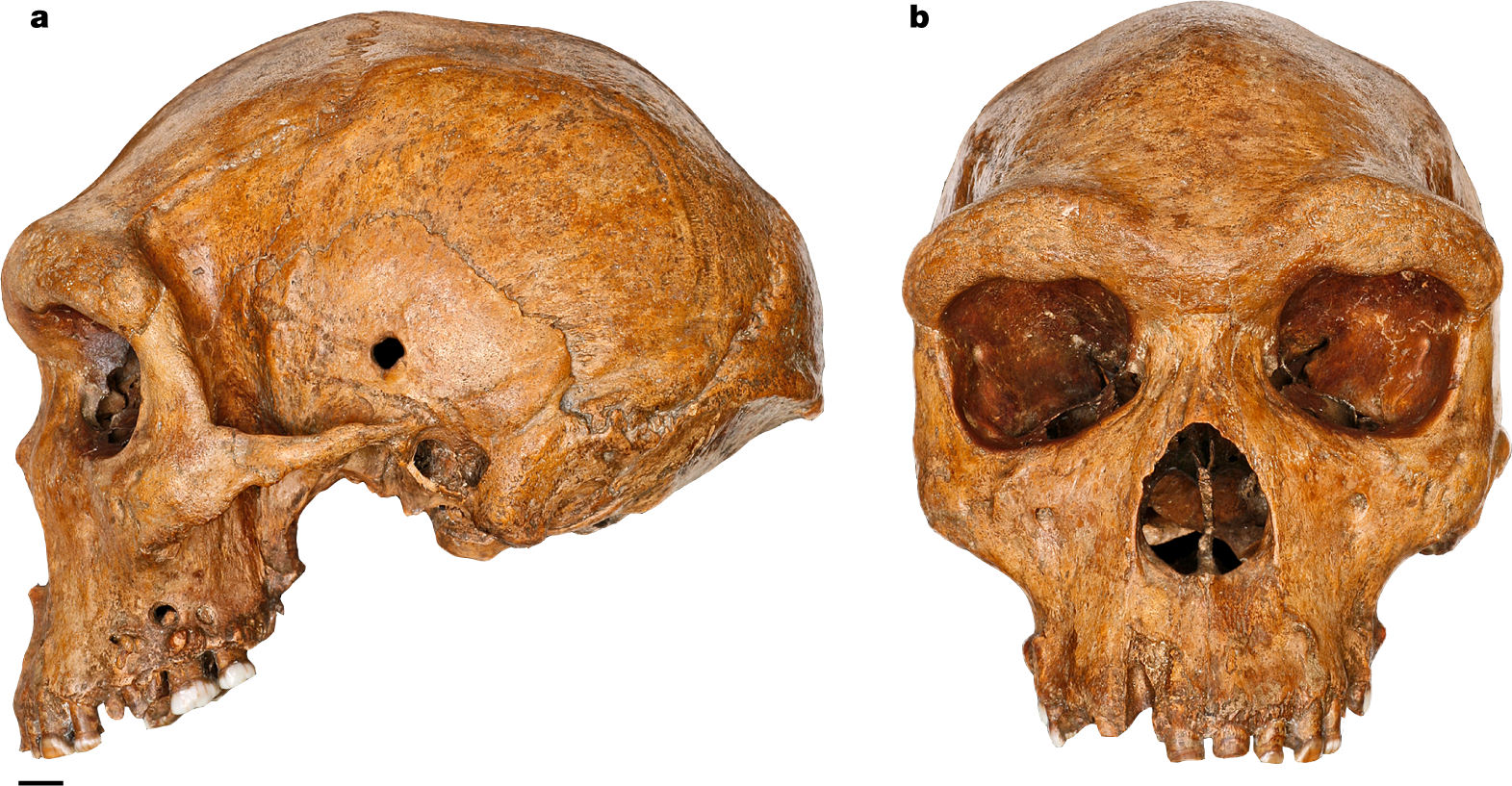
Discovered accidentally in 1921 during zinc mining operations in Kabwe, Zambia, the Broken Hill Skull (cataloged as Kabwe 1) is one of the most magnificent, intimidating, and structurally complete fossil craniums ever recovered from the African Middle Pleistocene. Initially classified speculatively as Homo rhodesiensis, this massive skull is now widely recognized as a classic, hyper-robust representative of Homo heidelbergensis (or a closely related archaic African lineage), providing a vital look at the stocky, heavy-browed ancestral populations that occupied Africa concurrently alongside the emergence of early Homo sapiens.
[ ARCHAEOLOGICAL ASSUMPTION ] ──► Early Middle Pleistocene (~500,000 YA)
                                            │
                             (U-Series Direct U-Th/ESR Scan)
                                            │
                                            ▼
[ CHRONOLOGICAL TRUTH ] ────────► 299,000 ± 25,000 YA: Late Archaic Survivor
Hyper-Robust Morphological Features
Kabwe 1 is the anatomical antithesis of Jebel Irhoud. It exhibits an extreme suite of primitive, robust features that reflect an immense physical investment in skull structural integrity and muscle attachment:
The Supraorbital Torus: The skull features the largest, thickest, and most prominent brow ridge of any hominin fossil ever discovered, forming an unbroken, massive shelf of solid bone over the eye orbits.
The Cranial Vault: The braincase is long, low, and thick-walled, featuring a pronounced occipital torus (a bony ridge at the back of the skull) to anchor massive neck muscles. However, despite its primitive architecture, the brain size is surprisingly large, measuring roughly 1,280 cubic centimeters ($1280\text{ cm}^3$), well within the lower volume threshold of living humans.
Redating an Enigma
For nearly a century, the exact age of the Broken Hill Skull was impossible to verify because the mining operations completely blasted away the original cave site, destroying its stratigraphic context. Early estimates guessed an age of 500,000 to 700,000 years old, positioning it safely as a distant, ancient ancestor.
However, a high-precision, direct-dating project applied advanced Uranium-series (U-Th) and Electron Spin Resonance (ESR) dating directly to the skull fragments and associated faunal remains.
The results provided a startlingly young age of $299,000 \pm 25,000$ years old. This timeline means that Kabwe 1 was not a distant, isolated primitive ancestor; it was a late-surviving contemporary.
While early Homo sapiens with modern faces were actively hunting across Morocco and East Africa, this massive, hyper-robust Homo heidelbergensis morphotype was still actively surviving in Southern Africa, demonstrating that the African Middle Pleistocene was an evolutionary landscape crowded with diverse, overlapping human species.