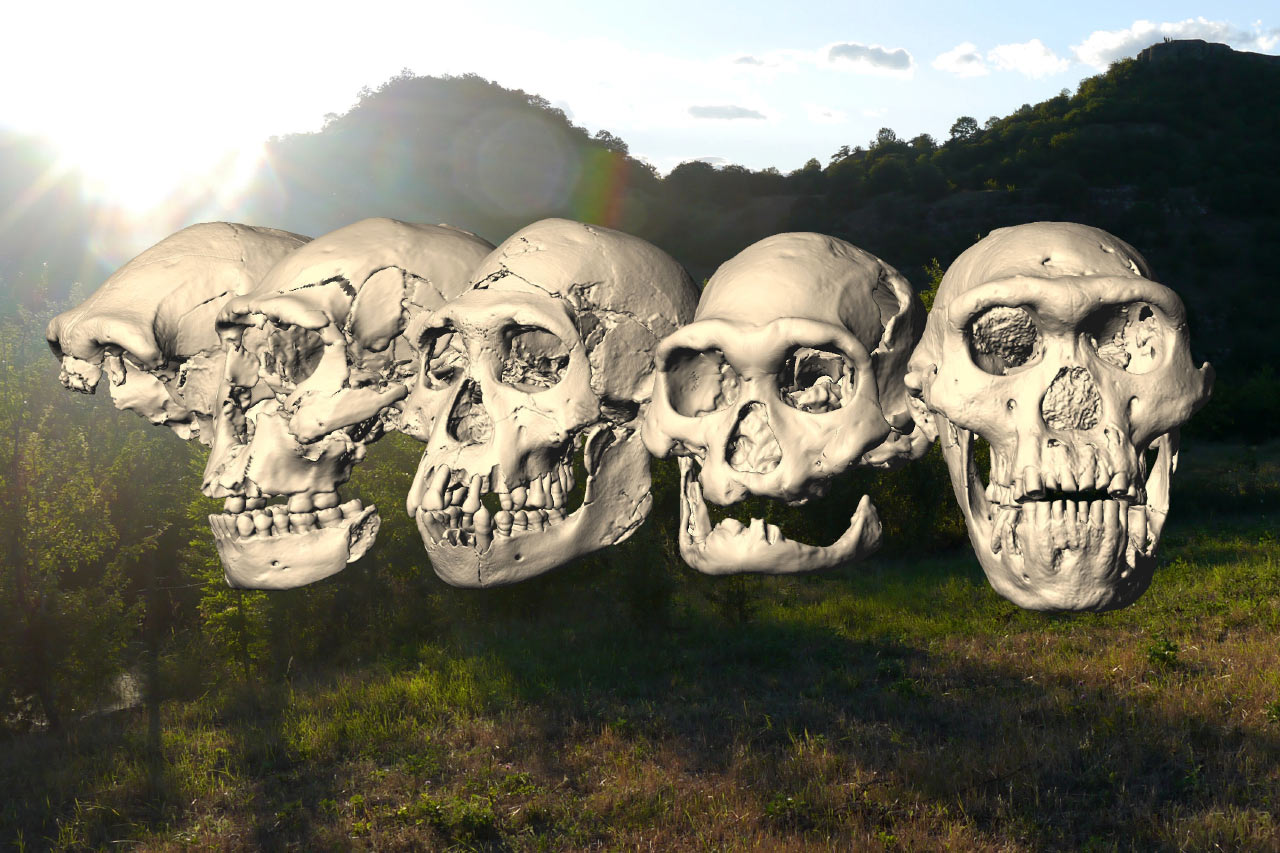
Situated on a high, wind-swept volcanic promontory in southern Georgia, the site of Dmanisi stands as the absolute foundational gateway of the human diaspora out of Africa. Excavations at the site recovered a flawless taphonomic sample: five extraordinarily well-preserved hominin skulls, complete postcranial skeletons, primitive stone tools, and thousands of extinct animal bones, all securely sealed beneath a basalt lava layer dated precisely to 1.85 million years ago. This site represents the earliest, indisputable evidence of primitive humans living outside the African continent.
                    [ THE DMANISI INTRAPOPULATION MATRIX ]
                                       │
         ┌─────────────────────────────┼─────────────────────────────┐
         ▼                             ▼                             ▼
[ SKULL 2 (D2282) ]           [ SKULL 4 (D3444) ]           [ SKULL 5 (D4500) ]
* Gracile, youth profile      * Completely edentulous       * Hyper-robust massive jaw
* Small 650 cc brain volume   * Survived years without teeth* Ultra-primitive 546 cc vault
* Classic H. ergaster trait   * High-density social care    * Resembles H. habilis/rudolfensis
The Variation Shockwave: Skull 5
The morphological variation contained within this single, synchronous paleodemographic population sent shockwaves through paleoanthropology, most notably with the discovery of Skull 5 (D4500) paired with its massive mandible (D2600). Skull 5 is an astonishing anatomical hybrid:
The Vault vs. The Face: It possesses the smallest, most primitive neurocranium of the entire cohort, measuring a tiny 546 cubic centimeters ($546\text{ cm}^3$), a brain volume barely larger than a chimpanzee's. Yet, this tiny braincase is anchored to a massive, projecting, and hyper-robust face with an enormous jaw and large chewing teeth.
If these five skulls had been discovered in different geographic regions or distinct stratigraphic layers across Africa, they would have inevitably been classified as completely separate species—some designated as Homo habilis, others as Homo ergaster or Homo erectus.
Because they were found together in the same mud layer within the same collapsed cave chamber, they prove they belong to a single, highly variable population of early Homo erectus. This discovery single-handedly suggests that many named early human species may simply be natural variations within a single, highly diverse evolutionary lineage.
The Survival of the Toothless: Ancient Altruism
Beyond the taxonomic implications, Dmanisi provided the world’s earliest, deeply moving evidence of advanced social empathy and hominin altruism in the form of Skull 4 (D3444). This individual was completely edentulous—they had lost all their teeth years before their death, and the jawbone had completely resorbed and healed over.
In a brutal, predator-dominated Pleistocene landscape 1.8 million years ago, a toothless human could not chew raw meat, strip vegetation, or manufacture tools with their mouth.
The survival of Skull 4 for several years without teeth proves that the Dmanisi group must have actively supported this vulnerable individual—likely by cooking food, pre-masticating soft meat for them, and protecting them from the giant saber-toothed cats (Megantereon) whose bones litter the cave floor. Long before the evolution of a large brain, humanity’s ultimate survival strategy was already deep-layer social cooperation.