Jebel Irhoud: Morocco's 300,000-Year-Old Modern Face
For decades, the textbook narrative of human evolution placed the cradle of anatomically modern Homo sapiens firmly in East Africa (specifically Ethiopia) around 200,000 years ago. However, groundbreaking multi-disciplinary excavations at the desert site of Jebel Irhoud, located just 100 kilometers western of Marrakesh, Morocco, completely shattered this linear model. The site yielded the remains of at least five individuals directly dated to approximately 300,000 years ago, shifting both the timeline and the geography of our species' origins.
                  [ JEBEL IRHOUD CRANIAL MOSAIC ]
                                 │
         ┌───────────────────────┴───────────────────────┐
         ▼                                               ▼
[ THE ANTERIOR MODERN FACE ]                   [ THE POSTERIOR BRAINCASE ]
* Retracted, delicate cheekbones               * Elongated, archaic globular shape
* Modern orthnathic profile                    * Low, sloping frontal bone
* Indistinguishable from living humans          * Lacks modern parietal expansion
The Morphological Mosaic
What makes the Jebel Irhoud fossils revolutionary is their stark, evolutionary anatomical dichotomy. They do not represent a fully formed "modern" human, but rather an evolutionary snapshot of our lineage in transition:
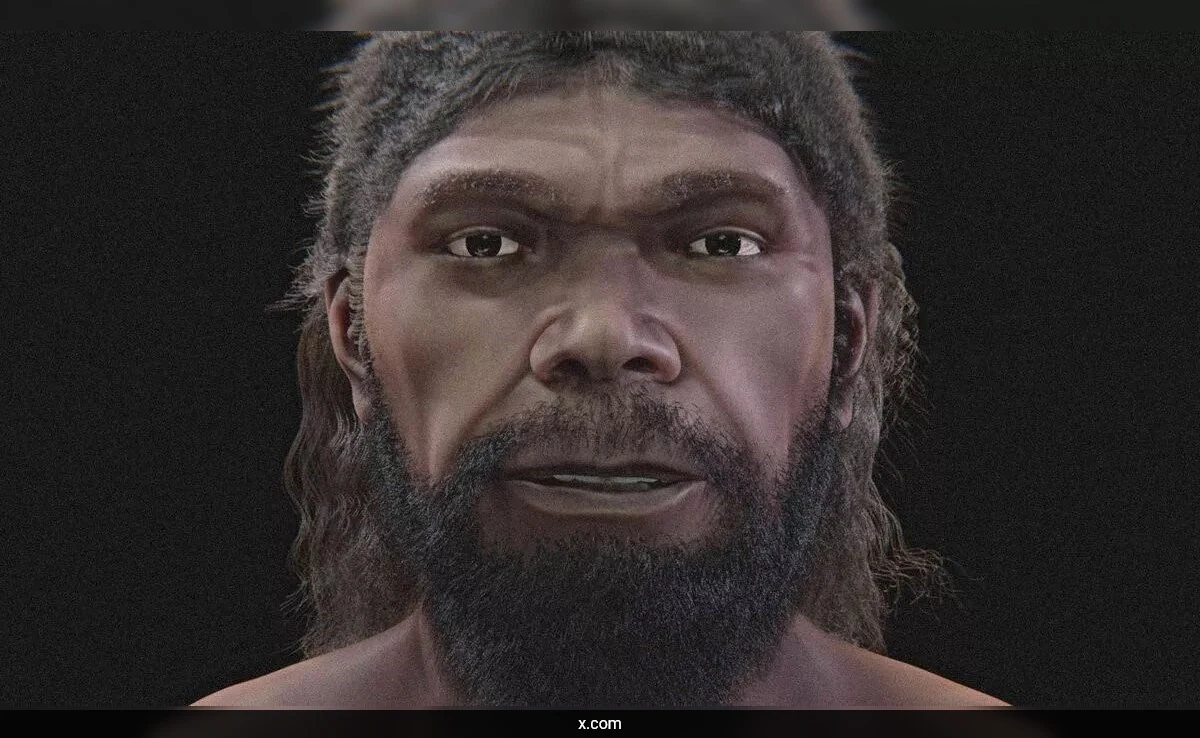
The Modern Face: If you were to see a Jebel Irhoud individual wearing a modern hat, you would not notice any difference. The face is entirely anatomically modern. It features a retracted, short, and delicate facial profile (orthognathic) with small cheekbones and a brow ridge structure that directly anticipates living populations.
The Archaic Braincase: The moment the hat is removed, the illusion fades. The neurocranium (braincase) remains deeply primitive. It is elongated, low, and archaic (dolichocephalic), lacking the tall, globular, balloon-like vault and expanded parietal lobes that characterize modern human brains.
High-Precision Thermoluminescence Dating
The extraordinary antiquity of the Jebel Irhoud hominins was secured using advanced Thermoluminescence (TL) dating applied to heated stone tools found in direct stratigraphic alignment with the human bones. Flints that had been accidentally dropped into ancient campfires by the hominins had their internal "atomic clocks" reset by the heat.
By measuring the accumulated radiation dose in these flints since they were last heated, physicists established an airtight age matrix centering on $315,000 \pm 34,000$ years ago. This absolute timeline was independently confirmed via Electron Spin Resonance (ESR) testing on a human tooth from the site.
The Pan-African Evolution Model
Jebel Irhoud effectively dismantled the "Single Eden" theory of human origins. The presence of these early Homo sapiens in North Africa, possessing modern faces but archaic brains, proves that our speciation was not a sudden localized event in an East African valley.
Instead, it was a pan-African phenomenon. Our species evolved across a highly interconnected, continent-wide network of diverse populations that exchanged genes and behavioral technologies across a green, wet Sahara, gradually patching together the mosaic of features that define modern humanity today.