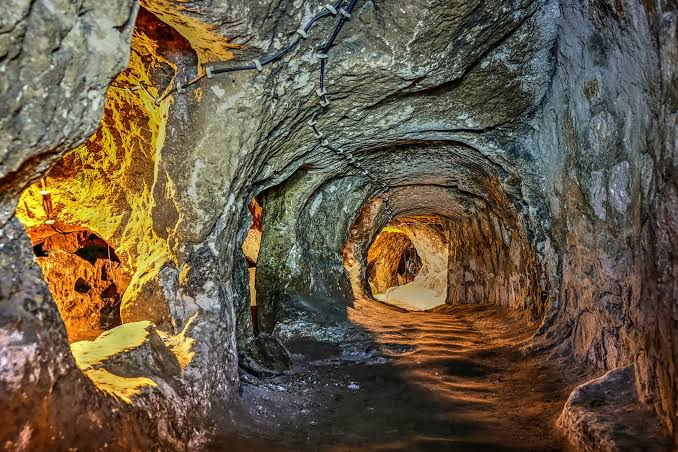
Deep beneath the soft, volcanic landscapes of Cappadocia, Turkey, sits one of the most astonishing engineering marvels of the ancient world: Derinkuyu (originally known as Elengubu). Plunging approximately 85 meters ($280\text{ feet}$) into the earth, this subterranean metropolis features a staggering 18 levels of hand-carved tunnels, living quarters, and municipal infrastructure.
Far from a simple, primitive cave network, Derinkuyu was designed as a highly sophisticated, fully functioning city capable of sheltering up to 20,000 people, along with their livestock and food supplies, completely cut off from the surface world.
1. The Accidental Rediscovery
For centuries, the full scale of Derinkuyu was completely forgotten by the modern world. Its re-emergence in 1963 reads like a work of fiction.
A local homeowner in Nevşehir Province was renovating his stone house and noticed that his chickens kept mysteriously disappearing through a small hairline fracture in his basement wall. Deciding to investigate, he knocked down the masonry wall with a sledgehammer. Behind it, he exposed a dark, hand-hewn stone passage that sloped steeply down into a pitch-black abyss.
He had accidentally reopened the gateway to an ancient underworld that had been sealed shut and abandoned for decades.
2. The Geology of Survival: Carving Pyroclastic Tuff
How did ancient builders excavate an 18-story city without modern steel drills or explosives? The answer lies in Cappadocia’s unique volcanic geology.
Millions of years ago, intense volcanic eruptions blanketed the region in thick layers of ash, which compressed over time into a rock formation known as pyroclastic tuff.
The Sieve Effect: When this soft, porous rock is first exposed to air or dampness, it is remarkably pliable and can be hollowed out using simple tools like copper, bronze, or iron picks.
The Hardening Process: Remarkably, once the interior stone dries and cures upon exposure to oxygen, it undergoes a chemical stabilizing process. It hardens into a highly durable, self-supporting structure.
The ancient engineers possessed an advanced grasp of static forces; they left behind massive, perfectly balanced rock pillars on every tier to support the unfathomable weight of the earth pressing down from above, preventing catastrophic cave-ins across all 18 levels.
3. Subterranean Urban Architecture
Derinkuyu was not a temporary emergency trench; it was custom-built to sustain organized, daily community life for months at a time during prolonged military sieges or religious persecutions. The levels were organized with strict spatial logic:
Levels 1–2 (The Upper Tier): These floors housed vast stables for cattle, horses, and goats. Keeping the livestock near the top minimized the spread of foul odors, made waste disposal easier, and allowed for efficient feeding via surface access points. These levels also featured large communal wine and oil presses, complete with stone troughs and drainage basins.
Levels 3–4 (The Living and Educational Core): These tiers contained tightly packed networks of family living quarters, sleeping chambers, and massive storage cellars filled with grain jars. This layer also features a unique, spacious hall topped with a beautifully carved barrel-vaulted ceiling, which archaeologists have identified as a religious school and theological study center.
Levels 5–8 and Deeper (The Sacred and Critical Infrastructure): Winding, narrow staircases led down to the deep interior of the complex. The lower floors housed communal meeting refectories, burial chambers, and a grand cruciform Christian chapel carved directly into the rock on the fifth level.
4. Masterclass Engineering: Air, Water, and Defense
To keep 20,000 people alive without electricity, sunlight, or plumbing, Derinkuyu’s builders engineered radical solutions to three existential problems: ventilation, water access, and military defense.
The Self-Propelled Ventilation Network
Human life requires an immense, continuous volume of oxygen. To ventilate the dark corridors, engineers cut more than 50 massive, vertical ventilation shafts extending all the way from the surface down to the deepest chambers.
   [ COLD SURFACE AIR ] ───► Sinks Down Primary 55-Meter Ventilation Shafts
                                                │
                                   (Natural Thermal Siphon)
                                                │
   [ EXHAUST & HEAT ] ◄──── Rises Up and Out Narrow Secondary Air Vent Ducts
By taking advantage of the natural thermal temperature differences between the chilly subterranean air and the warm surface air, they created a self-propelled air-conditioning siphon. Fresh air constantly rushed down the main shafts and circulated laterally through thousands of interconnected horizontal duct pipes, keeping even the lowest levels dry and fully oxygenated.
The Secured Water Tables
The main ventilation shafts pulled double duty as deep water wells. Crucially, the bottom of these wells tapped into deep underground water tables that were entirely separate from the surface water supply. This design protected the hidden population from an invading army’s primary weapon: poisoning or cutting off the city’s water.
Furthermore, the wells could only be accessed from the inside; the bottom sections lacked openings to the topmost floors, preventing enemies on the surface from dropping poison down the shafts.
The Rolling Stone Blast Doors
Derinkuyu was structurally designed to be a fortress of absolute containment. The corridors connecting the individual levels were carved exceptionally narrow and low, forcing any invading soldiers to march in a slow, single-file line while hunched over—making them completely vulnerable to defensive ambushes.
At critical checkpoints, the tunnels were fitted with massive, circular stone wheel doors weighing up to 1,000 pounds ($450\text{ kg}$). These doors sat inside deep wall niches.
One-Way Mechanics: Using leverage pockets, defenders on the inside could quickly roll the massive stone disc across the tunnel, completely locking it.
The Center Port: The center of each stone wheel featured a small, carved hole. This served a dual purpose: it acted as a viewing porthole to spy on the tunnel, and a defensive firing port through which spears or arrows could be shot at invaders attempting to breach the door. The wheel doors could only be opened from the inside, turning each level into an independent, impregnable bunker.
5. Summary of Subterranean System Dynamics
The Architecture: An 18-level urban complex extending 85 meters down, built to fully sustain 20,000 inhabitants and their animals through a grid of stables, kitchens, and schools.
The Engineering: Mastery of self-supporting volcanic tuff rock physics, utilizing heavy stone columns to distribute massive upper-crust weight loads.
The Life Support: A network of 50+ thermal ventilation shafts drawing clean oxygen deep into the earth, coupled with secure, non-accessible surface wells to combat water poisoning.
The Defenses: Intentionally low, single-file choke-point corridors secured by 1,000-pound, one-way rolling stone wheel doors equipped with central weapon ports.
The absolute origins of Derinkuyu remain a subject of fierce archaeological debate. Some scholars suggest the earliest excavations began with the Hittites around 1600 BCE, while others attribute the expansion to the Phrygians in the 8th century BCE. What is completely certain is that the city reached its fully formed, architectural apex during the Byzantine Era (c. 5th–10th centuries CE), when early Christians expanded the grid into a massive, secure sanctuary to survive the Arab-Byzantine wars.
Derinkuyu stands as an incredible testament to human resilience—a monument proving that when faced with overwhelming threats from the horizon, ancient humanity possessed the engineering brilliance to move an entire civilization beneath the stone, carving out an entire world in the dark.