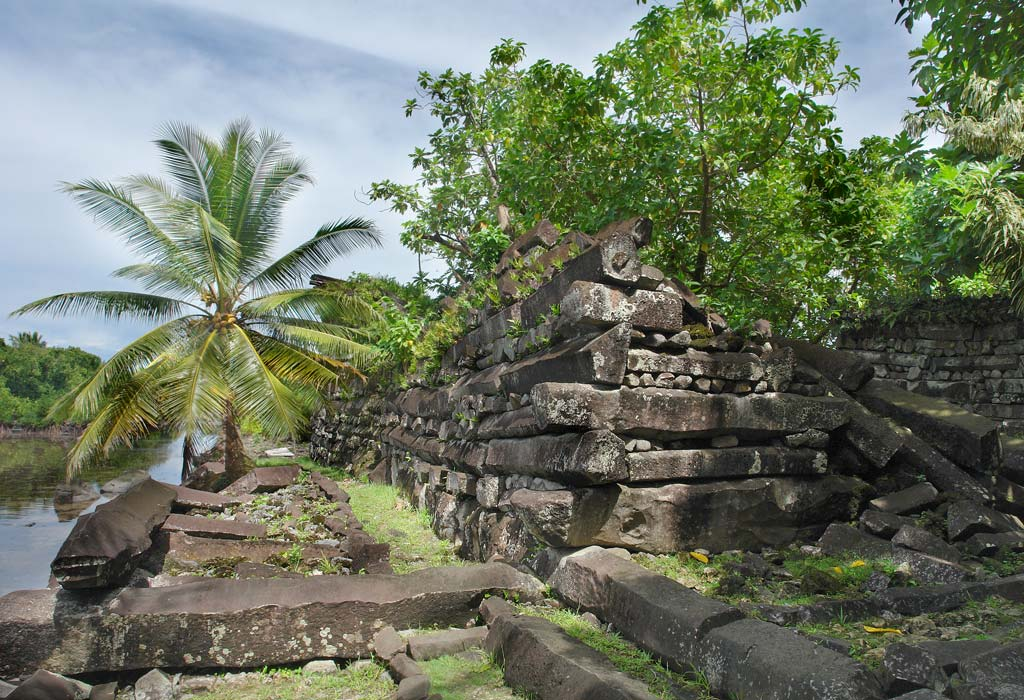
Rising out of the shallow coral lagoons on the eastern coast of the island of Pohnpei, Micronesia, sits Nan Madol. Often dubbed the "Venice of the Pacific," this abandoned archaeological complex is one of the most enigmatic and logistically baffling feats of megalithic architecture in human history.
Constructed entirely on top of a living coral reef, Nan Madol is a sprawling network of 92 artificial islet platforms linked by a maze of tidal canals. Built using hundreds of thousands of tons of naturally formed, hexagonal basalt pillars, this prehistoric city completely challenges our understanding of ancient Pacific seafaring logistics, labor organization, and engineering capability.
1. The Geopolitical Center of the Saudeleur Dynasty
Nan Madol was built to serve as the highly stratified ritual, administrative, and religious capital of the Saudeleur Dynasty, which unified and ruled over the entire island of Pohnpei from roughly 1100 to 1628 CE.
The layout of the city was a masterclass in social engineering and political control. The Saudeleur rulers forced the island's regional chiefs, priests, and elite families to leave their rural territories and live permanently inside the coral city. This served a brilliant tactical purpose: it allowed the central rulers to keep their potential political rivals under constant, close surveillance, preventing provincial rebellions.
The city was strictly segregated into two functional sectors separated by a central waterway:
Madol Powe (The Upper Sector): Mortuary and religious islets dedicated to the priesthood, featuring elaborate burial vaults, tombs, and temples to the shark deity, Nahn Samwohl.
Madol Pah (The Lower Sector): The administrative core housing the royal palaces of the Saudeleur kings, elite residential complexes, and massive public areas for state banquets.
2. The Logistics Defiance: Moving Volcanic Basalt
The ultimate mystery of Nan Madol rests upon its materials. The city's massive walls are not built out of local coral limestone, but columnar basalt—a heavy volcanic rock that naturally cools into elongated, five- to eight-sided interlocking prismatic pillars.
The engineering challenges associated with these stones defy simple logic:
The Distance: There are no volcanic basalt formations anywhere near the coral reef of Nan Madol. The massive pillars had to be quarried from volcanic vents located on the completely opposite, northwestern side of Pohnpei.
The Weight: The site contains an estimated 250,000 tons of basalt. Individual structural pillars range from 5 to 20 feet in length, with the heaviest foundation blocks weighing up to 50 tons.
The Missing Tools: The ancient Pohnpeians possessed no draft animals, no wheeled carts, no block-and-tackle pulley systems, and no metal tools. They operated entirely within a stone-and-shell technology framework.
According to vibrant Pohnpeian oral histories, the stones were transported to the reef using dark sorcery. The myth states that two twin sorcerers, Olosohpa and Olosihpa, used magic spells to make the gargantuan basalt pillars fly through the air, floating effortlessly across the island to land perfectly in place on top of the reef.
The Maritime Reality
Stripped of myth, modern archaeologists suggest a equally impressive physical feat: maritime transport via specialized bamboo rafts.
   [ BASALT VENTS: NORTHWEST POHNPEI ] ───► Leveled Down via Fire and Water Cracking
                                                   │
                                     (The Raft Transit Logistics)
                                                   │
                                                   ▼
   [ BAMBOO MEGALITH RAFTS ] ────────────► Floated via Ocean Currents Around the Coast
                                                   │
                                                   ▼
   [ CORAL REEF DESTINATION ] ───────────► Rolled up Slanted Palm-Trunk Lever Ramps
Blacksmiths or quarrymen likely used thermal shock—heating the basalt columns with intense fires and quenching them with cold water—to pop the natural joints free. The workers then loaded these multi-ton columns onto massive, multi-layered bamboo outrigger rafts during high tides, floating them down river systems and guiding them along the coastal ocean currents around the island to the shallow eastern reef.
3. Engineering on a Living Reef: The Lincoln-Log Technique
Once the basalt arrived at the eastern lagoon, the Pohnpeians faced an unprecedented architectural challenge: how do you build monumental, permanent stone structures on top of a soft, shifting coral reef constantly battered by ocean tides and waves?
To solve this, they invented a highly specialized underwater masonry technique mimicking a "Lincoln-Log" configuration.
The Coral Foundations: First, workers waded into the shallow water during low tides and laid down massive, wide basalt blocks straight onto the dead coral bedrock to establish a broad, stable footprint.
The Interlocking Framework: Next, they built the walls by systematically alternating the direction of the long basalt pillars. They laid down a parallel row of stones running front-to-back (headers), followed by a perpendicular row running side-to-side (stretchers).
The Core Filling: The hollow square pockets created inside this interlocking wooden-style framework were filled with millions of smaller, broken fragments of coral debris and volcanic gravel, creating a solid, elevated, and well-drained stone platform rising up to 30 feet above the ocean waves.
This design was an engineering triumph. The gaps between the naturally irregular basalt pillars allowed the daily ocean tides to flow harmlessly through the base of the walls rather than crashing against them with full hydraulic force. This prevented the water from building up destructive kinetic pressure, allowing the un-mortared walls to remain structurally stable for centuries.
4. The Megalithic Climax: Nandauwas
The absolute architectural jewel of Nan Madol is Nandauwas, the royal mortuary compound located in the holy upper sector of the city.
Nandauwas features soaring, double-tiered defensive walls rising over 25 feet high, protecting a central courtyard. The main entrance is guarded by a monumental gateway constructed out of some of the longest and straightest basalt pillars at the site, acting as massive stone lintels.
Inside the central courtyard sits a grand, subterranean tomb built out of flat basalt slabs, which served as the final resting place for the Saudeleur kings. The architecture of Nandauwas was engineered to project absolute, terrifying psychological awe; any provincial chief entering this sacred space would be instantly crushed by the sheer physical manifestation of the king’s ability to command human labor.
5. Summary of Nan Madol's Structural Dynamics
The Footprint: 92 artificial, hand-built islets constructed directly on top of a shallow coral reef, covering over 18 square kilometers of tidal canals.
The Logistics: Transportation of over 250,000 tons of volcanic columnar basalt across the island without draft animals, wheels, or metal tools, utilizing open-ocean bamboo rafting.
The Architecture: Utilization of a mortarless, interlocking "Lincoln-Log" technique, alternating basalt headers and stretchers filled with coral gravel to withstand tidal wave currents.
The Political Purpose: A centralized, highly monitored fortress city designed to house the elite, using architectural scale as state propaganda to maintain absolute dynasty control.
The collapse of Nan Madol matched the dramatic nature of its construction. Around 1628 CE, an invading warrior named Isokelekel sailed from a neighboring island and overthrew the final, tyrannical Saudeleur king, splitting Pohnpei back into a decentralized system of tribal chiefdoms. Nan Madol was completely abandoned shortly thereafter; without a central, forced labor force to bring fresh water and food from the mainland, the coral city was unlivable.
Today, Nan Madol stands as a haunting, beautiful testament to Pacific Islander engineering. By successfully conquering the boundary between shifting ocean waters and permanent stone monuments, these ancient builders proved that with clear geometric planning and massive communal coordination, human architecture can thrive even where logic dictates it should be completely impossible.