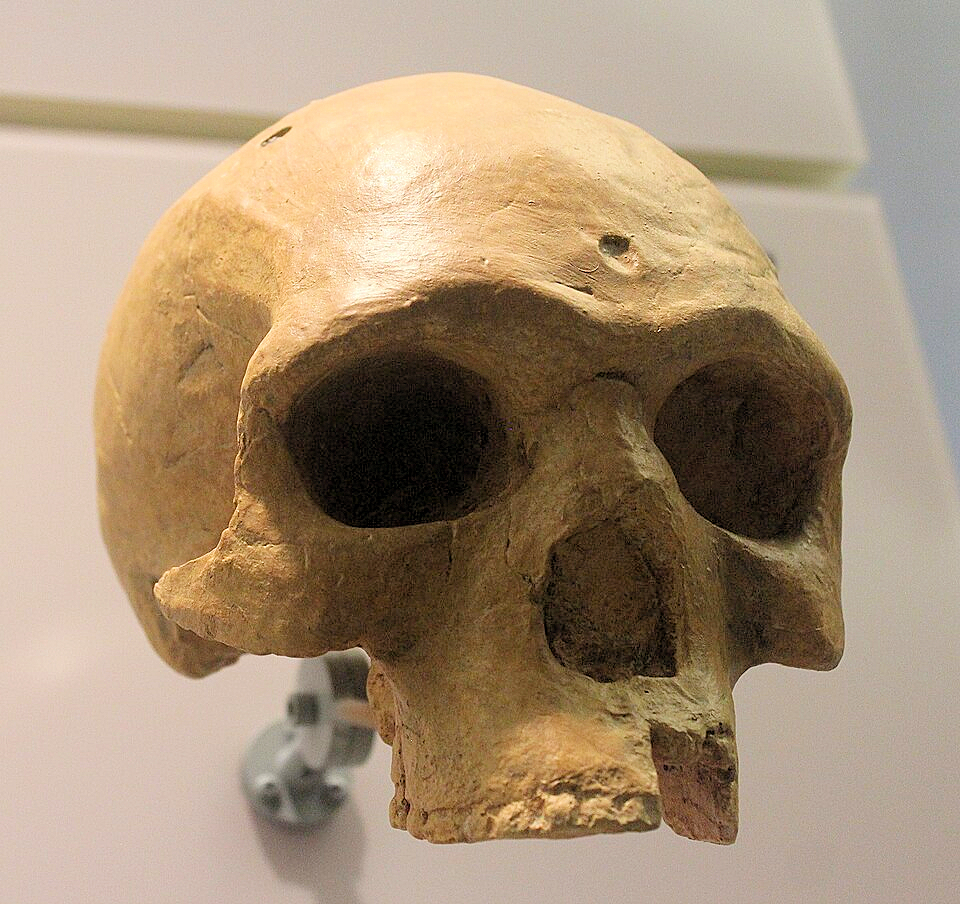
Discovered in 1932 by T.F. Dreyer at the Florisbad thermal spring site in the Free State Province, South Africa, the Florisbad Skull (cataloged as Florisbad 1) is an indispensable, highly controversial fossil puzzle piece. Consisting of a partial cranium featuring a remarkably well-preserved right face, an extensive frontal bone, and segments of the braincase walls, this fossil exhibits a classic "mosaic" configuration that continues to test the boundary lines between late archaic humans and the absolute earliest dawn of our own species.
   [ ARCHIC REGIONAL ANCESTRY ] ──► Archaic Homo heidelbergensis Trait Baseline
                                                 │
                                      (The Evolutionary Drift)
                                                 │
                                                 ▼
   [ RE-CLASSIFIED ENDPOINT ] ◄──── Early "Archaic" Homo sapiens Core (260,000 YA)
The Mosaic Architecture
The Florisbad skull refuses to fit cleanly into any single taxonomic box because its structural traits are split between two distinct evolutionary worlds:
The Modern Frontal Architecture: The forehead and frontal squama display a pronounced, modern-like curvature and vertical bulging. The spatial relationship between the face and the frontal lobes directly mimics the orientation seen in modern Homo sapiens, eliminating the flat, low slope characteristic of Homo erectus.
The Archaic Parietal Flattness: In sharp contrast, the parietal regions (the top and sides of the head) are flat, low, and elongated. Furthermore, the frontal lobes are exceptionally broad, displaying a lateral widening that shares surprising affinity with the robust cranial architecture of Neanderthals and Homo heidelbergensis.
High-Precision Dating and Environmental Taphonomy
The antiquity of the Florisbad cranium was anchored to $259,000 \pm 35,000$ years ago using direct electron spin resonance (ESR) dating applied to an intact upper right third molar found alongside the skull fragments.
Taphonomic analysis of the bone surfaces revealed a dark history: the skull fragments show clear, distinct hyena puncture marks and chewing scars, indicating that this early human likely fell victim to a large Pleistocene carnivore, with their remains washed into the churning, mineral-rich vertical vents of an active thermal spring.
The Reclassification as Early Homo Sapiens
For decades, the skull was assigned its own independent species name, Homo helmei, to denote its intermediate status. However, following the 2017 re-dating of the Jebel Irhoud fossils to 300,000 years ago, a strong scientific consensus emerged among world-leading paleoanthropologists.
The Florisbad skull is now widely classified alongside Jebel Irhoud as an authentic, critical representative of early or "archaic" Homo sapiens. Positioned at roughly 260,000 years old, Florisbad represents the southern vanguard of our species' early diversification, confirming that our early ancestors were already morphologically diverse and widely distributed across the entire length of the African continent.