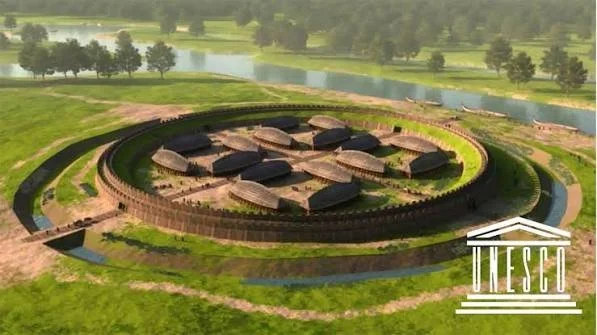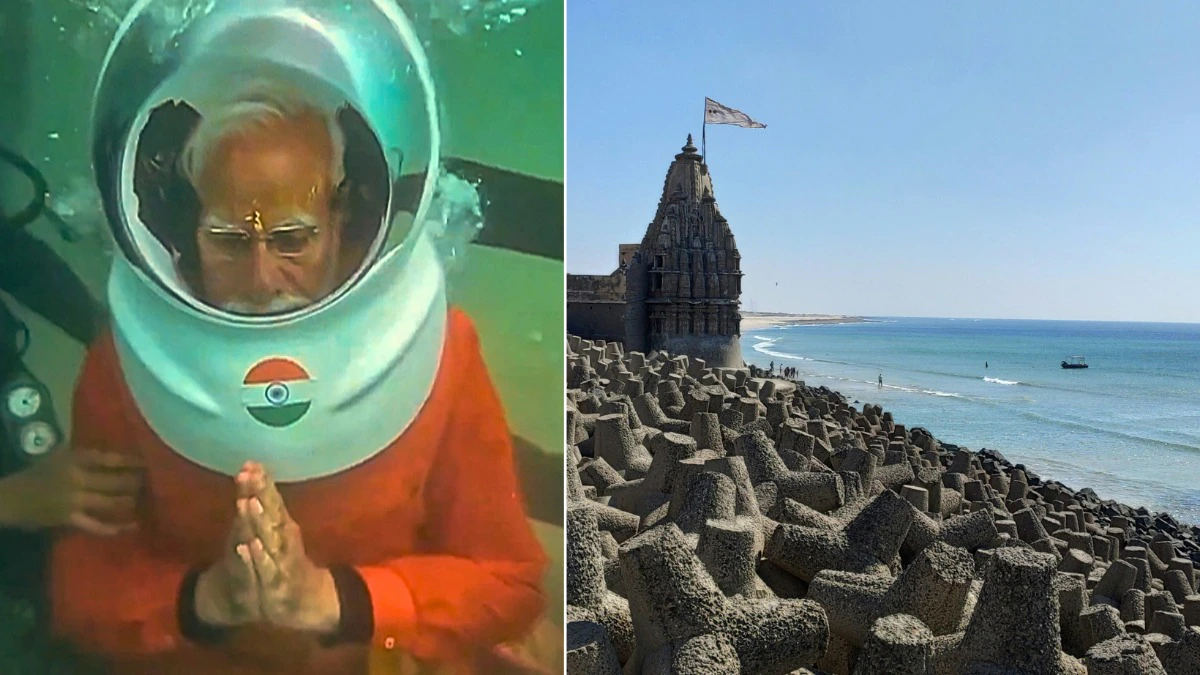
In the sacred texts of Hindu literature—most notably the epic Mahabharata and the Harivamsa—the ancient city of Dwarka was a magnificent, fortified island metropolis constructed by the divine architect Vishwakarma at the explicit request of Lord Krishna.
According to ancient texts, Krishna founded this golden kingdom off the western coast of Gujarat to protect his people from constant invasions. The texts describe a sprawling city constructed out of gold, silver, and precious gems, featuring 900,000 royal palaces, massive defensive bastions, and a highly organized network of assembly halls and deep harbors.
The Mahabharata records that when Krishna departed the earthly realm at the end of the Dvapara Yuga, the ocean rose and systematically swallowed the entire city, turning the mythical capital into a sunken kingdom.
                  [ THE MYTHOLOGICAL CHRONOLOGY ]
                                 │
        ┌────────────────────────┴────────────────────────┐
        ▼                                                 ▼
[ MAHABHARATA NARRATIVE ]                       [ MARINE ARCHAEOLOGICAL FINDS ]
* Golden city of Lord Krishna                   * Massive sandstone block bastions
* Swallowed by ocean upon his death            * Triangular three-holed stone anchors
* Long dismissed as pure myth                   * Protracted Late Bronze Age trade port
Pulling Myth Into Archaeological Reality
For millennia, Western historians dismissed the narrative of Dwarka as pure poetic myth. However, beginning in the late 20th century, the Marine Archaeology Unit of India’s National Institute of Oceanography (NIO), led by pioneering archaeologist Dr. S.R. Rao, began systematic underwater sweeps off the coast of modern Dwarka in the Arabian Sea. What they discovered fundamentally bridged the gap between mythology and science.
Submerged between 3 to 20 meters beneath the Arabian Sea, underwater archaeologists mapped a sprawling complex of man-made stone structures extending across the seafloor:
The Fortified Bastions: Researchers discovered massive, interlocking dressed sandstone blocks forming semicircular bastions, protective seawalls, and structural foundations.
The Maritime Anchors: Divers recovered dozens of large, triangular stone anchors featuring three precision-drilled holes, identical to the maritime anchors utilized by Late Bronze Age and Harappan trade networks across the Mediterranean and Persian Gulf.
The Ancient Jetty: Remnants of stone-paved jetties and flight steps (ghats) indicate that this sunken city operated a highly sophisticated, deep-water port facility designed to handle heavy international merchant fleets.
Chronological Controversies
The discovery of sunken Dwarka has sparked intense academic debate regarding its exact age. Dr. S.R. Rao and his team argued that the structural typology, the specific types of pottery recovered, and the stone anchors align with the Late Bronze Age (c. 1500–1200 BCE), which perfectly matches the traditional chronological placement of Krishna’s era.
Other researchers urge caution, suggesting some architectural layers date to the early historical period of the historical Indian kingdoms. Regardless of the exact century of its construction, the underwater ruins of Dwarka prove that the ancient writers of the Mahabharata were not inventing a fantasy city out of thin air; they were recording a real, highly advanced maritime civilization that was reclaimed by the sea during a period of intense post-glacial coastal adjustment.