Archaeological Discoveries Near Chesterfield’s Iconic Crooked Spire
An excavation project near Church of St Mary and All Saints—famous for its distinctive crooked spire—has revealed new insights into the town’s past. The findings are reshaping how historians understand everyday life in Chesterfield beyond its well-known Roman and medieval roots.
Renovation Work Leads to Historic Finds
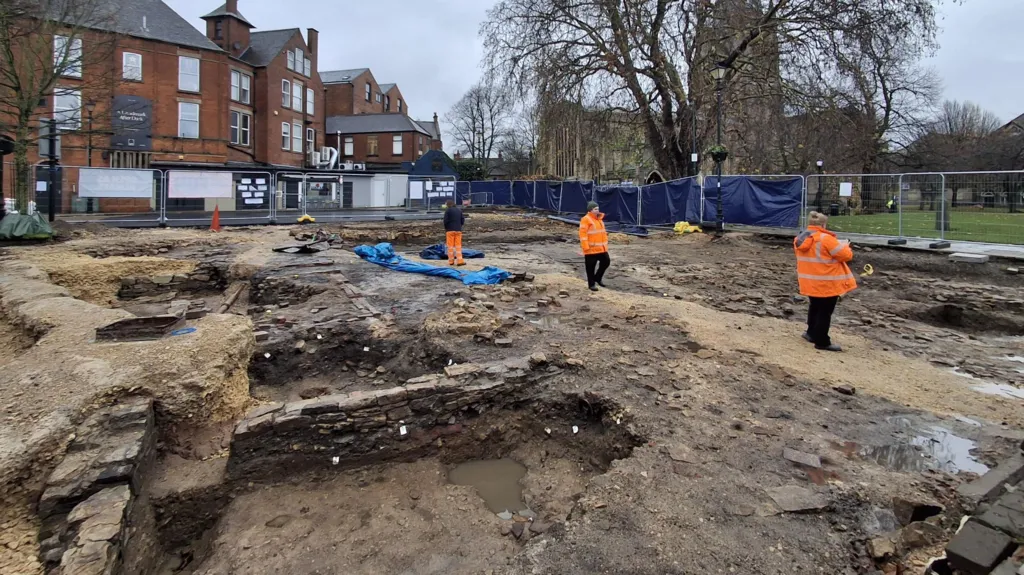
The discoveries were made during redevelopment work at Rykneld Square, where construction was temporarily paused after early archaeological evidence emerged.
A team from University of Leicester Archaeological Services (ULAS) carried out a detailed excavation, uncovering the remains of multiple buildings once located beside the church.
Evidence of Almshouses and Cottages
Archaeologists identified a sequence of structures, including former almshouses and a row of cottages dating back to the 17th and 18th centuries. These buildings were originally constructed to house poorer residents and were supported by local benefactors.
Although most of these structures were demolished by the 19th century, their underground remains were found to be remarkably well-preserved. Excavations exposed sections of stone walls, offering a clearer picture of how the area was once laid out.
Artifacts Spanning Centuries
The team also recovered a variety of artifacts, including pottery fragments ranging from the medieval period through to the 19th century. These items will be analyzed further and eventually housed at Chesterfield Museum, along with detailed records of the excavation.
In addition, skeletal remains were uncovered in a disused section of the churchyard. These will be respectfully reburied at the site.
Preserving the Past While Planning the Future
To protect the findings, the structural remains will be preserved in place and covered. Meanwhile, redevelopment plans for the square are being revised to avoid disturbing the archaeology.
The updated design still includes improvements such as:
New paving and seating areas
Expanded walkways
Additional greenery, with smaller plants replacing trees to minimize ground disturbance
The project is part of a wider £10.28 million regeneration initiative funded through the UK government’s Levelling Up Fund, aimed at revitalizing the town center.
A Broader View of Chesterfield’s History
According to project leaders, the excavation provides a deeper understanding of daily life in the area across several centuries. The well-preserved remains highlight continuous occupation near the church and offer valuable context beyond the town’s earlier historical periods.
Looking Ahead
With excavation work now complete, researchers will focus on analyzing the collected artifacts and records. Their goal is to build a more detailed narrative of how people lived in this part of Chesterfield over time.
As redevelopment resumes, the project stands as a strong example of how urban renewal and heritage preservation can work together—ensuring that the past remains part of the town’s future.