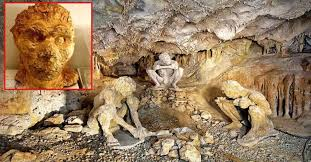
Nestled within the limestone cliffs of the Chalkidiki peninsula in northeastern Greece, Petralona Cave houses one of the most enigmatic, complete, and intensely debated hominin fossils in European history. Discovered in 1960 by local villagers encrusted in a thick layer of glittering stalagmitic travertine, the Petralona Cranium represents a magnificent, pristine look at the mid-Pleistocene colonization of Europe, acting as a crucial morphological bridge linking early African migrants to the subsequent evolution of the Neanderthals.
                  [ THE PETRALONA CHRONOLOGICAL RESOLUTION ]
                                      │
         ┌────────────────────────────┴────────────────────────────┐
         ▼                                                         ▼
 [ THE POULIANOS EXTREME CLAIMS ]                        [ THE U-SERIES CONSENSUS ]
 * Stratigraphic guessing: 700,000 YA                     * 2025 High-precision U-Th on outer crust
 * Assigned to fake genus *Archanthropus* * Firm minimum age bound: 286,000 ± 9,000 YA
 * Rejected by global scientific community                * Aligns safely within the Middle Pleistocene
The Morphological Hybrid
The Petralona cranium is a spectacular example of an evolutionary transitional form. It exhibits a massive, heavy facial architecture characterized by huge, round eye orbits, an immense nose, and an broad upper jaw that closely tracks the primitive features of Homo erectus.
Yet, when viewed from the side, the braincase is remarkably expanded, housing an impressive cranial capacity of 1,230 cubic centimeters ($1230\text{ cm}^3$).
The skull features a distinct arc in its brow ridges and an inflation of the mid-facial bones that represents the absolute earliest, structural beginnings of the classic Neanderthal facial blueprint, leading most mainstream anthropologists to classify it as an advanced Homo heidelbergensis.
The Dating Wars Resolved
The chronology of Petralona was a scientific battlefield for over four decades. The Greek anthropologist Aris Poulianos speculatively claimed the skull was 700,000 years old, inventing a non-existent genus name (Archanthropus) and claiming it proved humans evolved independently in Europe. This claim was roundly rejected by mainstream science due to a lack of verifiable methodology.
The definitive resolution finally arrived through an exhaustive, high-precision study published in the Journal of Human Evolution. A team of geochronologists applied state-of-the-art Uranium-series (U-Th) dating directly to the micro-stratigraphic layers of the calcite travertine crust that had formed directly on the surface of the bone after it was deposited in the cave.
The analysis yielded an airtight, definitive minimum age bound of $286,000 \pm 9,000$ years old.
This timeline safely places the Petralona hominin within the Middle Pleistocene, proving it lived concurrently with the late-surviving Homo heidelbergensis of Europe and the emerging Neanderthal lineages. It paints a complex, beautiful picture of Europe as a dynamic evolutionary theater where diverse hominin groups braved the cycling ice ages, leaving their bones to be sealed in stone.