The 1,000-Year-Old Messages Carved Into the Mountains: Inside Garsha's Forgotten Himalayan Inscriptions
Long before printed books, digital archives, or even widespread paper records, people throughout Asia found another way to leave messages for the future.
They carved them into stone.
In the Himalayan region historically associated with Garsha, now linked with the wider Lahaul area of Himachal Pradesh, inscriptions, religious markings, and carved symbols provide evidence of the movement of cultures across one of Asia's most difficult landscapes.
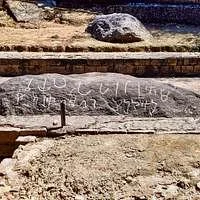
A rock inscription may appear simple: a few letters, a religious formula, a name, or a symbol carved into a boulder.
Yet archaeologically, such a mark can reveal extraordinary information.
It can preserve evidence of language.
It can demonstrate the spread of religious traditions.
It can reveal the movement of travelers.
It can indicate political influence.
And sometimes, it can preserve the presence of a person who would otherwise have disappeared completely from history.
Garsha and the Crossroads of the Himalayas
The Lahaul region occupies a strategic position within the western Himalayas.
Historically, its valleys connected regions influenced by Indian, Tibetan, Central Asian, and Himalayan cultures. Movement was difficult, particularly during harsh winters, but mountain passes and river valleys created routes through which goods, ideas, and religious traditions could travel.
The ancient name Garsha appears in historical and Tibetan sources connected with this wider Himalayan world.
The region was not culturally isolated.
Buddhist influence moved through mountain corridors.
Trade brought communities into contact.
Political powers attempted to extend influence across highland territories.
Pilgrims and monks traveled between religious centers.
Rock inscriptions are among the physical traces of these movements.
Why Carve an Inscription Into Stone?
Stone offers permanence.
A message written on cloth can decay.
Wood can rot.
Paper can burn.
But a deeply carved inscription may survive for centuries.
For travelers moving through mountain landscapes, a boulder beside a route could become a public surface.
The inscription could commemorate a religious act.
It could invoke a sacred formula.
It could mark a place.
It could record the name of a donor or official.
It could demonstrate the presence of a particular religious community.
In this sense, ancient Himalayan inscriptions can be understood as a kind of permanent communication system embedded directly into the landscape.
Scripts as Archaeological Evidence
The study of inscriptions involves more than translating words.
Epigraphers examine the physical form of writing.
The shape of individual letters can help determine chronology.
Changes in script occur over time.
Therefore, even when an inscription does not include a date, specialists may compare its writing style with securely dated examples.
Researchers may examine:
Letter forms.
Direction of writing.
Linguistic features.
Religious terminology.
Surface weathering.
Carving technique.
Archaeological context.
This makes epigraphy an interdisciplinary science involving history, linguistics, archaeology, and art history.
Buddhism and the Mountain Routes
Buddhist traditions spread across the Himalayas through networks of monasteries, teachers, travelers, and political patrons.
Sacred formulas could be carved into rocks.
Images of religious figures could appear beside inscriptions.
Symbols could transform an ordinary route into a sacred landscape.
A traveler moving through a valley might encounter repeated religious signs. The environment itself became a kind of spiritual map.
This practice was especially important in regions where large permanent monuments were difficult to construct.
A boulder was already present.
All that was required was the labor and skill to transform its surface.
Who Made the Inscriptions?
One of the most fascinating questions is also one of the hardest to answer.
The person who carved an inscription may have been:
A monk.
A local patron.
A traveler.
A merchant.
A political official.
A pilgrim.
A skilled artisan.
A member of a religious community.
Sometimes inscriptions preserve names.
In other cases, the author remains anonymous.
But anonymity does not reduce their historical importance.
The carved mark still records human presence.
The Technology of Carving
Creating an inscription required tools.
Depending on the stone and period, artisans could use metal implements or other suitable instruments to produce incised lines.
The work required precision.
A poorly placed strike could damage a letter.
Complex scripts demanded familiarity with written forms.
Therefore, inscriptions represent both literacy and craftsmanship.
The Environment as an Archive
Mountain environments can preserve inscriptions for long periods, but they also threaten them.
Wind can erode surfaces.
Water can cause cracking.
Freeze-thaw cycles can damage stone.
Modern construction can destroy archaeological contexts.
Vandalism and unregulated tourism can also pose serious dangers.
An inscription that survived a thousand years can be damaged in minutes.
This makes documentation critically important.
Photography, digital scanning, and three-dimensional recording allow researchers to preserve information even when physical surfaces begin to deteriorate.
Why the Inscriptions Matter
Garsha's carved rocks remind us that ancient history was not limited to royal capitals.
Important cultural exchange occurred in valleys, passes, and remote landscapes.
A mountain route could connect civilizations.
A simple inscription could preserve evidence of that connection.
Today, these carvings remain silent.
But they were once messages.
Someone deliberately stood before a stone and decided that an idea, a name, or a sacred phrase was important enough to leave behind.
A thousand years later, that decision still speaks.