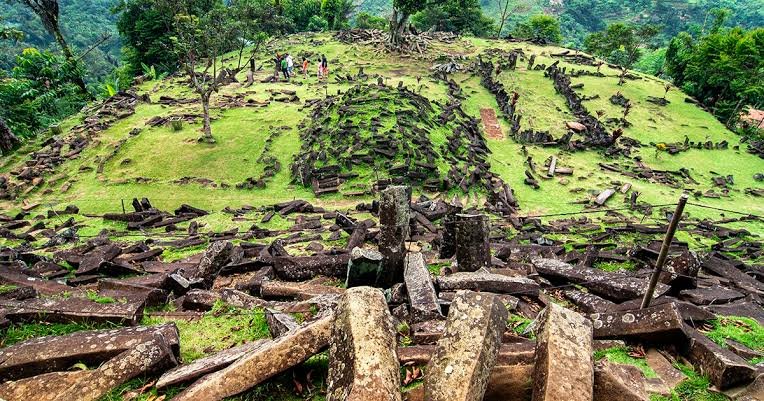
Deep in the lush, terraced highlands of West Java, Indonesia, sits Gunung Padang ("Mountain of Enlightenment"). Crowning the summit of an extinct volcano, this breathtaking archaeological zone is the largest megalithic site in Southeast Asia.
In recent years, Gunung Padang became the center of an explosive global controversy. Pop-culture documentaries and a high-profile 2023 scientific paper claimed that the hill was actually a 27,000-year-old stepped pyramid—built by a lost, advanced Ice Age civilization long before the rise of ancient Egypt or Mesopotamia.
However, science works by testing extraordinary claims against strict evidence. Following an intense international backlash, the scientific journal Archaeological Prospection officially retracted the paper in March 2024. The truth of Gunung Padang does not rely on a lost prehistoric empire, but rather on a brilliant synergy between natural volcanic geology and genuine, highly sophisticated iron-age human engineering.
1. The Anatomy of the 27,000-Year-Old Claim
The sensation surrounding Gunung Padang was driven by an indigenous research team led by geologist Danny Hilman Natawidjaja. Using ground-penetrating radar (GPR), seismic tomography, and core drilling, they proposed that the hill was an engineered pyramid divided into four distinct, subterranean layers:
Unit 1 (The Surface): The visible stone terraces, universally accepted to be human-made.
Unit 2: A layer a few meters below the surface, claimed to be an arrangement of columnar rocks built around 7,000 BCE.
Unit 3: A deeply buried layer containing massive cavities or "hidden chambers," claimed to be artificial masonry dating back to 13,000 BCE.
Unit 4: The basalt core at the very bottom, which the team radiocarbon-dated to 25,000 BCE, claiming it was hand-carved by humans during the height of the last Ice Age.
2. The Scientific Pushback: Dating Nearby Dirt
When independent geologists and mainstream archaeologists examined the data, the "world's oldest pyramid" narrative quickly fell apart. The journal's 2024 retraction highlighted a fundamental scientific error: the researchers had mistakenly dated natural volcanic dirt rather than human activity.
The Physics of Columnar Jointing
The entire foundation of Gunung Padang is composed of an extraordinary geological phenomenon known as columnar jointing. When an ancient volcano erupts and its thick basaltic lava cools slowly over time, the stone naturally contracts and fractures into highly geometric, five- or six-sided vertical columns.
To an untrained eye, these neat, interlocking stone pillars look perfectly "carved" or "laid down" by stonemasons. In reality, nature manufactures this precise geometry entirely on its own (a phenomenon also seen at the Giant's Causeway in Ireland).
The Carbon-Dating Error
To prove a structure was built by humans, archaeologists must find organic material—like wood charcoal from a hearth, butchered bones, or tools—directly associated with the building blocks.
The team at Gunung Padang drilled deep into the hill and carbon-dated loose organic soil trapped between the natural volcanic stones. The dates they returned (up to 27,000 years old) were perfectly real, but they simply measured the age of ancient environmental dirt and decomposed plant matter that had naturally filtered down through the rock fractures over millennia. There were no tool marks, no signs of bone or charcoal, and no evidence of human modification in those deep layers. The "chambers" detected by the radar scans were indistinguishable from natural lava tubes and volcanic cavities.
3. The Real Wonder: An Iron Age Masterpiece
Dismantling the 27,000-year-old myth does not make Gunung Padang unremarkable. The genuine archaeological reality of the site is an incredible testament to ancient human devotion and organization.
Around 500 to 200 BCE (the late Bronze to early Iron Age), an ancient Sundanese community climbed to the summit of this extinct volcano. They recognized the spiritual majesty of the landscape and the unique geometry of the natural columnar basalt pillars scattered across the hill.
   [ EXTINCT VOLCANIC SUMMIT ] ──► Natural Columnar Basalt Pillars Exposed
                                              │
                                  (The True Human Effort)
                                              │
                                              ▼
   [ FIVE STEPPED TERRACES ] ◄─── Formed manually to track the stars and Mount Gede
Through massive communal coordination, these ancient builders manually hauled, stacked, and arranged thousands of these multi-ton stone pillars to form five monumental, rising stepped terraces.
They sculpted the natural hill into a grand, open-air terraced sanctuary designed to align directly with neighboring Mount Gede, using the site as a sacred space for ancestor worship, astronomical tracking, and spiritual rituals.
4. Summary of the Gunung Padang Paradox
The Sensation: A highly publicized claim that a West Javanese hill was an engineered pyramid dating back 27,000 years, making it the oldest human monument on Earth.
The Retraction (2024): Peer-reviewed retraction issued due to a fatal methodology error—the extreme dates belonged to natural, deep-seated environmental soil rather than archeological human strata.
The Geological Foundation: High-density, geometric columnar basalt pillars formed entirely by the natural cooling properties of ancient volcanic lava.
The Actual Chronology: A highly advanced Iron Age sanctuary (c. 2,500 years old) built by indigenous populations who masterfully manipulated natural stone geometry into a massive terraced holy site.
The controversy of Gunung Padang serves as a powerful cautionary tale for modern science, highlighting the danger of letting national pride or a compelling narrative outpace rigorous data. Yet, stripping away the pseudo-scientific hype exposes an entirely authentic marvel. The true builders of Gunung Padang did not need advanced Ice Age lasers or lost technologies; they simply needed an absolute reverence for their landscape, an advanced understanding of natural geometry, and the collective willpower to transform a rugged volcanic peak into a timeless monument of sacred architecture.