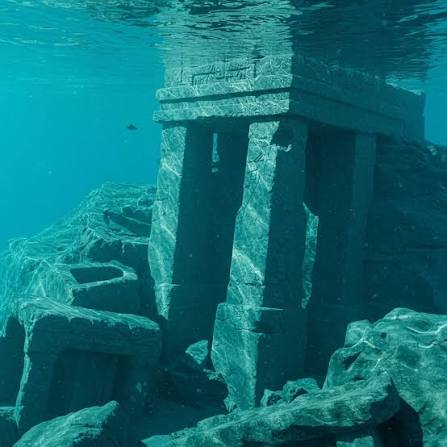
Off the coast of Japan’s southernmost Ryukyu Islands lies the Yonaguni Monument, a massive underwater rock formation that has sparked one of the most polarizing debates in modern marine archaeology. Discovered in 1986 by a local diving instructor looking for hammerhead sharks, this monolithic structure sits roughly 25 meters ($80\text{ feet}$) beneath the waves.
To alternative historians and fringe researchers, Yonaguni is Japan's "Atlantis"—a 10,000-year-old stepped pyramid built by a lost Pacific civilization before being swallowed by rising sea levels at the end of the last Ice Age. However, marine geologists and mainstream archaeologists look at the monument differently. The real story of Yonaguni does not rely on ancient masonry, but rather on a fascinating display of underwater geology, wave energy, and tectonic fracturing.
1. The "Atlantis of Japan" Argument
The theory that Yonaguni is an engineered city was popularized by Masaaki Kimura, a marine geologist at the University of the Ryukyus. Kimura mapped the site and argued that it features several unmistakable hallmarks of human handiwork:
The Main Terrace: A massive, tiered structure resembling a stepped pyramid, featuring sharp, 90-degree corners, flat vertical walls, and straight horizontal platforms.
The Twin Megaliths: Two massive, upright stone pillars standing side-by-side that appear to have been deliberately carved and erected.
The Loop Road: A narrow, flat pathway wrapping around the base of the main structure, which Kimura identified as an ancient stone road.
The "Face" Sculpture: A unique section of the rock reef that loosely resembles a stylized human face or a stone idol.
Kimura hypothesized that the structure was carved out of the bedrock during the last glacial maximum (around 10,000 to 12,000 years ago) when sea levels were significantly lower, and was later submerged by catastrophic melting or tectonic shifts.
2. The Geological Reality: Cross-Jointing and Tuff
Despite the seductive allure of a lost underwater city, the overwhelming consensus among international marine geologists—most notably Robert Schoch of Boston University—is that the Yonaguni Monument is a completely natural formation.
The "laser-straight" steps and right angles that look engineered are actually the result of basic structural geology.
The Anatomy of Sandstone and Mudstone
The Yonaguni Monument is composed of Miocene-era sedimentary rocks—primarily thick layers of sandstone interspersed with thin sheets of soft mudstone. When these rock layers were originally deposited millions of years ago, they formed flat, horizontal beds (bedding planes).
Orthogonal Jointing
The Ryukyu island arc sits directly on top of one of the most tectonically volatile regions on Earth, right where the Philippine Sea Plate subducts beneath the Eurasian Plate. Over millennia, continuous, violent earthquakes subjected the Yonaguni sandstone to immense tectonic stress.
When solid sandstone is compressed and twisted by tectonic forces, it does not shatter randomly. Instead, it fractures along clean, parallel lines of stress known as joints. At Yonaguni, the rock fractured along two intersecting sets of parallel joints that meet at almost precise 90-degree angles. This widespread phenomenon is known as orthogonal jointing.
3. Wave Energy and the Architecture of Erosion
Once the rock fractured internally along these perfect, orthogonal grids, nature began to sculpt the "steps" of the monument through a process of selective erosion:
   [ WAVE & HYDROKINETIC FORCE ] ───► Infiltrates Fractured Soft Mudstone Layers
                                                    │
                                      (The Flaking Progression)
                                                    │
   [ VERTICAL GRAVITY PULL ] ────────► Brittle Sandstone Blocks Drop Off Cleanly
                                                    │
                                                    ▼
                             [ PERFECT 90-DEGREE STEPPED TERRACES ]
The Weak Link: Ocean currents and wave energy infiltrated the fractures, systematically grinding away the soft, thin mudstone layers separating the thick sandstone blocks.
The Collapse: Deprived of their supporting mudstone foundations, chunks of brittle sandstone naturally split along their clean, 90-degree joint lines and sheared off completely under the pull of gravity.
The Cleared Terrace: As these massive stone blocks tumbled away down the reef slope, they left behind perfectly crisp, vertical rock faces and flat horizontal steps.
This exact same geological process can be observed above water in various coastal formations around the world, such as the famous Giant's Causeway in Northern Ireland or the Giants' Playground in Taiwan, where nature consistently manufactures seemingly "artificial" geometry.
4. The Missing Hallmarks of Humanity
Mainstream archaeologists point out that if Yonaguni were truly a 10,000-year-old city built by a highly organized, tool-bearing workforce, the site should be littered with the physical garbage of human existence. Yet, extensive diving expeditions have revealed none:
No Tool Marks: Unlike Sacsayhuamán or the Lion Gate, where microscopic pitting proves human stone-pounding, Yonaguni's vertical walls are completely free of chisel marks, wedge holes, or hammer scars.
No Domestic Debris: Excavators have found zero signs of charcoal hearths, pottery shards, butchered animal bones, or organic refuse anywhere near the monument.
Unusable Infrastructure: The "Loop Road" that wraps around the structure is actually a dead-end channel that slopes irregularly, making it functionally useless as a human thoroughfare. Furthermore, many of the "steps" are several feet high, requiring acrobatic climbing rather than normal human walking.
5. Summary of the Yonaguni Controversy
The Mythical Premise: A 10,000-year-old submerged stepped pyramid featuring geometric platforms, roads, and monuments carved by a lost prehistoric Pacific dynasty.
The Geological Foundation: Natural Miocene sedimentary sandstone layered over mudstone, subjected to extreme tectonic pressures along volatile fault lines.
The Structural Mechanics: Fracture lines created by orthogonal jointing, creating pristine 90-degree structural blocks within the rock bed.
The Erosive Execution: Wave dynamics and tidal currents hollowed out the soft mudstone, causing the sandstone to split along joint lines and drop off, leaving behind natural terraced stairs.
The Yonaguni Monument stands as a stunning example of nature's capacity to mimic human architecture. While it is disappointing to some that the monument is likely not a lost ancient city, the geological reality is arguably more compelling. It reveals a highly dynamic underwater ecosystem where the raw, crushing power of tectonic plates and the relentless erosion of the Pacific Ocean have conspired to carve a breathtaking stone monolith. Whether viewed as an archaeological mystery or a geological masterpiece, Yonaguni continues to captivate the imagination, serving as a reminder of how beautifully nature can order the world beneath the sea.