Note: The user query references "Xebara Cave," a common typographic variant for Kebara Cave ($\text{\textit{Me'arat Kebbara}}$) on Mount Carmel, Israel. This site houses the definitive anatomical evidence regarding the long-debated question of Neanderthal linguistic and vocal capabilities.
For over a century, linguists and evolutionary biologists asserted that even if Neanderthals possessed complex brains, they were anatomically incapable of spoken language. Computer simulations based on skull bases argued that their vocal tracts were too high and rigid, restricting them to crude, ape-like grunts and clicks.
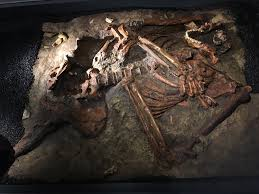
This linguistic barrier was permanently shattered in 1983 with the discovery of Kebara 2 (affectionately nicknamed "Moshe"), a extraordinarily complete 60,000-year-old adult male Neanderthal skeleton.
   [ SPECULATIVE VOCAL BARRIER ] ──► High, Rigid Ape-Like Larynx (Grunts Only)
                                                 │
                                     (The Micro-CT Trabecular Scan)
                                                 │
                                                 ▼
   [ CONFIRMED SPEECH CAPACITY ] ◄── Modern Hyoid Structure & Biomechanical Remodeling
The Discovery of the Hyoid
While Moshe’s skull was missing due to post-depositional erosion, his torso, arms, and pelvis were preserved in pristine condition. Most importantly, the excavation recovered a tiny, incredibly fragile U-shaped bone located at the base of the throat: the hyoid bone.
The hyoid is the absolute logistical anchor of human speech; it secures the tongue, lifts the larynx, and coordinates the rapid, fluid muscular contractions necessary to modulate air into distinct vowels and consonants.
The Kebara 2 hyoid was a revelation—its external macroscopic dimensions, muscle attachment points, and overall shape were completely indistinguishable from those of modern living humans.
Micro-Biomechanics of Phonation
To prove the bone was actually used for speech rather than simple swallowing, an international team of biomechanical engineers subjected the Kebara 2 hyoid to high-resolution micro-CT scanning and finite element analysis (FEA).
They mapped the internal trabecular bone architecture, which continuously models and remodels itself throughout a lifespan in direct response to the specific mechanical stresses applied to it.
The analysis proved that the internal micro-geometry and stress-distribution pathways of the Neanderthal hyoid perfectly matched those of modern humans. The bone was being routinely subjected to the intense, highly specific mechanical loadings generated by the rapid, rhythmic muscle contractions of phonation (speech).
While Neanderthals likely spoke with a slightly higher, louder, and more nasal pitch due to their massive chests and large nasal cavities, Kebara 2 proves they possessed the complete anatomical and biomechanical hardware required to communicate via fully formed, complex spoken language.