Introduction
Situated on a protected island off the southern coast of Tanzania, Kilwa Kisiwani was the preeminent commercial emporium of the Swahili Coast from the 12th to the 15th century CE. Controlling the lucrative maritime gold trade flowing out of Great Zimbabwe through the southern port of Sofala, Kilwa transformed its immense mercantile wealth into monumental stone and coral architecture, culminating in the construction of the palace complex of Husuni Kubwa. For generations, colonial historians claimed that these coastal stone towns were foreign Arab colonies; systematic modern excavations have completely overturned this view, proving that Kilwa was an African urban Islamic state that dynamically blended indigenous Swahili culture with global Indian Ocean economic networks.
The Architecture of Maritime Wealth and Global Exchange
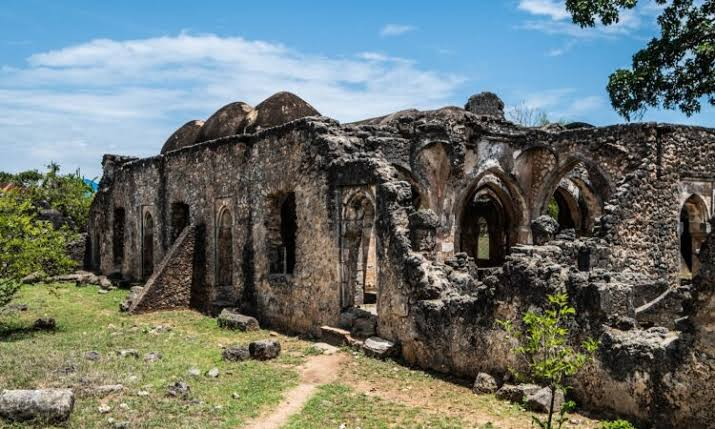
The urban grandeur of Kilwa Kisiwani has been preserved through its unique monumental architecture, constructed entirely from local coral rag bound with fine lime mortar. The crown jewel of the site is Husuni Kubwa, a massive 14th-century palace and warehouse complex built on a cliff edge by Sultan al-Hasan ibn Sulaiman. This architectural masterpiece featured an open-air octagonal swimming pool, grand vaulted reception halls, domestic residential quarters, and expansive commercial warehouses designed to secure incoming maritime cargo.
Excavations within the palace and the nearby Great Mosque—which boasts a spectacular array of coral-formed domes—have unearhed an extraordinary concentration of imported global luxuries. Archaeologists discovered vast quantities of high-grade Chinese Ming Dynasty porcelain, Islamic monochrome glazed ceramics from the Persian Gulf, and thousands of glass beads from India. Crucially, the discovery of a local mint containing thousands of unique copper coins bearing the names of Kilwa's sultans proves that the city operated an independent, highly regulated monetized economy. This material record shows that Kilwa was a major cosmopolitan power, converting interior African resources like gold, ivory, and timber into international currencies.
Conclusion
The archaeological unmasking of Kilwa Kisiwani provides a critical baseline for understanding the deep integration of East Africa into the early global economy. It proves that the Swahili Coast was not a passive fringe, but a sophisticated, literate maritime empire that actively shaped international trade routes across the Indian Ocean. The grand coral palaces and independent coinage documented at the site demonstrate a highly successful synthesis of African social organization and Islamic architectural forms. Today, the majestic ruins of Kilwa Kisiwani stand as an enduring monument to African maritime achievement and urban sophistication.