Deep beneath the suburban streets of Paola, Malta, sits a subterranean architectural marvel that challenges our understanding of Neolithic engineering, acoustic science, and spiritual life: The Ħal Saflieni Hypogeum.
Discovered accidentally in 1902 by stonemasons cutting cisterns for a new housing development, this massive, three-tiered underground sanctuary was carved entirely out of solid globigerina limestone between 3600 and 2500 BCE. While it served as a monumental collective tomb—housing the skeletal remains of an estimated 7,000 individuals—its most staggering feature is its highly sophisticated acoustic design, particularly within a room known globally as the Oracle Chamber.
1. The Architecture of the Underworld: Mirroring the Above
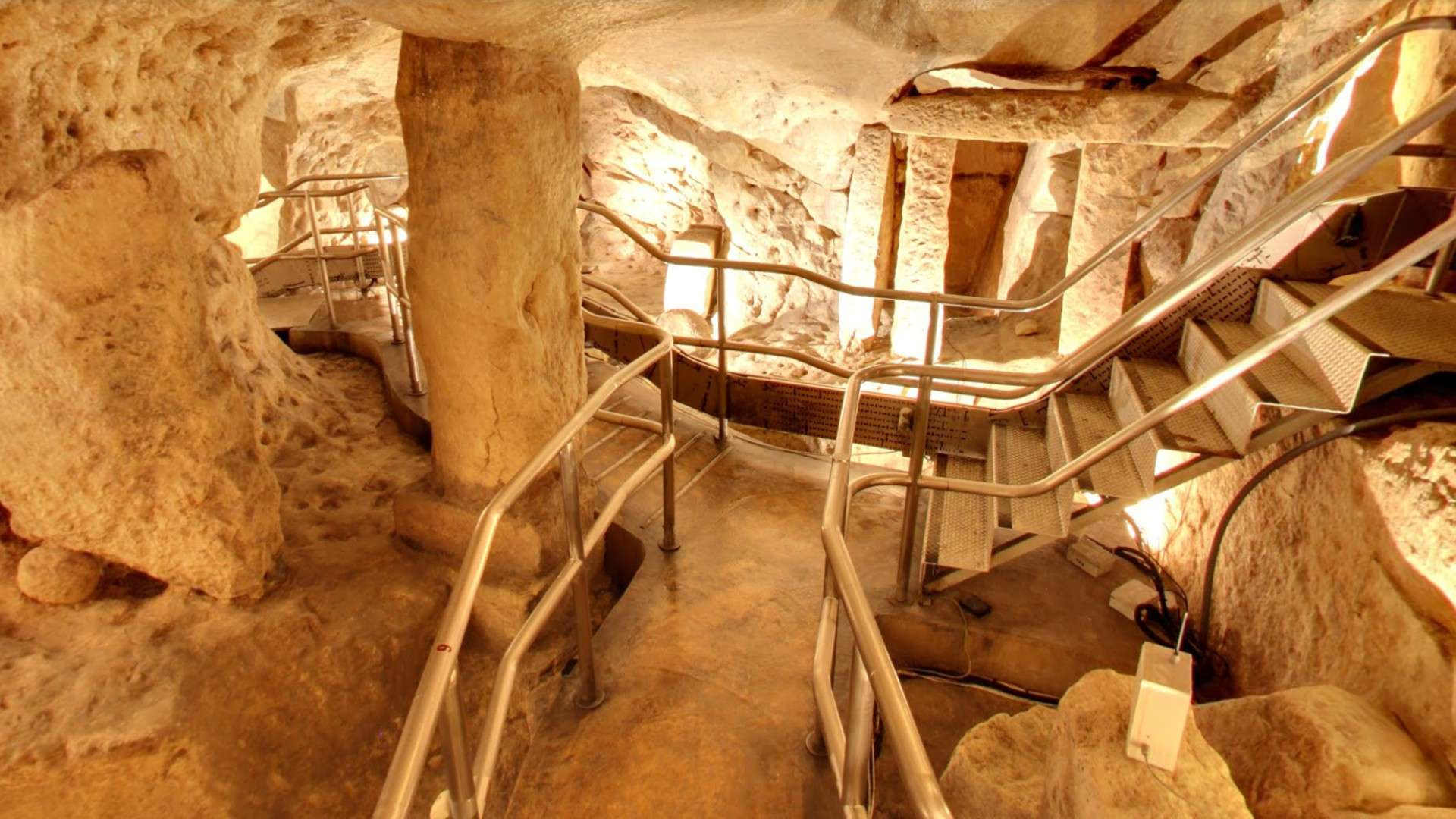
The Hypogeum (literally meaning "underground" in Greek) is not a chaotic network of rough caves. Instead, the prehistoric builders painstakingly carved the solid rock to mimic the grand, open-air megalithic temples they were constructing simultaneously on the surface, such as Ħaġar Qim and Tarxien.
Spanning three distinct, descending levels that reach a depth of roughly 10 meters ($33\text{ feet}$), the complex features beautifully smooth, curved walls, monumental lintels, and trilithon doorways. In the Main Chamber, the masons went so far as to carve false corbelled domes into the solid ceiling rock, creating an optical illusion of open, vaulted roofs where none existed. Through this intense expenditure of labor using nothing but flint, obsidian, and antler picks, they successfully transformed a dark, subterranean void into a highly structured, majestic theater for the dead.
2. The Oracle Chamber: The Physics of Sub-Woofer Resonance
The absolute apex of the Hypogeum’s intellectual design is found on the middle level inside the Oracle Chamber. This relatively small, rectangular room features a unique, small oval niche carved into the wall at face height.
For over a century, acoustic physicists and archaeoacousticians have studied this room because of its mind-boggling sound manipulation properties. If a person speaks into the room normally, very little happens. However, if a male voice drops his pitch to a specific low-frequency resonance—precisely 110 Hz—the entire subterranean complex reacts like a giant, stone sub-woofer.
   [ LOW-FREQUENCY VOCALIZATION ] ──► Chanted into the Custom Oval Wall Niche
                                                 │
                                   (The Acoustic Resonance Loop)
                                                 │
                                                 ▼
   [ 110 HZ SOUND WAVELENGTHS ] ◄──── Amplified by Curving Rock Facets / Echoes through Tier Grid
This precise acoustic resonance is achieved through several deliberate structural factors:
The Amplification Niche: The oval niche acts as a natural megaphone, concentrating the sound waves and projecting them outward.
The Curving Ceiling Facets: The ceiling of the chamber is carved with unique, sweeping curves that prevent sound waves from flat-lining or scattering. Instead, it channels the sound, causing it to bounce and amplify exponentially as it rolls through the room.
The Continuous Echo: A single low chant in this room generates a powerful, vibrating echo that travels seamlessly through all three levels of the complex, making the sound feel as though it is emerging out of the very earth itself.
3. Archaeoacoustics: The Neurological Impact of 110 Hz
Why did these Neolithic builders spend centuries carving a room perfectly tuned to 110 Hz? While we have no written texts to confirm their motives, modern cognitive neurology and archaeoacoustics offer a fascinating, scientific hypothesis.
In 2008, a pilot study conducted by the Mantra Consortium monitored the brain activity of healthy adults exposed to different acoustic frequencies. The results revealed that when the human brain is subjected to a sustained 110 Hz frequency, a striking neurological shift occurs:
Deactivation of the Language Center: Activity in the left prefrontal cortex—the region responsible for logical processing, language, and linear thought—suddenly drops.
Activation of Emotional Processing: The brain shifts its activity toward the right prefrontal cortex, which governs creativity, abstract visualization, and intense emotional states.
The Trance State: This specific frequency mimics the brainwave states associated with deep meditation, religious ecstasy, and trance.
To the Neolithic people of Malta, entering the dark, flickering light of the Hypogeum to hear a priest or oracle chant from the hidden wall niche would have been an overwhelming, reality-altering experience. The physical vibration of the stone walls combined with the neurological shift caused by the 110 Hz resonance would induce vivid hallucinations and a profound sense of cosmic detachment—perfectly engineering a space where the living could commune directly with the spirits of their ancestors.
4. Summary of the Hypogeum's Structural Dynamics
The Scale: A three-tiered, hand-carved underground necropolis housing 7,000 individuals, chiseled out of solid globigerina limestone using only stone and antler tools.
The Architecture: Intentionally mimics the layout, trilithons, and corbelled roofs of Malta’s surface megalithic temples to establish an intentional spatial bridge between the worlds of the living and the dead.
The Acoustic Mechanics: Utilizing an integrated wall niche and curved limestone ceiling geometries to isolate and amplify a specific low-frequency resonance of 110 Hz.
The Neurological Purpose: Sound design engineered to trigger a shift from logical left-brain thought to right-brain abstract processing, inducing ritualistic, meditative trance states during ceremonies.
The Ħal Saflieni Hypogeum stands as one of our planet's most brilliant early symphonies of architecture and sensory manipulation. It proves that prehistoric societies were not merely primitive builders stacking rocks; they possessed an incredibly nuanced, experimental grasp of structural dynamics, materials, and how the physical geometry of a room can directly alter human consciousness. By turning the dark interior of the earth into a living acoustic instrument, the ancient builders of Malta created a timeless sanctuary where architecture, sound, and the human mind became permanently fused together in the dark.