Introduction
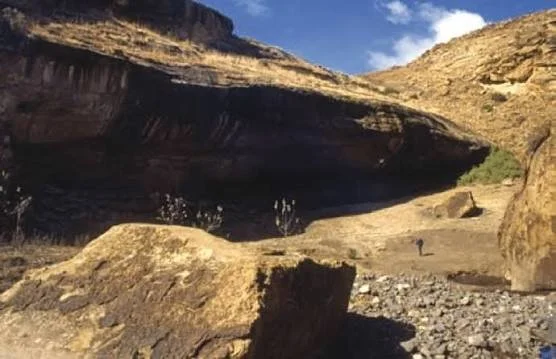
Sehonghong Shelter is an important archaeological locality in Lesotho, known for its contribution to research on prehistoric settlement, stone-tool technology, and the history of human occupation in the region. It is part of a wider southern African archaeological landscape in which caves and shelters preserve evidence of people adapting to mountain and highland environments.
The title refers to rock art approximately four thousand years old. That age should be treated as a claim requiring site-specific confirmation, rather than a date that can automatically be assigned to every painting or archaeological deposit at Sehonghong. A shelter may have been visited over a long period, and its archaeological deposits may contain material from different episodes of occupation.
The site’s broader importance lies in its archaeological record and its position within Lesotho’s highland environment. Rock art, where documented, must be considered alongside the evidence for settlement, subsistence, and technological change.
The Highland Environment
Lesotho’s landscape is dominated by highlands, steep valleys, river systems, and mountain slopes. These environments offered access to water, plant resources, and animals, while also presenting challenges associated with cold temperatures, changing weather, and difficult travel routes.
Shelters could provide protection from wind and rain. Their locations may have made them useful during movement through the highlands or during particular seasonal activities.
The surrounding landscape has changed over thousands of years. Climate fluctuations influenced vegetation and animal distributions, while erosion and other geological processes shaped the terrain. Archaeologists use environmental evidence to reconstruct the conditions under which people lived.
Archaeological Importance
Sehonghong is known in southern African archaeology for its deposits and the evidence they provide about long-term human occupation. Archaeological sequences from shelters can contain stone artefacts, animal remains, charcoal, and other materials introduced through human activity or natural processes.
Stone tools reveal how people selected raw materials and shaped them into implements. Animal remains can provide information about hunting and the availability of food resources. Sediment layers help establish the sequence in which these materials accumulated.
A long archaeological sequence does not necessarily indicate continuous occupation. People may have visited the shelter repeatedly, with long intervals between visits. Researchers therefore examine the structure of the deposits and the dating evidence before reconstructing patterns of settlement.
Rock Art and Its Chronology
Rock art is an important source of evidence for Indigenous artistic traditions in southern Africa. Painted images may depict animals, human figures, and abstract or symbolic forms.
However, the age of a shelter is not the same as the age of its paintings. A location may have been used long before an image was created, and later visitors may have added new paintings beside older ones.
Dating rock art is challenging because pigments do not always contain material suitable for direct analysis. Researchers may rely on pigment studies, comparisons with other sites, and relationships with dated archaeological deposits. These methods may establish a broad range rather than an exact year.
For Sehonghong specifically, any claim that particular images date to four thousand years ago should be supported by a documented study that identifies the paintings and explains the dating method.
Art, Environment, and Cultural Memory
Rock art can reflect close observation of the natural world, but its meaning may extend beyond a simple record of animals or daily activities. Images can carry symbolic significance and may be associated with particular places in the landscape.
The highland setting is relevant because the environment shaped how people moved, found food, and interacted with other communities. Yet the location of a painting alone cannot reveal whether it was created for practical, social, or spiritual reasons.
Researchers should distinguish direct evidence from interpretations based on comparisons with other traditions. Indigenous knowledge may offer important perspectives, but similarities between images do not necessarily establish identical meanings.
Conservation in Lesotho
Rock shelters and their archaeological deposits are vulnerable to erosion, uncontrolled collecting, vandalism, and damage caused by visitors. Once a layer is disturbed, the relationships between artefacts and sediment may be lost.
Conservation involves recording sites, managing access, preserving collections, and working with heritage authorities and local communities. It is also important to communicate the significance of archaeological sites without overstating what is known about them.
Conclusion
Sehonghong Shelter is an important part of Lesotho’s archaeological heritage and contributes to understanding human occupation of southern Africa’s highlands. Its archaeological record offers opportunities to investigate technology, subsistence, and environmental adaptation.
The specific claim of four-thousand-year-old rock art should be verified through evidence that directly relates to the images in question. By distinguishing the age of the site from the age of individual artworks, researchers can produce a more reliable account of Lesotho’s past while protecting its cultural heritage.