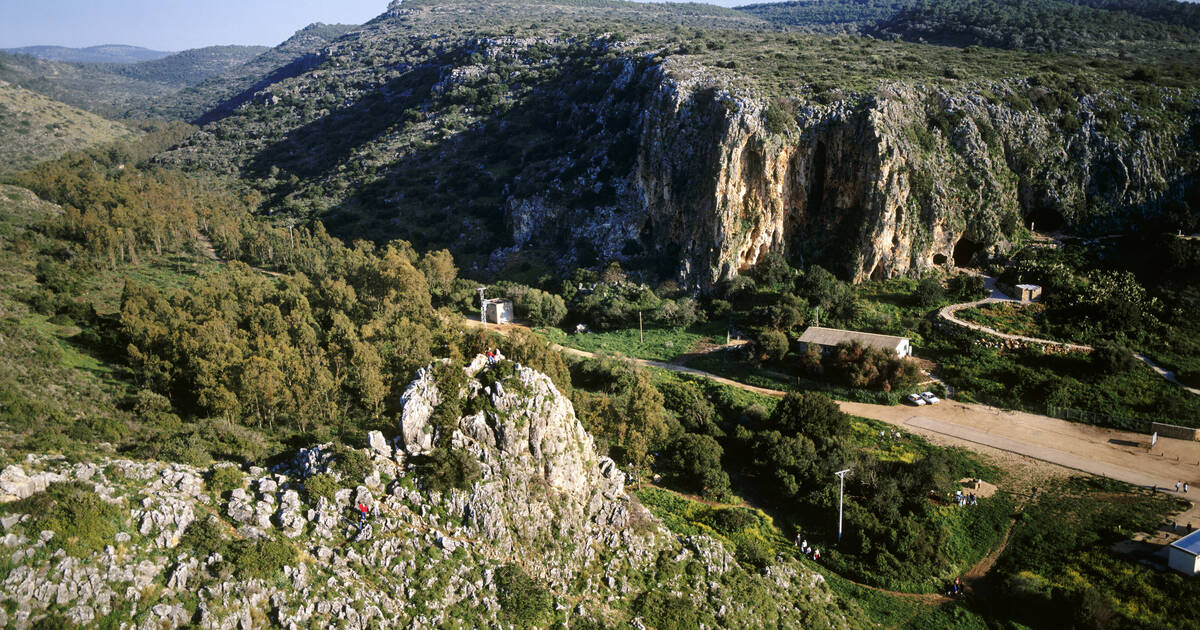
If Skhul Cave represents a fleeting evolutionary snapshot, Tabun Cave—located just a few hundred meters away—is a monumental, deep-time calendar of human prehistory. Excavated initially by Dorothy Garrod between 1929 and 1934, Tabun features one of the longest, most uninterrupted stratigraphic sequences in the entire world, preserving a 500,000-year record of shifting climates, changing human species, and evolving tool technologies.
                  [ THE TABUN DEEP-TIME STRATIGRAPHIC COLUMN ]
                                        │
         ┌──────────────────────────────┴──────────────────────────────┐
         ▼                                                             ▼
 [ THE UPPER LAYER (BED C/D) ]                                  [ THE LOWER BASEMENT (BED E/F) ]
 * ~120,000 Years Ago                                           * ~500,000 - 350,000 Years Ago
 * Tabun C1: Complete female Neanderthal                        * Massive, heavy Acheulean handaxes
 * Early Levallois-Mousterian flake tools                       * Massive butchery of *Dama mesopotamica*
The Acheulean Industrial Core
The deepest, oldest horizons of Tabun Cave (Beds E and F) preserve a massive accumulation of the Acheulean Industrial Complex dating back half a million years. Here, early hominins—likely Homo heidelbergensis or early Homo erectus—manufactured thousands of iconic, teardrop-shaped Acheulean handaxes from local flint nodes.
These layers document a highly stable, deep-time behavioral pattern, where hominins returned to this specific limestone cavern for hundreds of thousands of years to systematically process carcasses, shape wood, and exploit the rich ecological corridor of the coastal plain.
The Tabun C1 Enigma
Moving up into the younger, 122,000-year-old layers of Bed C, the technology shifts dramatically to the advanced, flake-based Levallois-Mousterian industry. It is here that archaeologists unzipped the famous Tabun C1 skeleton, a near-complete fossil of an adult female Neanderthal:
Tabun C1 is a critical anatomical baseline for the Levant. She features a classic Neanderthal long, low cranial vault, a strongly projecting midface (midfacial prognathism), and a broad, robust pelvis.
However, her stratigraphy remains intensely contested. Because Garrod excavated using broad vertical spit-levels rather than modern micro-stratigraphy, researchers still debate whether Tabun C1 was a deep intentional burial dug down from a younger layer or a direct contemporary of the early Homo sapiens living at Skhul, illustrating a complex, fluid Levantine landscape where two distinct human species traded occupancy of the same mountain range across millennia.