56. The Archaeology of Ice-Season Hunting Drives in High Latitudes
In high-latitude environments, seasonal ice and snow have shaped human movement, hunting strategies, and settlement patterns for thousands of years. During colder periods, frozen rivers, snow-covered plains, and expanding ice surfaces could transform landscapes that were difficult to cross during warmer months. For communities that depended on wild animals, these seasonal conditions sometimes created opportunities to guide or concentrate prey along predictable routes. Archaeologists studying possible ice-season hunting drives investigate how people used terrain, animal behavior, and environmental conditions to improve hunting success in cold climates.
A hunting drive is a coordinated strategy in which hunters influence the movement of animals toward a selected location. Depending on the species and landscape, people might use barriers, lines of hunters, visual signals, noise, or constructed features to direct prey toward a narrow passage or waiting hunting group. Some systems could involve substantial communal effort, while others might be relatively small and temporary. The effectiveness of a hunting drive would depend on knowledge of animal behavior, the terrain, and the timing of seasonal movements.
Ice can influence these strategies in several ways. Frozen waterways may provide routes across landscapes that are difficult to traverse in other seasons. Snow can make tracks easier to detect, while exposed terrain may help hunters observe animal movements from a distance. In certain circumstances, narrow passages between water, cliffs, snowbanks, or other obstacles could restrict the directions in which animals could travel. However, ice does not automatically make hunting easier. Unstable surfaces, blizzards, extreme cold, and limited daylight could create serious dangers for both hunters and prey.
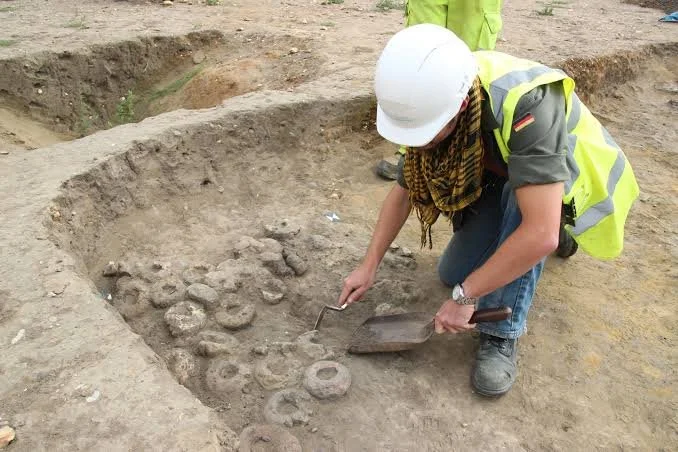
The archaeological traces of hunting drives can vary considerably. Researchers may encounter stone alignments, low walls, stakes or postholes, narrow corridors, pits, and concentrations of animal remains. Some features may have served as barriers or guides, while others may represent ordinary landscape modifications unrelated to hunting. In regions where wood and other organic materials were used, the most important components of a drive may have disappeared, leaving only faint traces in the soil or scattered archaeological evidence.
Landscape analysis is therefore essential. Archaeologists examine the relationship between suspected structures, animal migration routes, natural bottlenecks, water crossings, and nearby camps. A line of stones positioned across a natural passage might have helped guide animals, but its purpose cannot be established from its shape alone. Researchers must determine whether the structure is artificial, establish its age, and compare it with evidence from other sites before assigning it a hunting function.
Animal remains can provide additional clues. Species identification may reveal which animals were hunted, while the age and sex of individuals can sometimes offer information about the composition of the prey population. Butchery marks, impact damage, and patterns of bone fragmentation may indicate how animals were processed. A large concentration of bones could reflect a communal hunting event, repeated hunting over many years, natural deaths, or a location where predators accumulated remains. Distinguishing these possibilities requires careful examination of the archaeological context.
Seasonality is particularly difficult to establish directly. Animal age profiles, tooth development, bone growth, and other biological indicators may sometimes suggest the season in which an animal died. Environmental evidence, including preserved plant remains and sediment records, can help reconstruct the conditions surrounding a hunting event. Yet no single indicator is always decisive, and the interpretation may be complicated by the movement of animal remains after death or by repeated use of a site.
Dating is another important challenge. A landscape feature may have been reused across multiple periods, especially if it occupied a naturally convenient hunting location. Radiocarbon dating of suitable organic remains can provide chronological estimates, while stratigraphic relationships may establish the order in which deposits formed. Researchers must ensure that dated materials are directly associated with the feature being studied rather than with a later or earlier episode of activity.
Ice-season hunting could also have involved substantial social organization. Coordinated drives require participants to communicate, understand the terrain, and perform complementary tasks. Communities may have developed specialized knowledge about migration patterns, weather conditions, and the behavior of particular species. Successful hunts could provide food, hides, bones, and other materials, while the distribution and storage of these resources might reveal how communities organized cooperation and shared risk.
The importance of hunting drives would have varied between regions and periods. Some communities relied heavily on fishing, gathering, or other hunting methods, while others may have used coordinated drives only under particular environmental conditions. It would be misleading to assume that all high-latitude societies practiced the same techniques or that every concentration of animal bones resulted from a communal hunt.
Modern climate change creates additional challenges for studying cold-region archaeology. Thawing ground, retreating ice, and changes in permafrost can expose organic materials that have remained preserved for centuries or millennia. Although these discoveries can provide exceptional scientific information, they may also be rapidly damaged by erosion, decomposition, and human activity. Archaeologists and local communities therefore face the task of documenting vulnerable sites while respecting Indigenous knowledge, land rights, and cultural heritage.
The archaeology of ice-season hunting drives reveals how people adapted their subsistence strategies to changing environments. By combining landscape reconstruction, animal-bone analysis, dating methods, and evidence of human activity, researchers can investigate whether ancient communities used ice and snow as part of coordinated hunting systems. The most convincing interpretations emerge when physical features and environmental evidence support one another, allowing archaeologists to reconstruct not only how people obtained food but also how they developed detailed knowledge of the landscapes they inhabited.