Introduction
Access to clean drinking water has been a fundamental concern throughout human history. Before the development of modern water-treatment systems, communities relied on natural sources, settling techniques, boiling, and various forms of filtration to improve water quality. Although large-scale aqueducts and public water systems receive considerable attention, smaller technologies used by households and travellers are equally important for understanding everyday water management.
Portable water filters are particularly interesting because they could be carried between settlements, camps, and temporary workplaces. Their archaeological study can reveal how people responded to water quality problems and adapted practical technologies to different environments. However, identifying an ancient object as a water filter requires caution because many perforated containers and porous materials had other purposes.
Understanding Portable Water Filtration
Filtration is the process of separating suspended particles from a liquid by passing it through a material containing small openings or pores. Unlike boiling, which can kill many disease-causing organisms, ordinary filtration primarily removes physical particles and may not make water microbiologically safe.
Pre-industrial communities could use cloth, woven fibers, sand, gravel, porous ceramics, and other materials to strain or clarify water. Some devices may have been designed to remove visible sediment, while others could have served as part of a more complex water-treatment process.
A portable filter would have needed to be relatively light, durable, and convenient to transport. Its design would depend on the materials available and the amount of water that needed to be processed.
Materials Used in Ancient Filtration
Cloth and woven plant fibers are among the simplest possible filtration materials. A piece of fabric could be stretched across a container or used to strain water as it was poured. Such materials would have been easy to replace, although their organic composition makes archaeological preservation unlikely in many environments.
Porous ceramics offer another possibility. Unfired or specially prepared ceramic materials can allow water to pass through while retaining some suspended particles. The effectiveness depends on the clay composition, firing temperature, and size of the pores.
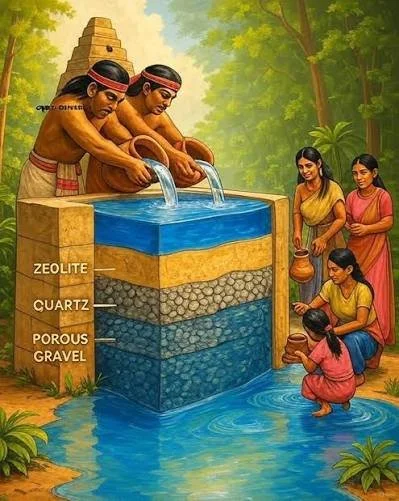
Sand and gravel could also be used in layered filtration arrangements. Water passing through these materials may lose some suspended particles, although the archaeological identification of an ancient portable sand filter would require evidence of a deliberately constructed container and filtration sequence.
Charcoal may have been included in some filtering arrangements because it can adsorb certain substances. However, charcoal alone does not establish that a device was intended for water purification.
Archaeological Identification
Portable water filters are difficult to identify because their forms may resemble ordinary household equipment. A perforated ceramic vessel, for example, could have been used for straining food, draining liquids, preparing cheese, or processing other materials.
Archaeologists examine the object's shape, manufacturing technique, wear patterns, and surrounding deposits. A container with a fine porous structure and evidence of repeated water movement may be consistent with filtration, but its function must be compared with alternative explanations.
Residue analysis can sometimes identify mineral deposits or organic materials that accumulated during use. Microscopic examination may reveal patterns of clogging or repeated cleaning.
The archaeological context is especially important. A suspected filter found near water-storage vessels, wells, or domestic preparation areas may provide a stronger interpretation than an isolated object.
Portable Filters and Travel
Portable filtration may have been useful for people who regularly moved between settlements or worked away from established water supplies. Traders, soldiers, pastoralists, sailors, and travellers all depended on accessible drinking water.
A lightweight straining device could help remove insects, plant fragments, and visible sediment from water collected in rivers, ponds, or temporary sources. It may also have been used to prepare water for cooking or other household activities.
However, there is an important distinction between improving the appearance of water and making it safe to drink. Ancient users may not have understood microorganisms in the modern scientific sense, even if they recognized that some sources were unpleasant or associated with illness.
Water Quality and Environmental Knowledge
Pre-industrial communities developed practical knowledge about water sources through repeated observation. They could recognize differences in taste, smell, color, and sediment content.
Certain springs may have been preferred because their water appeared clearer, while stagnant pools or heavily sedimented streams might have been avoided. Seasonal changes could also influence water quality.
Portable filters would have complemented this knowledge rather than replacing the need to select suitable water sources. Communities could combine filtration with settling, boiling, or storage in clean containers.
The archaeological study of these practices can help reconstruct how people managed water under different environmental conditions.
Scientific Methods for Studying Ancient Filters
Microscopy is useful for examining pore structures, surface wear, and deposits within ceramic or stone materials. Researchers can determine whether a material contains natural openings or whether its surface was deliberately modified.
Chemical analysis may identify mineral residues associated with repeated exposure to water. Organic residue analysis can help detect traces of plant fibers, oils, or other substances, although contamination and preservation conditions must be considered.
Experimental archaeology can test possible uses by reproducing ancient filter designs. Researchers can construct replicas using historically plausible materials and compare their performance when exposed to different water conditions.
Such experiments can demonstrate whether a proposed design is technically workable, but they cannot independently prove that a particular ancient community used it.
Filtration, Storage, and Household Practices
Portable filters may have formed part of a wider system of water management. Water could be collected in a container, allowed to settle, passed through a filtering material, and then stored for later use.
The arrangement of vessels and tools within a household can help researchers identify these activities. A combination of narrow-necked jars, basins, strainers, and storage containers may suggest a sequence of water preparation.
However, many of these objects also served food preparation and other domestic functions. Researchers must therefore consider the full assemblage rather than interpreting one artifact in isolation.
Limitations of the Evidence
Organic filters made from cloth, grass, or other plant fibers are unlikely to survive in many archaeological environments. Their absence from excavated sites does not prove that filtration was unknown.
Portable devices may also have been reused for different purposes. A strainer originally used for food processing could later have been used to remove debris from water.
Furthermore, ancient filtration should not be equated with modern water purification. Many simple filters cannot remove dissolved chemicals or reliably eliminate harmful microorganisms.
Conclusion
The archaeology of portable water filters offers a valuable perspective on everyday technology and the management of freshwater before industrial water-treatment systems. Cloth, porous ceramics, sand, gravel, and other materials could have helped remove visible impurities from water, although their precise functions must be established through archaeological and scientific analysis. By combining artifact study, residue examination, experimental reconstruction, and environmental evidence, researchers can better understand how pre-industrial communities adapted filtration practices to travel, household life, and changing water conditions.