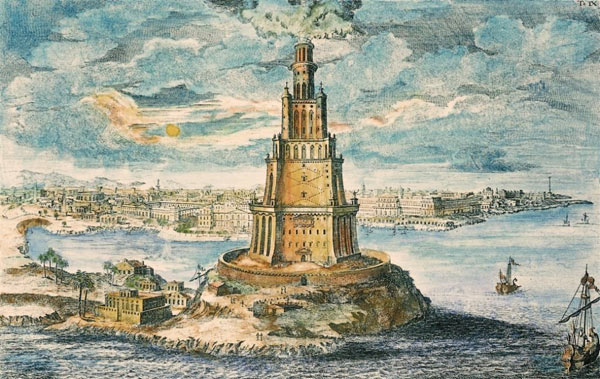
The Pharos of Alexandria, one of the Seven Wonders of the Ancient World, was an incredible technological and architectural triumph of the Ptolemaic Kingdom. Standing at least 100 meters (330 feet) tall on the island of Pharos in Egypt, it guided sailors into the bustling harbor of Alexandria for over 1,500 years before succumbing to a series of devastating earthquakes.
Today, diving into the waters of Alexandria's Eastern Harbor offers a glimpse into a submerged architectural archive.
1. A Submerged Wonder of the Ancient World
For centuries, the remains of the Great Lighthouse lay under 20 to 26 feet (6 to 8 meters) of water in Alexandria's Eastern Harbor, covered by sediment and waves.
The Discovery: Systematic underwater archaeology began in 1994 when a team led by French archaeologist Jean-Yves Empereur mapped the submerged site off the coast of the Qaitbay Citadel.
Monumental Relics: Divers cataloged over 3,500 items, including massive granite blocks weighing up to 60 tons, sphinxes, obelisks, and colossal statues of Ptolemy II and his wife, Arsinoe.
2. Recent Archaeological Breakthroughs
A massive breakthrough occurred when an international team from the French National Centre for Scientific Research (CNRS) and Egypt's Centre d'Études Alexandrines successfully raised 22 monumental stone blocks from the seabed.
Massive Lintel Stones: The recovered stones weigh between 77 and 88 U.S. tons each and include parts of the lighthouse's entrance, such as lintels, jambs, and a threshold.
A Hidden Pylon: Archaeologists identified parts of a previously unknown pylon with an Egyptian-style door constructed using Greek engineering techniques, highlighting the cosmopolitan nature of Hellenistic Alexandria.
3. Building a Digital Twin
Working in the murky conditions of the Eastern Harbor is difficult, so archaeologists are turning to modern technology to preserve the site without removing all the artifacts.
Photogrammetry: The 22 massive blocks are being 3D scanned along with more than 100 other pieces that have been documented underwater over the past decade.
Virtual Reconstruction: Using these digital models, engineers with the Dassault Systèmes Foundation are piecing together the blocks like a giant puzzle to build a "digital twin" of the Pharos. This will help researchers test hypotheses about how the ancient wonder was constructed and how it collapsed.
4. Diving the Site Today
For adventurous divers, the remains of the ancient city and the lighthouse are accessible just off the coast of the Qaitbay Citadel in an underwater zone covering roughly 4 to 7 acres.
What to See: Divers can swim among columns, statues, and paving slabs from the ancient Portus Magnus.
Museum Displays: For those who prefer to stay dry, thirty-six restored pieces, including the colossal statues of the Ptolemaic royals, are on display in open-air museums in Alexandria, such as the Roman Theatre.
The Pharos was not only an engineering marvel but an emblem of human ambition, bridging the practicality of a beacon with the artistic mastery of the Hellenistic world.