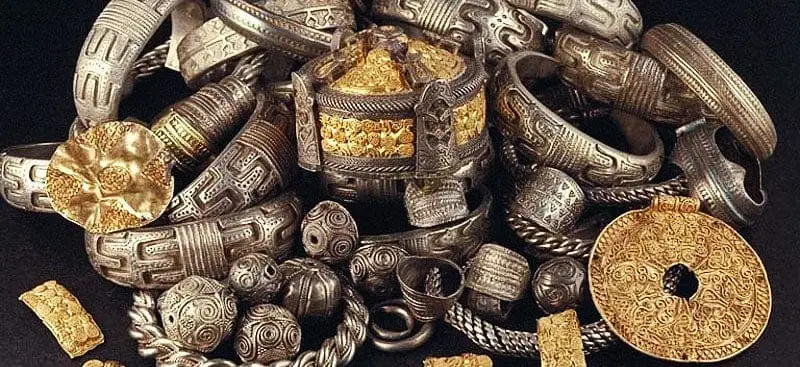
Viking Age jewelry was far more than mere decoration. In a society without a standardized coinage system for much of its history, jewelry functioned as a portable bank account, a badge of social hierarchy, and a powerful medium for religious expression.
Using techniques like lost-wax casting, filigree, and granulation, Norse smiths transformed silver, gold, and bronze into intricate masterpieces that defined the "Viking look" from the 8th to the 11th centuries.
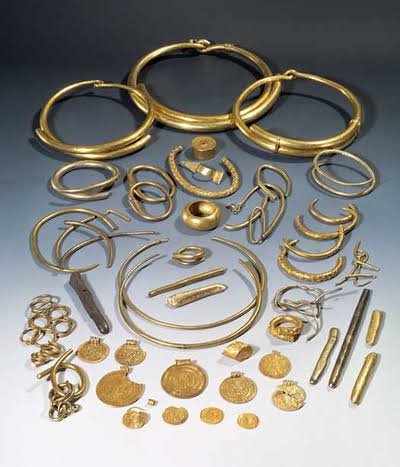
1. The "Hack-Silver" Economy
For a Viking warrior or trader, jewelry was literally money. Much of the silver in Scandinavia arrived via trade routes from the Islamic Caliphate in the form of dirhams (coins).
Portability: Large silver neck rings and arm rings were designed to be worn for security and status.
The "Hack" Method: If a Viking needed to pay for a smaller item, such as a goat or a skin of ale, they would simply use a knife to hack off a piece of their arm ring.
Bullion Value: Because the value was based on the weight of the metal rather than the design, archaeologists frequently find "hoards" containing bits of broken jewelry, known today as hack-silver.
2. The Iconic Tortoise Brooch
The most recognizable piece of Norse jewelry is the oval brooch, commonly called the "tortoise brooch" due to its domed shape.
Function: These were worn in pairs by Norse women to fasten the shoulder straps of their apron-dresses (hangerock).
The Suspended Kit: Between the two brooches, women often hung decorative chains featuring practical tools like small knives, whetstones, ear-spoons, and keys—the keys being a symbol of the woman’s authority over the household and its chests.
Mass Production: These brooches were among the first "mass-produced" items in Scandinavia, cast from molds in trading hubs like Birka and Hedeby.
3. The Evolution of Norse Art Styles
Viking jewelry is the primary record of the changing artistic tastes of the Norse people. Their art was almost entirely zoomorphic, meaning it was composed of stylized, intertwining animals.
Oseberg Style: Features "gripping beasts"—small, muscular creatures with paws that clench the borders of the design.
Borre Style: Known for ribbon-like animals and geometric knots that create a dense, "noisy" visual texture.
Jelling and Mammen Styles: Characterized by large, powerful, S-shaped animals, often birds or dragons, with "ribbed" bodies.
Urnes Style: The final Viking style, featuring elegant, slender greyhounds and snakes intertwined in delicate, flowing loops.
4. Spiritual Protection: Mjölnir and the Valknut
Jewelry served as a visual prayer or a declaration of allegiance to the Old Gods.
Thor’s Hammer (Mjölnir): The most popular amulet by far. Small silver or iron hammers were worn to invoke the protection of Thor, the god of the common man. Interestingly, as Christianity began to spread, some molds have been found that could cast both a Hammer and a Cross simultaneously.
Garnet Inlays: High-status jewelry often featured deep red garnets, sometimes imported from as far as India, symbolizing the blood of battle or the fire of the forge.
5. The Penannular Brooch: The Viking Safety Pin
Borrowed from Celtic traditions in Ireland and Scotland, the penannular (C-shaped) brooch became a staple for Viking men.
The Design: A large ring with a long, movable pin. The pin was pushed through the heavy wool of a cloak and then rotated to lock it in place.
Status Length: Some of these pins were so long (up to 50 cm) that they posed a physical hazard to others, leading to laws in some regions about how they could be worn safely.
6. Advanced Techniques: Filigree and Granulation
Despite the "brutalist" reputation of the Vikings, their goldsmiths were capable of incredible delicacy.
Filigree: The soldering of tiny, twisted gold or silver wires onto a base plate to create lace-like patterns.
Granulation: The attachment of microscopic spheres of gold to a surface. This required such precise heat control that it remains difficult to replicate even for some modern jewelers.
The jewelry of the Viking Age tells a story of a culture that was as refined as it was restless. It was an art form designed for a life in motion—durable enough for a sea voyage, valuable enough for a trade, and beautiful enough for the halls of Valhalla.