The life of a Roman legionary was structured with a level of bureaucratic and military precision that was unprecedented in the ancient world. It was a rigorous, 25-year contract that transformed a civilian into a professional instrument of the State. To understand the depth of this commitment, one must look at the intersection of economic incentive, institutional fear, and the promise of a future as a landowning citizen.
I. The Economics of the Legion: More Than Just a Salary
A legionary’s financial life was governed by a sophisticated system that functioned much like a modern banking account.
The Stipendium and Deductions: While 225 to 300 denarii annually might seem modest, it provided stability in an otherwise volatile economy. However, the State was a shrewd landlord. The fiscus (the military treasury) deducted costs for the essentials of life in the field:
Frumentum (Rations): The cost of grain provided to the soldiers.
Vestitus (Clothing): Replacements for tunics, cloaks, and leather footwear.
Armatura (Arms & Armor): Costs for maintaining gladii, pilum, and lorica segmentata.
The Burial Club: Soldiers paid into a community fund to ensure they received a proper burial—a necessity in a world where an unattended corpse was considered a profound religious and social tragedy.
The Signifer as Banker: Since soldiers had no place to spend large amounts of cash while on campaign, the signifer (standard-bearer) of their century acted as an informal but strictly regulated banker. He held the soldiers' savings, paying interest and providing a sense of financial security that encouraged long-term service.
Donativa and Booty: A soldier’s real wealth was often made on the frontiers. Successful military campaigns resulted in the sale of prisoners and goods, with shares distributed by rank. Furthermore, the donativum—a massive cash bonus given by an Emperor upon his accession—served to solidify the army's political loyalty during sensitive transitions of power.
II. The Culture of Discipline: Fear as the Ultimate Anchor
The Roman military operated on the principle that the internal threat (the soldier’s own failure) was as dangerous as the external one. Discipline was maintained through a dual system of immediate, localized correction and extreme, public sanction.
The Centurion’s Vitis: The Centurion was the ultimate arbiter of daily discipline. His authority was signaled by the vitis, a vine staff. While it served as a symbol of his office, it was frequently used to administer instant corporal punishment—flogging or beating a soldier who failed to march in step, neglected his equipment, or showed signs of insubordination.
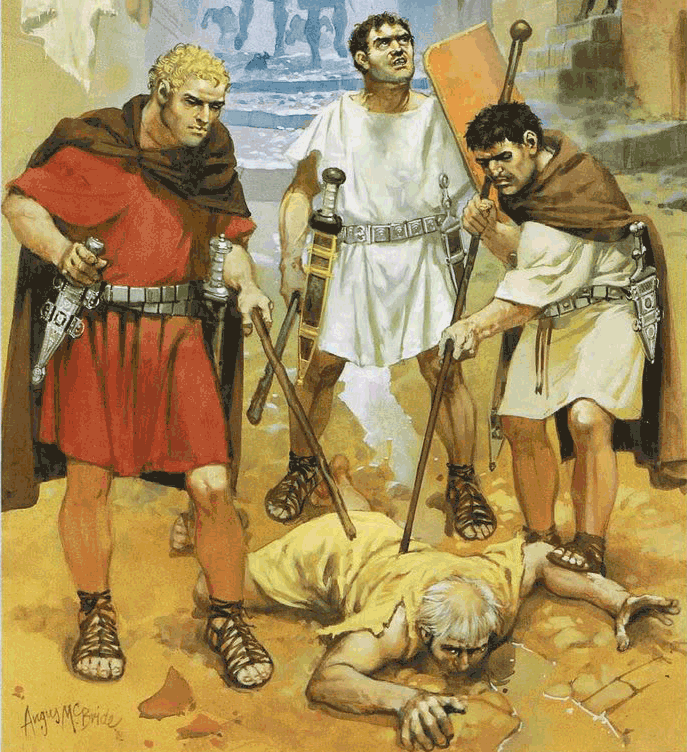
The Fustuarium (Clubbing): Reserved for offenses that threatened the safety of the unit (such as sleeping on watch or stealing), this was a communal execution. The culprit was stripped, and his fellow soldiers were required to beat him to death with clubs. This forced the unit to participate in the enforcement of discipline, ensuring that no individual felt empowered to break the rules at the expense of his peers.
Decimation: While rare, this was the nuclear option. If a unit fled in battle, they could be divided into groups of ten. Lots were drawn, and the "lucky" man who drew the shortest straw was executed by his nine companions. It was a brutal psychological tool designed to make the fear of one's own unit greater than the fear of the enemy.
III. The Praemium: The "Golden Handcuffs" of Retirement
The transition to a professional, long-term army was solidified by the creation of the aerarium militare by Augustus. This pension fund removed the reliance on generals to provide land for their troops—a practice that had historically caused the devastating civil wars of the late Republic.
The 25-Year Threshold: The service was grueling. Upon completion of 20 years of active duty and 5 years in the reserves (evocati), a soldier was granted an honesta missio (honorable discharge).
The Pension: The payout—roughly 12,000 sesterces—was enough to purchase a small farm in a colonia (a veterans' settlement). This turned former soldiers into a conservative, stable class of landowners who were personally invested in the continued peace and prosperity of the Empire.
Citizenship as Social Currency: Perhaps the most profound benefit was for those in the auxilia. Auxiliaries were often recruited from non-citizen tribes. After 25 years, the soldier, his wife, and his children were granted full Roman citizenship. This effectively turned the military into an engine of Romanization, pulling entire families out of "barbarian" status and into the Roman legal and social fold.
This system created a powerful feedback loop: soldiers were well-paid and well-pensioned to ensure loyalty, and they were disciplined with such extreme severity that they remained perfectly focused on their duties. The legionary was, in effect, a cog in a machine that offered him more social and economic security than he could have ever hoped to achieve as a simple civilian.