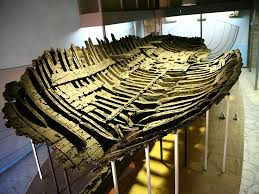
The Kyrenia Ship, a Hellenistic merchant vessel that sank off the coast of Cyprus around 285–272 BCE, stands as one of the most important archaeological discoveries for understanding the ancient Mediterranean trade economy. Discovered by diver Andreas Cariolou in 1965 and excavated by Michael and Susan Katzev from 1968 to 1969, the ship provides a remarkably well-preserved snapshot of maritime commerce during the era of Alexander the Great’s successors.
I. The "Amphora Trade"
The ship’s primary cargo consisted of approximately 380–400 transport amphorae. These jars were the "shipping containers" of the ancient world, and their presence on the Kyrenia ship maps an extensive trade network:
Regional Origins: The majority of the amphorae originated from the island of Rhodes, with others sourced from ports across the Eastern Mediterranean, including Samos, Kos, Knidos, Cyprus, and even as far as Palestine and Egypt.
Commodities: While many of the jars were found empty, archaeological analysis identified residues and contents such as wine, olive oil, and almonds. The presence of over 10,000 intact almonds suggests that the ship was likely participating in a diverse "bulk" trade, carrying various agricultural surpluses between major ports.
II. Beyond the Wine: A Diverse Cargo
The Kyrenia ship was not just a wine transporter; it functioned as a general-purpose freighter. Other notable items recovered from the hold include:
Ballast and Tools: The ship carried 27–29 stone grain millstones stacked in three rows over the keel, serving the dual purpose of ballast and valuable trade goods.
Industrial Goods: Archaeologists found iron billets (blooms), which were raw materials for blacksmiths.
Daily Life and Rigging: Excavations uncovered lead fishing net weights, cooking pots, ladles, and dining sets (black-glazed plates and cups). The distribution of these items in two distinct "cabin" areas (fore and aft) led researchers to conclude the ship likely carried a small, four-man crew who lived and worked on board for extended voyages.
III. Technological Significance
The ship’s construction itself is a treasure trove of nautical history:
Lead Sheathing: The vessel’s outer hull was covered in thin lead sheets affixed with copper tacks. This is the earliest known instance of using "hull armor" to protect wood from shipworms and marine borers—a clear sign that the ship was a high-value asset intended for long-term use.
"Shell-First" Construction: It was built using the ancient carvel method, where the outer hull planking was assembled before the internal ribs were inserted.
The "Piracy" Theory: Despite early theories of natural sinking, the discovery of bent iron spearheads embedded in the ship’s timber and the notable absence of personal valuables (other than a few coins) suggest the vessel may have been hunted down and sunk by pirates, a common threat to merchant ships of the period.
The Kyrenia ship remains a testament to the sophistication of Hellenistic maritime logistics, revealing a highly connected world where commodities like wine, grain, and nuts were moved across vast distances by specialized vessels built to withstand the rigors of the open sea.