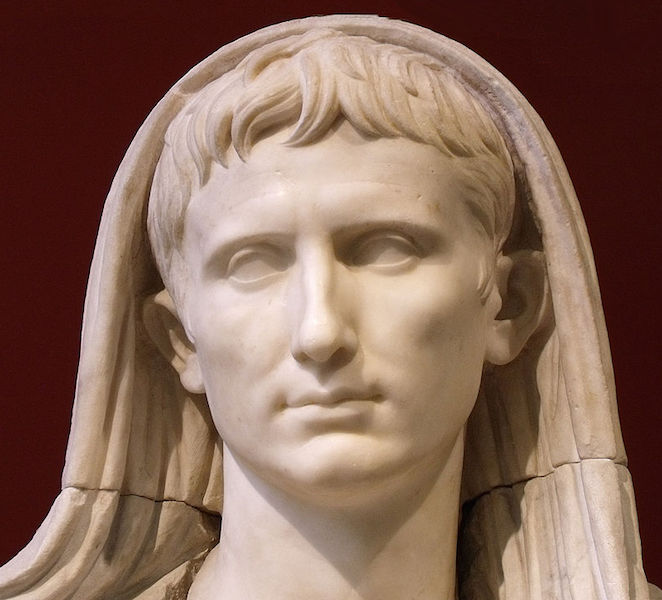
Declared by the Roman Senate as Optimus Princeps ("The Best Ruler"), Emperor Trajan (reigned 98–117 CE) ushered in the absolute zenith of the Roman Empire's wealth, territorial size, and architectural ambition.
To celebrate his definitive conquest of Dacia (modern-day Romania)—a victory that flooded Rome with hundreds of thousands of pounds of gold and silver—Trajan commissioned a monumental construction project that permanently altered the heart of the imperial capital: Trajan's Forum and its crowning jewel, Trajan's Column.
1. Engineering the Impossible: Trajan's Forum
Before a single stone could be laid, Trajan and his brilliant chief architect, Apollodorus of Damascus, faced a massive geographical obstacle. The valley between the Capitoline and Quirinal hills was far too cramped for the grand complex the Emperor envisioned.
Apollodorus executed a breathtaking engineering feat: he ordered his workforce to cut away the bedrock of the Quirinal hill itself.
Laborers excavated an estimated 850,000 cubic meters of earth and stone, leveling a ridge that was as tall as a 10-story building. On this newly created, massive flat plain, Apollodorus constructed the largest and most lavish of all the Imperial Fora, featuring:
The Tripartite Entry: Visitors entered through a colossal triumphal arch into a vast, colonnaded open piazza paved in white marble, centered around a massive bronze equestrian statue of Trajan.
The Basilica Ulpia: Instead of a traditional temple dominating the main square, the space was anchored by a colossal civic basilica. Named after Trajan's family (Ulpius), this structure featured a grand hall flanked by double rows of marble columns and a ceiling lined with gilded bronze tiles, serving as Rome's supreme court of law and administrative hub.
2. Trajan's Column: The Narrative Masterpiece
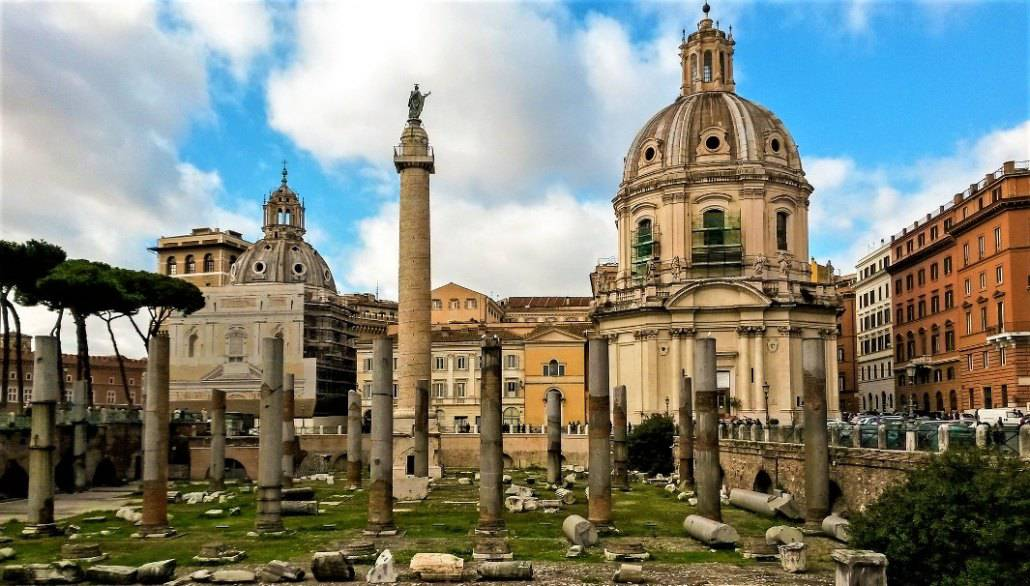
Standing directly behind the Basilica Ulpia, flanked by two libraries (one for Greek texts, one for Latin), rose Trajan's Column. Completed in 113 CE, this freestanding monument is one of the most innovative and perfectly preserved works of art from antiquity.
The Dimension of the Ridge
The column stands exactly 100 Roman feet (29.7 meters) tall, or roughly 35 meters including its large pedestal base. This height was not arbitrary; an inscription on the base explicitly notes that the column was built to show the viewer exactly how deep the Quirinal hill had been excavated to make room for the Forum.
The Marvel of Engineering
The monument is constructed from 20 colossal drums of Carrara marble, each weighing around 32 tons. The blocks were carved out internally before being stacked on top of one another with pinpoint precision to create a tight, hollow core. Inside this core sits a perfectly functional, dark spiral staircase of 185 steps, lit by 43 narrow slit windows cut into the marble exterior, leading straight to a viewing platform at the top.
3. The Continuous Frieze: A Stone Movie Reel
The exterior of the column is wrapped in a 225-meter-long continuous bas-relief frieze that winds upward around the shaft 23 times, like an unrolled scroll. The narrative contains over 2,500 individual carved human figures, charting a chronological account of Trajan’s two military campaigns against the Dacians.
To counteract optical illusion and make the narrative legible to a viewer standing on the ground, Apollodorus used perspective scaling. The band of the frieze is narrowest at the bottom (about 3 feet tall) and gradually widens as it reaches the top (over 4 feet tall), ensuring the higher figures do not appear smaller to an observer looking up from the forum floor.
What the Reliefs Reveal
Rather than just focusing on monotonous violence and bloodshed, the frieze acts as an incredibly detailed archaeological record of the Roman army's daily logistics.
The Work of War: Only a small percentage of the scenes depict actual hand-to-hand combat. Instead, the carvings focus heavily on the Roman engineering machine: soldiers clearing forests, digging trenches, building stone forts (castra), constructing roads, and building a legendary wooden bridge across the Danube River.
The Emperor's Role: Trajan appears 59 times throughout the narrative. He is consistently depicted not as a mythical god-warrior charging blindly into battle, but as a rational, highly organized commander addressing his troops (adlocutio), consulting with his generals, and overseeing religious sacrifices.
4. The Shift in Funerary Law
Beyond its roles as a victory monument and an engineering marker, Trajan's Column served a highly radical, unprecedented legal function: it was a tomb.
Under ancient Roman law (the Twelve Tables), burials were strictly forbidden within the sacred inner boundary of the city (the Pomerium) to prevent spiritual pollution. However, the Senate made a historic exception for Trajan due to his unparalleled achievements.
When Trajan died in 117 CE while campaigning in the East, his body was cremated, and his golden ashes were transported back to Rome. They were placed in a secure burial vault directly inside the hollow square pedestal base of the column. A bronze statue of Trajan was mounted at the absolute peak of the monument (later replaced by Saint Peter in 1587), allowing the Emperor to stand permanently above his forum, watching over the city he had built and redefined.
5. Trajan's Markets: The Retaining Wall
To prevent the raw earth of the freshly cut Quirinal Hill from collapsing into the new forum, Apollodorus built Trajan's Markets directly against the cliffside.
This multi-level, semi-circular complex was a structural masterpiece constructed from brick-faced concrete. While it functioned as a vibrant commercial mall housing over 150 individual shops (tabernae) and administrative offices, its primary engineering job was to act as a colossal, vaulted retaining wall holding back the hillside, proving that Roman architecture was always a perfect marriage of utilitarian safety and majestic luxury.
Through this cohesive urban plan, Trajan didn't just build a monument to his ego; he created a functional civil space that utilized cutting-edge geometry, engineering, and narrative art to concrete Rome’s image as the undisputed center of the civilized world.