In the Western Cape of South Africa, the rock shelter of Diepkloof has revealed one of the world's oldest, most expansive, and continuous traditions of graphic communication. Associated with the Howiesons Poort lithic industry dating back between 55,000 and 65,000 years ago, excavations recovered thousands of fragments of thick, mineralized ostrich eggshells (Struthio camelus).
Crucially, these fragments were not kitchen waste; they were the shattered remains of a highly standardized system of engraved storage canteens.
                        [ THE HOWIESON'S POORT SYSTEM ]
                                       │
         ┌─────────────────────────────┴─────────────────────────────┐
         ▼                                                           ▼
 [ MATERIAL HARDWARE ]                                      [ ABSTRACT SOFTWARE ]
 * Heavy, high-volume ostrich shells                       * Strict, repetitive line engraving
 * Drill-perforated pour spouts                            * Highly distinct sub-group motifs
 * Friction-fit organic wax plugs                          * Markers of identity or territorial mapping
The Canteen Hardware
An ostrich eggshell is a masterpiece of natural engineering—lightweight, exceptionally strong, and capable of holding roughly one liter ($1\text{ L}$) of fluid. The humans of Diepkloof systematically drilled small, clean circular holes into the apex of the eggs, hollowed out the organic contents, and used them as portable water canteens.
This technology was an absolute ecological game-changer, allowing hunter-gatherers to store water and cross the arid, unforgiving interior landscapes of the South African veld during severe seasonal droughts.
The Graphic Encoding System
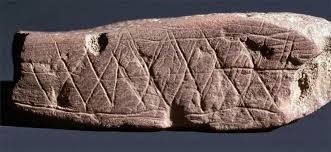
What elevates the Diepkloof eggshells to world heritage status is that over 400 individual fragments feature intricate, highly formalized engraved geometric motifs. These engravings were executed using sharp, heated flint tools directly onto the glossy outer enamel of the shells.
The engravings follow a strict, repetitive set of cultural rules:
The Hatching Motif: The most dominant motif consists of a long, central longitudinal line intersected at near-right angles by dozens of short, evenly spaced parallel cross-lines, resembling a tiny ladder or railway track.
The Chevron Motif: Other chronological layers display bands of parallel slightly curved lines or nested chevrons.
Because these exact motifs repeat identically across thousands of years of sediment accumulation at the site, they represent a true graphic communication system.
Anthropologists hypothesize that these patterns were not simple doodles; they were markers of social property, corporate identity, or landscape mapping. A specific band or lineage likely owned a distinct geometric pattern, stamping their canteens to declare ownership of the vital water contents or to map out specific water networks across the landscape, providing an ancient precursor to modern flags, brands, and heraldic crests.