• MAIN PAGE
  • LATEST NEWS
    • Lost Cities
    • Archaeology's Greatest Finds
    • Underwater Discoveries
    • Greatest Inventions
    • Studies
    • Blog
  • PHILOSOPHY
  • HISTORY
  • RELIGIONS
    • Africa
    • Anatolia
    • Arabian Peninsula
    • Balkan Region
    • China - East Asia
    • Europe
    • Eurasian Steppe
    • Levant
    • Mesopotamia
    • Oceania - SE Asia
    • Pre-Columbian Civilizations of America
    • Iranian Plateau - Central Asia
    • Indus Valley - South Asia
    • Japan
    • The Archaeologist Editor Group
    • Scientific Studies
    • Aegean Prehistory
    • Historical Period
    • Byzantine Middle Ages
    • Predynastic Period
    • Dynastic Period
    • Greco-Roman Egypt
  • Rome
  • PALEONTOLOGY
  • About us
Menu

The Archaeologist

  • MAIN PAGE
  • LATEST NEWS
  • DISCOVERIES
    • Lost Cities
    • Archaeology's Greatest Finds
    • Underwater Discoveries
    • Greatest Inventions
    • Studies
    • Blog
  • PHILOSOPHY
  • HISTORY
  • RELIGIONS
  • World Civilizations
    • Africa
    • Anatolia
    • Arabian Peninsula
    • Balkan Region
    • China - East Asia
    • Europe
    • Eurasian Steppe
    • Levant
    • Mesopotamia
    • Oceania - SE Asia
    • Pre-Columbian Civilizations of America
    • Iranian Plateau - Central Asia
    • Indus Valley - South Asia
    • Japan
    • The Archaeologist Editor Group
    • Scientific Studies
  • GREECE
    • Aegean Prehistory
    • Historical Period
    • Byzantine Middle Ages
  • Egypt
    • Predynastic Period
    • Dynastic Period
    • Greco-Roman Egypt
  • Rome
  • PALEONTOLOGY
  • About us
No results found

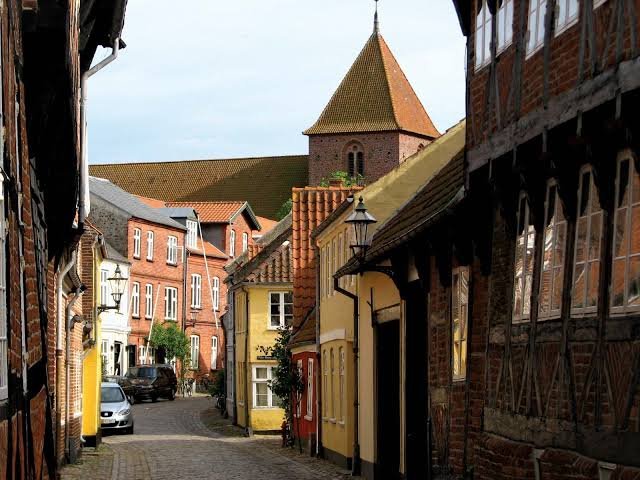
Ribe: Denmark's 8th-Century Trading Post

September 14, 2026

Introduction

Ribe is one of the earliest and most significant urban settlements in Scandinavia.

Founded during the early eighth century in southwestern Denmark, Ribe developed into a major center of commerce, craftsmanship, and cultural exchange.

Its importance is particularly significant because it emerged before the conventional beginning of the Viking Age in 793.

Ribe therefore demonstrates that the commercial and technological foundations of the Viking world existed before the famous raids associated with Viking history.

The Birth of a Trading Center

Ribe was established near the River Ribe and close to the North Sea.

The location provided access to maritime transportation while also connecting the settlement to inland communities.

Its position made it suitable for trade between Scandinavia and western Europe.

Merchants could bring goods to Ribe, exchange them, and continue onward through regional networks.

Early Urban Development

Ribe was not initially a large city.

It began as a specialized marketplace.

Temporary market stalls and workshops gradually developed into a more permanent settlement.

This process represents one of the earliest examples of Scandinavian urbanization.

Archaeological Discoveries

Ribe has produced an extraordinary archaeological record.

Excavations have uncovered:

  • coins;

  • beads;

  • imported ceramics;

  • glass;

  • bronze objects;

  • iron tools;

  • animal bones;

  • textile equipment;

  • craft debris;

  • building remains.

Because some occupation layers preserved organic materials unusually well, archaeologists have been able to reconstruct many aspects of daily life.

International Trade

Ribe was connected to a broad trading network.

Merchants interacted with communities from the North Sea and continental Europe.

Objects from distant regions demonstrate that Ribe's inhabitants were not economically isolated.

The exchange of goods also meant the exchange of ideas, technologies, artistic traditions, and religious practices.

Beadmaking

One of Ribe's most famous archaeological signatures is evidence for bead production.

Glass was melted and shaped into colorful beads.

The presence of manufacturing debris demonstrates that beads were not simply imported finished products.

Specialized craftspeople produced them locally.

Metalworking

Metalworkers also operated at Ribe.

Iron and non-ferrous metals could be transformed into tools, ornaments, fittings, and other objects.

Metalworking required specialized knowledge and access to fuel and raw materials.

Its presence indicates a sophisticated craft economy.

Coins and Commerce

Coins provide another important source of information.

Early Scandinavian trade did not depend entirely on coins.

Silver could be weighed and exchanged.

Nevertheless, coins from different regions demonstrate contact with foreign economic systems.

Weights and scales allowed merchants to conduct transactions efficiently.

Daily Life

Ribe was populated by people from many social backgrounds.

Merchants and craftspeople interacted with farmers, sailors, laborers, and political authorities.

The archaeological record reveals household activities, food consumption, manufacturing, clothing, and personal adornment.

This makes Ribe one of the best places to study ordinary life in early medieval Scandinavia.

Ribe and the Viking Age

Ribe's early foundation changes how the Viking Age should be understood.

The Viking Age did not suddenly begin when Scandinavian warriors attacked monasteries.

Long-distance trade, shipbuilding, specialized craftsmanship, and political organization were already developing.

Ribe represents part of this earlier transformation.

Christianity

Christianity eventually became increasingly important in Ribe.

The establishment of ecclesiastical institutions reflected the broader Christianization of Denmark.

Religious transformation affected burial practices, architecture, artistic styles, and political organization.

Urban Continuity

Unlike many Viking Age settlements that disappeared, Ribe continued developing through the medieval period.

This continuity makes it especially valuable.

Archaeologists can compare earlier Viking-period activity with later medieval urban development.

Conclusion

Ribe was one of Scandinavia's earliest trading towns and an important precursor to the mature Viking Age commercial world.

Its archaeological evidence reveals long-distance trade, specialized crafts, monetary exchange, international contacts, and emerging urban life.

Ribe reminds us that the Viking Age was not simply an age of raiding.

It was also an age of commerce and innovation.

The marketplace established at Ribe helped create the economic environment in which later Viking expansion became possible.
Hedeby: Denmark-Germany's Viking Empor

September 14, 2026

Introduction

Hedeby was one of the most important trading centers of the Viking Age and one of the greatest archaeological sites associated with early medieval northern Europe.

Located near the southern edge of the Jutland Peninsula, close to the modern German-Danish border, Hedeby occupied an exceptionally strategic position.

Its location connected the North Sea with the Baltic Sea through the narrow land and water corridors of Schleswig.

This geography transformed Hedeby into a commercial gateway between Scandinavia, continental Europe, the North Atlantic, and the eastern Baltic.

A Strategic Location

Hedeby's success was fundamentally geographical.

The settlement stood near the Schlei inlet, which provided access to the Baltic.

At the same time, travelers could cross relatively short distances overland to reach waterways leading toward the North Sea.

This meant merchants could avoid dangerous open-sea voyages around Jutland.

The settlement consequently became a natural transfer point between different maritime systems.

Foundation and Growth

Hedeby emerged during the eighth century and expanded significantly during the following centuries.

Its development corresponded with the growing importance of long-distance trade.

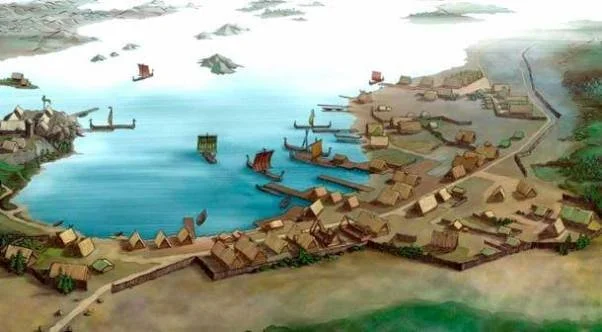
The settlement eventually contained houses, workshops, streets, landing facilities, and defensive structures.

Thousands of people may have participated in its economic life over the course of its occupation.

International Commerce

Hedeby's archaeological record demonstrates an enormous geographic range of connections.

Goods came from:

  • Scandinavia;

  • the Frankish world;

  • the British Isles;

  • the Baltic;

  • eastern Europe;

  • the North Atlantic;

  • regions farther south.

Merchants could exchange furs, amber, textiles, metals, weapons, food products, ceramics, glass, and luxury goods.

The settlement functioned as an international marketplace.

The Port

Water transportation was central to Hedeby.

Ships could bring cargo directly to the settlement.

Archaeological evidence indicates extensive maritime activity.

The harbor would have been filled with vessels during periods of commercial activity, bringing merchants and sailors from different regions.

The port was therefore not merely an economic facility but a point of cultural contact.

Craftspeople

Hedeby supported many specialized crafts.

Archaeologists have discovered evidence of:

  • metalworking;

  • bone carving;

  • antler working;

  • glass production;

  • beadmaking;

  • textile production;

  • leatherworking;

  • woodworking.

Craft specialization demonstrates that the settlement possessed a complex economy.

Houses and Urban Structure

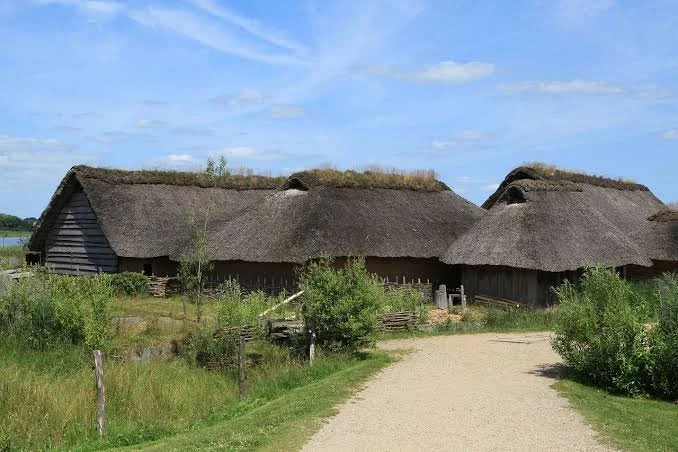
Hedeby's houses were typically constructed from timber and other organic materials.

Because wood, leather, textiles, and food waste were preserved in certain archaeological layers, excavations provide remarkable information about everyday life.

The settlement included organized streets and densely occupied areas.

This degree of spatial organization demonstrates that Hedeby was substantially more urban than ordinary Viking Age rural settlements.

Defensive Earthworks

Hedeby was protected by substantial defensive structures.

The settlement became connected with the Danevirke defensive system, which controlled movement across southern Jutland.

These fortifications demonstrate the political significance of the region.

Trade and defense were closely connected.

A ruler who controlled Hedeby could potentially influence the movement of wealth across northern Europe.

Religious Change

Hedeby existed during the transition from traditional Norse religion to Christianity.

Pagan beliefs remained important for much of its history.

Later, Christianity became increasingly prominent.

The archaeological record reflects this transformation through burial practices, religious objects, and the eventual establishment of Christian institutions.

Hedeby therefore provides an unusually valuable setting for studying religious change.

Coinage

Coins were essential to Hedeby's commercial system.

Both local and foreign coins have been discovered.

Arabic dirhams and coins from western Europe demonstrate the enormous geographic range of trade networks.

Silver could also circulate as bullion.

Weights and scales allowed merchants to conduct transactions based on precious-metal weight.

Everyday Life

Despite its international significance, Hedeby was also a place where ordinary people lived.

Archaeologists can study diet, housing, clothing, tools, household activities, and crafts.

Animal bones reveal aspects of food consumption.

Objects such as combs, needles, knives, beads, and household implements provide insight into personal and domestic life.

Political Importance

Control of Hedeby meant control over a major economic resource.

Danish rulers and regional political powers therefore had strong incentives to protect and influence the settlement.

Hedeby's importance illustrates a central principle of Viking Age politics: economic power and political power were closely connected.

Decline

Hedeby eventually declined during the eleventh century.

Changes in political geography, commercial routes, and competing settlements contributed to its loss of importance.

Nearby Schleswig eventually developed as a successor urban center.

The abandonment of Hedeby, however, preserved archaeological layers that later became extraordinarily valuable to researchers.

Archaeological Significance

Hedeby is important because it captures a critical period in European history.

It demonstrates how Scandinavian societies became integrated into international trade networks.

It also reveals the diversity of Viking Age communities.

The archaeological record contains evidence for people, objects, technologies, and ideas moving across enormous distances.

Conclusion

Hedeby was much more than a Viking marketplace.

It was an international port, craft center, political asset, cultural meeting point, and gateway between northern and continental Europe.

Its strategic geography allowed merchants to connect the Baltic and North Sea worlds, while its defensive structures demonstrate the political importance of controlling commerce.

Today, Hedeby remains one of the most important archaeological windows into Viking Age urban life.

Its remains reveal a world that was remarkably mobile, commercially sophisticated, culturally diverse, and deeply connected to the wider medieval world.

Kaupang: Norway's Early Viking Trading Town

September 14, 2026

Introduction

Kaupang occupies a special place in the archaeology of the Viking Age because it represents one of Scandinavia's earliest urban trading settlements. Located in present-day Vestfold in southeastern Norway, the site developed during the late eighth century and became an important center for commerce, craft production, maritime activity, and cultural exchange.

The name Kaupang is itself revealing. It is related to Old Norse terms associated with buying, selling, and marketplaces, reflecting the settlement's commercial character. Rather than being simply a farming village, Kaupang was part of a wider network connecting Scandinavia with the North Sea, the Baltic, and regions farther east.

Its importance becomes particularly clear when Kaupang is compared with other Viking Age commercial centers such as Ribe, Hedeby, Birka, and later trading towns. Archaeological excavations have uncovered evidence of imported objects, manufacturing, coinage, weights, metalworking, glassworking, textiles, and maritime commerce.

Kaupang therefore provides an extraordinary opportunity to study how Scandinavian society began developing more complex economic centers during the transition into the Viking Age.

Geographic Setting

Kaupang was situated near the western side of the Oslo Fjord system.

Its location was strategically valuable because waterways were the principal transportation routes of Viking Age Scandinavia. Ships could move people and goods considerably more efficiently than overland transportation.

The surrounding landscape also provided agricultural resources, timber, pasture, and access to maritime resources.

Most importantly, Kaupang's position allowed it to participate in regional and international maritime networks.

The Founding of Kaupang

Archaeological evidence indicates that Kaupang was established around the late eighth century, approximately contemporary with the beginning of the Viking Age.

Its emergence was not an isolated event.

Across Scandinavia and the wider North Sea world, new commercial settlements were developing. These locations brought together merchants, craftspeople, sailors, farmers, political authorities, and travelers.

Kaupang appears to have been established as part of this broader transformation.

The settlement did not necessarily resemble a modern city. Instead, it consisted of workshops, houses, activity areas, storage spaces, paths, landing places, and commercial zones.

Archaeological Excavation

Modern archaeological investigation at Kaupang has revealed an exceptionally rich collection of evidence.

Excavators have recovered:

  • glass beads;

  • imported ceramics;

  • coins;

  • weights;

  • iron objects;

  • bronze ornaments;

  • textile equipment;

  • animal bones;

  • metalworking debris;

  • evidence of craft production;

  • fragments of imported materials.

The distribution of these discoveries allows archaeologists to reconstruct different activities within the settlement.

Some areas appear to have been associated with craft production, while others were residential or commercial.

Craft Production

Kaupang was not merely a place where imported goods were exchanged.

Craftsmanship was one of its defining characteristics.

Evidence indicates production of objects including jewelry, tools, textiles, and other manufactured goods.

Metalworkers transformed raw materials into finished objects, while beadmakers and other craftspeople produced decorative items.

Textile production was also important.

Spinning and weaving were essential Scandinavian industries, and archaeological discoveries of spindle whorls and other textile equipment demonstrate that domestic and specialized production occurred within the settlement.

International Trade

Perhaps the most significant aspect of Kaupang is the evidence for international commerce.

Objects originating from distant regions demonstrate that people living or trading at Kaupang were connected to networks extending far beyond Norway.

The Viking Age was characterized by extensive movement of goods through maritime routes.

Products could travel from the British Isles and continental Europe into Scandinavia and onward toward the Baltic and eastern European river systems.

Luxury goods, raw materials, ornaments, coins, and everyday commodities all participated in these networks.

Kaupang therefore functioned as a meeting point between different economic and cultural systems.

Coinage and Weights

Trade required mechanisms for measuring value.

Archaeological discoveries of weights and scales demonstrate that merchants at Kaupang engaged in transactions involving measured quantities of precious metals and commodities.

Unlike modern economies, Viking Age commerce did not rely exclusively on standardized coinage.

Silver could be weighed and exchanged according to its mass.

Coins could be used as bullion rather than simply as currency.

This system required specialized weights and careful measurement.

The presence of such equipment provides evidence of sophisticated commercial practices.

Ships and Maritime Activity

Kaupang's economic success depended heavily on ships.

Viking Age vessels served simultaneously as transportation systems, trading platforms, military machines, and symbols of political power.

Merchants could transport cargoes across enormous distances.

The settlement's location near navigable waterways made maritime access fundamental to its existence.

Ships also brought people.

Foreign merchants, travelers, craftspeople, and settlers contributed to the cultural diversity of Viking Age commercial centers.

Cultural Diversity

The archaeological evidence from Kaupang suggests that the settlement was more cosmopolitan than a typical rural Scandinavian community.

Imported objects reveal contact with different cultural regions.

Such contact could involve trade, migration, marriage, political alliances, warfare, or religious exchange.

The Viking world was therefore not culturally isolated.

Kaupang demonstrates that Scandinavian communities were integrated into international networks centuries before the development of modern nation-states.

Religion and Belief

Although Kaupang was fundamentally commercial, religion remained embedded in Viking society.

Merchants and craftspeople operated within a world shaped by Norse religious beliefs.

Amulets, symbolic objects, burial practices, and artistic motifs can provide evidence for religious traditions.

At the same time, contact with Christian Europe meant that Christian objects could also reach Scandinavian trading centers.

Kaupang thus existed during a period when Scandinavian religious culture was beginning to encounter increasingly strong Christian influence.

Social Organization

A trading settlement required cooperation between people with different occupations.

Farmers provided food.

Craftspeople manufactured objects.

Merchants organized trade.

Sailors transported goods.

Political authorities provided protection and controlled access to resources.

This created a complex social environment.

Kaupang demonstrates that Viking Age society cannot be understood solely through rural farms or warrior elites. Commercial communities were becoming increasingly important.

Kaupang and Urbanization

Kaupang is sometimes described as an early town, but Viking Age urbanization was different from modern urban development.

The settlement was relatively small by modern standards.

Its importance came from the concentration of people, economic activity, craft production, and long-distance trade.

This represented a major transformation in Scandinavian economic organization.

Instead of every community producing nearly everything it needed, specialized centers could facilitate exchange.

Decline

Kaupang did not remain permanently dominant.

By the tenth century, its importance had declined.

The reasons were probably complex.

Changes in trade routes, political organization, economic centers, and regional power structures could all influence the fortunes of a settlement.

The rise of other Scandinavian centers eventually reduced Kaupang's commercial importance.

Yet its decline does not diminish its historical significance.

Archaeological Importance

Kaupang provides direct evidence for the emergence of early Scandinavian commercial society.

It demonstrates:

  • long-distance trade;

  • specialized craftsmanship;

  • maritime transportation;

  • monetized exchange;

  • cultural interaction;

  • social specialization;

  • early urban development.

The site is particularly valuable because archaeological evidence preserves aspects of Viking life that written sources rarely describe.

Conclusion

Kaupang was one of the earliest major trading settlements in Norway and an important participant in the international networks of the Viking Age.

Its workshops, imported objects, weights, coins, and maritime connections reveal a society undergoing profound economic transformation.

The settlement shows that Viking Age Scandinavia was not merely a world of isolated farms and raiding warriors.

It was also a world of merchants, artisans, sailors, marketplaces, international exchange, and increasingly complex communities.

Kaupang therefore represents an essential stage in the development of Scandinavian urbanism and commerce—a place where the emerging Viking economy connected Norway to the wider medieval world.

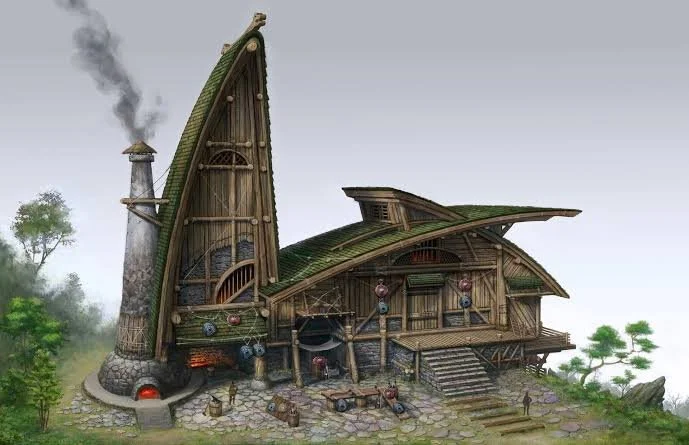
Skeie: Norway's Viking Smithy

September 14, 2026

Introduction

Skeie provides an important window into one of the least glamorous but most essential aspects of Viking society: craft production.

The popular image of the Viking Age often focuses on ships, warriors, kings, and dramatic raids. Yet none of these activities could have existed without skilled craftspeople.

Blacksmiths produced weapons, tools, fittings, agricultural equipment, nails, rivets, and countless other objects essential to everyday life.

A Viking smithy therefore represents much more than a workshop. It was a technological center where raw materials were transformed into objects that supported warfare, agriculture, transportation, construction, and trade.

The Importance of Iron

Iron was one of the most important materials in Viking Age Scandinavia.

Unlike stone or wood, iron could be reshaped repeatedly through heating and hammering.

This made it ideal for producing durable tools and weapons.

However, iron production was labor-intensive.

Ore had to be extracted, processed, smelted, and refined before a blacksmith could turn it into usable metal.

The Viking Blacksmith

A skilled smith possessed specialized knowledge.

The craftsman needed to understand:

  • furnace temperatures;

  • iron behavior;

  • carbon content;

  • hammering techniques;

  • welding;

  • quenching;

  • sharpening;

  • tool maintenance.

These skills could not simply be learned from written instructions.

Much of the knowledge was practical and transmitted through apprenticeship.

The Smithy Environment

A smithy required controlled heat.

The furnace or forge had to reach temperatures high enough to make metal workable.

Bellows increased airflow and allowed the smith to regulate the fire.

Anvil surfaces provided the hard platform needed for hammering.

The workshop would also require hammers, tongs, chisels, files, and other tools.

Weapons Production

Blacksmiths produced essential military equipment.

Spearheads were relatively common.

Axes could serve both agricultural and military functions.

Knives were universal tools.

Swords were more complicated and expensive.

A high-quality sword required advanced metallurgy and considerable labor.

Shipbuilding

The smithy was also essential to maritime technology.

Ships required numerous iron components.

Rivets held planks together.

Nails and fasteners were required for structural elements.

Other fittings supported rigging and equipment.

Without blacksmiths, Scandinavian shipbuilding could not have reached the scale represented by Viking Age archaeological discoveries.

Agriculture

Iron technology was equally important to farming.

Agricultural communities needed durable tools.

Iron sickles, knives, axes, and other implements increased productivity and reduced the limitations imposed by wooden or stone tools.

This means that the smith indirectly supported food production.

The Economics of Craftsmanship

A skilled smith represented valuable human capital.

Smithing required training, tools, fuel, and access to raw materials.

Elite communities may have supported specialist craftsmen directly.

In other cases, smiths could have operated independently or moved between settlements.

The presence of a smithy therefore provides evidence for economic specialization.

Trade and Exchange

Metalworking also connected communities.

Iron ore was not equally accessible everywhere.

Finished metal objects could therefore circulate through trade and exchange.

Smiths might obtain raw materials through local production or imported supplies.

The movement of metal provides archaeologists with clues about regional economic networks.

Archaeological Evidence

Smithies often leave distinctive traces.

These can include:

  • slag;

  • charcoal;

  • furnace remains;

  • hammer scale;

  • metal fragments;

  • damaged tools;

  • hearth structures.

Even when the wooden building itself disappears, these industrial residues can reveal that metalworking occurred at a site.

The Social Status of Smiths

The status of smiths in Viking society is difficult to determine.

Some literary sources portray smiths as highly skilled and sometimes mysterious figures.

Archaeological evidence demonstrates their importance, but not every smith necessarily possessed the same social position.

Some may have been elite specialists.

Others may have served local communities.

Technology and Power

Metalworking was closely connected with political authority.

A leader capable of equipping warriors required access to weapons.

A community capable of producing tools had greater economic resilience.

A society capable of constructing ships depended on both woodworking and metalworking specialists.

Craft production was therefore one of the foundations of Viking power.

Conclusion

Skeie and other Viking Age smithing sites remind us that history was built by more than kings and warriors.

The blacksmith stood behind the technological systems that made Viking society possible.

From sword blades and spearheads to ship rivets and farming tools, forged iron connected warfare, agriculture, transportation, and everyday life.

The remains of a smithy may appear modest compared with a monumental ship burial, but its historical significance is enormous.

Without the controlled fire of the forge, the hammer of the smith, and generations of accumulated metallurgical knowledge, the Viking Age would have looked very different.

Skeie therefore represents the technological workshop behind the Viking world—a place where raw metal became the tools, weapons, and structures upon which medieval Scandinavian society depended.

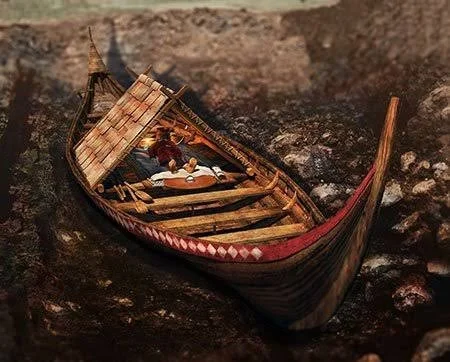
Myklebostad: Norway's Warrior Boat Grave

September 14, 2026

Introduction

Myklebostad represents another important chapter in the archaeological history of Viking Age Norway, particularly in the study of boat burials and warrior identity.

Boat graves provide a unique combination of evidence. They reveal the importance of maritime technology while simultaneously demonstrating how ships could become symbols of social status, military identity, and funerary power.

The archaeological evidence from such burials contributes to our understanding of a society in which warfare and seafaring were deeply interconnected.

The Norwegian Maritime Environment

Norway's geography made boats essential.

Long coastlines, fjords, islands, and mountain barriers encouraged communities to rely on maritime transportation.

Boats allowed people to move between settlements more efficiently than many overland routes.

This geographic reality helps explain why ships became such powerful symbols.

The Boat Grave Tradition

A boat grave differs from an ordinary burial because the vessel itself becomes part of the funerary monument.

The boat might be placed in a pit, surrounded by grave goods, and covered by a mound.

The scale of the vessel could communicate the wealth of the deceased.

Such a burial required resources that ordinary families might not possess.

Warrior Identity

The association of boat graves with weapons has contributed to interpretations of warrior status.

Weapons were important markers of elite identity in Viking Age Scandinavia.

However, as with other graves, archaeological interpretation must consider the symbolic function of objects.

A weapon in a grave demonstrates that the object was considered appropriate or meaningful for the deceased. It does not necessarily provide a complete biography.

Shipbuilding and Warfare

The connection between ships and warfare was practical.

A ship allowed warriors to travel quickly.

Viking vessels could approach shorelines with little warning and could operate in shallow water.

This made them particularly effective for coastal warfare and raiding.

The same technology also supported trade and peaceful transportation.

Social Investment

A large boat required enormous investment.

Timber had to be harvested.

Iron fasteners had to be produced.

Specialists had to shape the hull.

The construction process required coordination among many workers.

The presence of a substantial vessel in a burial therefore indicates significant social resources.

Burial Monuments and Memory

A boat grave could remain visible for generations.

The mound became a physical marker of ancestry.

Communities could use such monuments to remember important individuals and families.

In a society where oral traditions were important, physical monuments provided a durable anchor for collective memory.

Archaeological Interpretation

Modern archaeology attempts to reconstruct these sites using multiple lines of evidence.

Researchers examine:

  • surviving timber;

  • iron fasteners;

  • weapon fragments;

  • animal remains;

  • soil chemistry;

  • mound construction;

  • artifact distribution.

Each category contributes different information.

The Importance of Experimental Archaeology

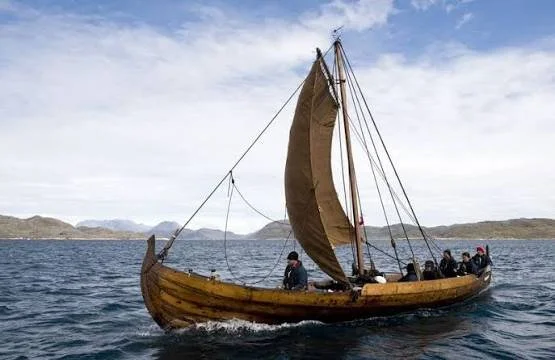
Replicas of Viking ships have demonstrated the practical capabilities of Scandinavian vessels.

Modern reconstructions can be tested in real water.

Researchers can measure speed, maneuverability, stability, and sailing performance.

These experiments help transform archaeological remains into functional technological knowledge.

Conclusion

Myklebostad belongs to the rich tradition of Viking Age boat burials that demonstrate the extraordinary importance of ships in Scandinavian society.

The boat represented more than transportation.

It embodied technological expertise, economic resources, maritime identity, and potentially military power.

When placed within a grave, the vessel became a monument to the deceased and the community capable of constructing it.

The site therefore contributes to a broader understanding of Viking society—one in which the sea was not a barrier but a central environment for travel, trade, warfare, and cultural connection.

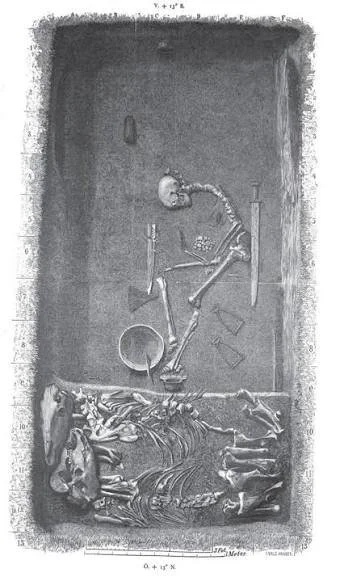
Flagghaugen: Norway's Shield Maiden Grave

September 14, 2026

Introduction

Flagghaugen is associated with the rich archaeological tradition of Viking Age burial monuments in Norway. Its popular interpretation as the grave of a "shield maiden" reflects the enduring fascination with female warriors in Scandinavian history and legend.

However, archaeological interpretation requires care. Terms such as "shield maiden" are modern descriptions influenced by literary traditions and popular culture. The presence of weapons or military equipment in a woman's grave does not automatically prove that she fought as a professional warrior.

Nevertheless, elite female burials containing weapons and other high-status objects provide important evidence that women could possess military symbolism, authority, wealth, or roles that extended beyond conventional domestic activities.

Women in Viking Age Society

Viking Age society was strongly hierarchical and gendered.

Men frequently occupied roles associated with warfare, political leadership, and long-distance raiding.

Women were commonly associated with household management, textile production, family organization, and agricultural responsibilities.

Yet archaeological evidence demonstrates that these categories were not absolute.

Women could own property, inherit wealth, manage estates, and occupy positions of considerable social influence.

Burial as Social Evidence

A grave is not necessarily a simple record of the person's occupation.

Burial rituals are constructed by the living.

Objects placed in a grave may represent the identity of the deceased, their family, their social position, or ideals that the community wished to associate with them.

A weapon might therefore indicate actual military participation, elite status, symbolic authority, or some combination.

The "Shield Maiden" Debate

The term shield maiden comes largely from medieval literary traditions.

Sagas and heroic narratives contain women portrayed as warriors.

However, many of these texts were written down centuries after the Viking Age.

Their descriptions cannot automatically be treated as direct historical records.

Archaeology provides a different kind of evidence.

When weapons appear in women's graves, they establish that weapons could be part of female funerary symbolism.

They do not, by themselves, settle questions about battlefield participation.

Weapons and Identity

Weapons were powerful status symbols.

Swords, shields, spears, axes, and other military equipment represented considerable value.

A grave containing such objects therefore indicates access to wealth.

The symbolic importance of weapons could also extend beyond actual combat.

They could communicate authority, ancestry, social position, or membership in an elite group.

The Broader Viking Burial Tradition

Viking burials varied enormously.

Some individuals received elaborate ship burials.

Others were buried with minimal grave goods.

The differences likely reflect variations in wealth, social status, regional custom, and personal identity.

Flagghaugen belongs to this broader funerary landscape.

Women and Political Authority

Elite women could play important roles in political networks.

Marriage connected families.

Women could manage estates while men were absent.

They could oversee household resources and maintain relationships with neighboring communities.

A high-status burial may therefore reflect social power that cannot be reduced to a single occupational label.

Archaeological Caution

One of the most important lessons from sites such as Flagghaugen is the importance of evidence-based interpretation.

Archaeologists must distinguish:

  1. what the excavation directly demonstrates;

  2. what can reasonably be inferred;

  3. what remains uncertain.

This distinction is especially important when interpreting gender and warfare.

Viking Age Gender Complexity

The Viking Age was not a society in which every individual fit neatly into modern categories.

Identity could involve ancestry, wealth, household position, religious role, political relationships, age, and personal reputation.

Burial objects formed part of the way these identities were communicated.

Conclusion

Flagghaugen's significance extends beyond the popular image of a female Viking warrior.

The site contributes to a much larger discussion about gender, identity, wealth, and power in Viking Age Scandinavia.

Whether the individual associated with the grave actually fought in battle may remain uncertain. What is clearer is that weapons and elite symbols could be incorporated into female funerary contexts, challenging simplistic assumptions about women's roles.

The archaeological record therefore presents a more complicated Viking world—one in which women could possess wealth, authority, and powerful symbols of status, while the precise meaning of those symbols must be interpreted carefully.

Flagghaugen reminds us that the Viking past is most fascinating when archaeological evidence is allowed to reveal complexity rather than being forced into simple heroic categories.

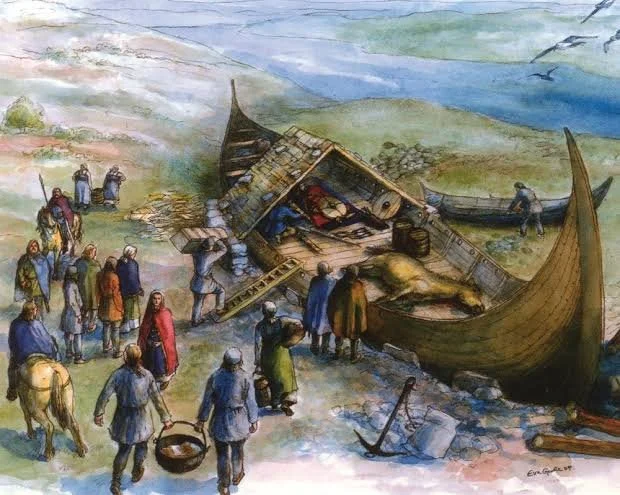
Storhaug: Norway's Double Ship Burial

September 14, 2026

Introduction

Storhaug is one of the remarkable Viking Age burial monuments of Norway, particularly important because archaeological investigation has revealed evidence connected with a ship burial and elite society.

The site belongs to a wider Scandinavian tradition in which ships, burial monuments, and high-status individuals were closely associated.

Ship burials are among the most visually dramatic expressions of Viking Age funerary culture. They required enormous resources and transformed an ordinary means of transportation into a monument to the dead.

The Meaning of a Ship Burial

A ship burial involved placing a vessel within a grave or burial monument.

The practice was not simply a practical method of disposing of a body.

A ship was an expensive technological object.

Constructing one required large quantities of timber, iron, skilled labor, and specialized knowledge.

Consequently, burying a ship demonstrated the resources available to the deceased or their community.

Storhaug in Context

Storhaug should be understood within the broader landscape of Viking Age elite culture in southwestern Norway.

The region contained wealthy farms, maritime routes, burial monuments, and communities involved in regional political networks.

The placement of monumental graves in prominent landscapes could help establish social authority.

The Idea of "Double" Burial

The site's association with multiple vessels or burial episodes has contributed to its distinctive archaeological interpretation.

However, terminology surrounding Viking burials can sometimes oversimplify complex archaeological evidence.

Researchers distinguish between primary burials, later interventions, boat components, and reused monuments.

Such distinctions are important because burial landscapes could remain meaningful for generations.

Ships as Symbols of Authority

Why were ships so powerful as symbols?

Part of the answer lies in their practical importance.

A large ship demonstrated access to resources.

It could transport warriors, merchants, diplomats, or settlers.

It connected communities across the sea.

A ship therefore represented mobility and power.

Placing one in a burial monument transformed that practical power into a permanent memorial.

Viking Maritime Technology

The ships associated with elite burials demonstrate sophisticated construction.

Scandinavian shipwrights used clinker techniques in which overlapping planks created flexible hulls.

The vessels could use both sails and oars.

Their shallow drafts allowed them to approach beaches and navigate coastal waterways.

These characteristics made Viking ships exceptionally versatile.

Burial Goods

Ship burials could include numerous objects.

Weapons might symbolize martial identity.

Tools could represent everyday activities.

Textiles and jewelry could communicate wealth.

Animals might have practical or ritual significance.

Transportation equipment could reinforce elite status.

The combination of objects provides archaeologists with clues about the social identity of the deceased.

Political Landscapes

Burial monuments were often positioned strategically.

A prominent mound could be seen from surrounding settlements or routes.

This visibility allowed the dead to remain part of the social landscape.

Ancestors could become symbols of continuity.

In societies where political legitimacy depended on lineage, monumental burial sites could therefore reinforce claims to authority.

Archaeological Methods

Modern investigation of Viking burial sites increasingly combines excavation with non-invasive methods.

Geophysical survey can detect buried structures.

Soil analysis can identify changes caused by ancient activity.

Scientific dating can establish chronological sequences.

Artifact analysis can reconstruct trade and craft networks.

Together, these methods provide a more complete picture than excavation alone.

Conclusion

Storhaug contributes to our understanding of the relationship between ships, burial, and political power in Viking Age Norway.

Its importance lies not simply in the physical remains but in what they reveal about the society capable of creating such monuments.

A ship required skilled craftsmen, forests, ironworkers, organized labor, and substantial resources. Turning that ship into a burial monument therefore represented a dramatic display of wealth and authority.

Storhaug demonstrates that Viking Age maritime technology was also a language of status. The ship could carry the living across the sea, but in death it could become a monument preserving the memory and power of an elite individual or family.

Borre Mounds: Norway's Viking Royal Cemetery

September 14, 2026

Introduction

The Borre Mounds form one of Norway's most important archaeological landscapes associated with the Viking Age. Located in Vestfold, the site contains a remarkable concentration of monumental burial mounds and other archaeological remains.

Borre is particularly significant because of its connection with elite society and because the site gave its name to the Borre artistic style, one of the major phases of Viking Age Scandinavian art.

The landscape demonstrates that Viking power was expressed not only through ships and weapons but also through monuments, burial rituals, visual symbolism, and control of important places.

The Burial Landscape

The Borre landscape contains numerous burial mounds.

These monuments were deliberately positioned within the landscape and would have been highly visible.

A large burial mound required considerable labor.

Soil and stone had to be moved, the burial prepared, and the monument constructed.

The result was a permanent statement of status.

Elite Burials

The scale of Borre's monuments indicates that high-status individuals were buried here.

Although it is tempting to label the cemetery as a royal burial ground, scholars must distinguish archaeological evidence from later assumptions.

The site clearly reflects elite social organization, but the exact identities and titles of those buried there are not always known.

The monuments nevertheless demonstrate the existence of powerful social hierarchies.

Monumental Architecture and Power

Burial monuments were political statements.

A mound visible across the surrounding landscape could communicate wealth and authority long after the deceased had died.

Monuments also connected the living with their ancestors.

A ruling family could use burial landscapes to establish continuity between generations.

This was particularly important in societies where political legitimacy could depend heavily on ancestry.

The Borre Artistic Style

Borre is famous for the artistic style associated with it.

The Borre style is characterized by highly stylized animal forms, gripping beasts, ribbon-like bodies, and intricate interlacing.

These designs appeared on objects made from:

  • metal;

  • wood;

  • stone;

  • bone.

The style spread widely across Scandinavia and beyond.

What Art Can Tell Us

Artistic styles provide evidence for cultural connections.

When similar motifs appear in distant locations, archaeologists can investigate whether they resulted from direct contact, movement of craftsmen, trade, imitation, or broader cultural influence.

The Borre style therefore provides a way to study Viking Age networks.

The Role of Ships

Viking burial traditions frequently incorporated ships.

Ships represented mobility and status.

Even when a ship was not physically buried, maritime symbolism could remain important.

At elite cemeteries, the association between ships, monuments, and high-status individuals demonstrates how strongly seafaring was connected to political power.

The Wider Vestfold Region

Borre existed within a broader landscape of elite settlements and archaeological sites in Vestfold.

The region contains evidence for farms, burial grounds, craft production, and maritime activity.

This suggests that political power was concentrated within a network rather than confined to a single isolated settlement.

Borre's monumental cemetery was one component of a larger social system.

Ritual and Belief

Viking Age funerary practices varied considerably.

Burials could involve cremation or inhumation, depending on local traditions and social circumstances.

Grave goods might include weapons, jewelry, tools, animals, vehicles, or ships.

These practices provide clues about beliefs concerning death and social identity.

However, archaeologists must be cautious when reconstructing specific religious beliefs from objects alone.

Archaeological Investigation

Modern archaeological techniques have changed our understanding of Borre.

Geophysical surveys, aerial photography, environmental archaeology, and scientific dating methods can reveal features without extensive excavation.

These approaches allow researchers to investigate the broader landscape surrounding the visible mounds.

Heritage and Modern Interpretation

Borre has become an important location for understanding Viking heritage in Norway.

The site's significance extends beyond individual artifacts.

Its value lies in the landscape itself—the relationship between monuments, settlement, geography, and historical memory.

Conclusion

The Borre Mounds represent one of the most impressive Viking Age monumental landscapes in Norway.

They demonstrate how elite Scandinavian communities used burial monuments to communicate status, ancestry, and political power.

The site is equally important because of the artistic tradition that bears its name.

The Borre artistic style provides evidence of cultural connections extending across Viking Age Scandinavia.

Ultimately, Borre shows that Viking power was expressed through more than warfare. It was also expressed through monumental landscapes, artistic traditions, ancestry, ritual, and the ability to mobilize communities for large construction projects.

Tune Ship: Norway's 9th-Century Clinker Boat

September 14, 2026

Introduction

The Tune Ship is one of Norway's earliest major Viking ship discoveries and an important source for understanding Scandinavian clinker-built vessels.

Discovered in a burial mound near Fredrikstad in southeastern Norway, the vessel dates to the 9th century and provides evidence for the technological development of Viking ships.

Although less complete than the famous Gokstad and Oseberg vessels, the Tune Ship remains historically significant because its surviving components reveal the construction principles that allowed Viking ships to become fast, flexible, and seaworthy.

The Viking Clinker Tradition

Clinker construction was a defining feature of Scandinavian shipbuilding.

Planks were arranged so that each plank overlapped the one below it.

These overlaps were secured using fasteners, producing a hull that was both strong and flexible.

The technique allowed shipbuilders to construct relatively light vessels without sacrificing structural integrity.

Why Flexibility Mattered

A completely rigid hull would be vulnerable in rough seas.

Viking ships needed to absorb waves and changing loads.

Clinker construction allowed the hull to flex slightly.

This flexibility contributed to the seaworthiness that became characteristic of Scandinavian vessels.

The Tune Burial

The ship was placed within a burial mound.

As with other Viking ship burials, this represented a significant investment.

A functioning ship was a valuable object.

Removing it from everyday use and placing it in a grave demonstrates the importance of the deceased and the symbolic value of the vessel.

The Vessel's Archaeological Importance

The Tune Ship is particularly valuable because it belongs to an early phase of Viking ship development.

Comparisons between Tune, Oseberg, and Gokstad help researchers understand how Scandinavian ship design evolved.

Differences in hull proportions, construction methods, and structural arrangements demonstrate that Viking ships were not all identical.

They were designed for different purposes.

Sail and Oar

Like other Viking vessels, the Tune Ship belonged to a technological system combining sail and oar propulsion.

Sailing provided efficient movement over longer distances when winds were favorable.

Oars provided control in narrow waterways and during periods of calm.

This dual system allowed ships to operate across varied environments.

Shipbuilding as Specialized Knowledge

Building a ship required more than simply knowing how to work wood.

Shipwrights had to understand:

  • hull proportions;

  • timber grain;

  • plank flexibility;

  • fastening systems;

  • weight distribution;

  • mast support;

  • steering;

  • hydrodynamics.

This knowledge was accumulated through experience.

A shipyard was therefore a center of specialized technological knowledge.

Ships and Social Organization

The construction of a large ship required organized labor.

Trees had to be felled and transported.

Iron fasteners had to be produced.

Wood had to be shaped.

Different components had to fit together precisely.

This required coordination and leadership.

Large ships consequently reveal something about the organizational capacity of Viking communities.

The Maritime Landscape

Southeastern Norway contained extensive waterways and access to the Skagerrak.

This made the region an important area for maritime activity.

Ships could connect inland settlements with coastal communities and wider Scandinavian networks.

The Tune Ship belongs to this interconnected maritime landscape.

The Legacy of the Tune Ship

The Tune vessel is sometimes overshadowed by its better-preserved counterparts.

Yet archaeological importance does not depend entirely on visual completeness.

Even incomplete remains can answer important technological questions.

The Tune Ship contributes to the comparative study of Viking shipbuilding and helps researchers reconstruct the development of Scandinavian maritime engineering.

Conclusion

The Tune Ship is a valuable survivor from the formative period of Viking Age maritime technology.

Its clinker-built hull reflects a construction tradition that combined flexibility, strength, and relatively low weight.

Its burial demonstrates the social and symbolic importance of ships in elite Scandinavian culture.

Although the vessel is less complete than the Oseberg or Gokstad ships, it remains essential to the archaeological record.

Together, these ships reveal that Viking maritime success was not the product of a single revolutionary invention. It was the result of generations of experimentation, craftsmanship, environmental knowledge, and cultural investment in the sea.

Oseberg Ship: Norway's 9th-Century Queen's Grave

September 14, 2026

Introduction

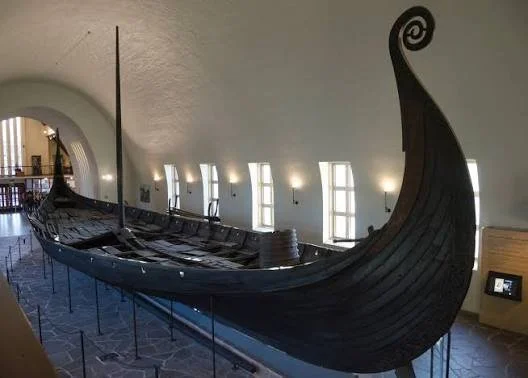
The Oseberg Ship is among the most extraordinary archaeological discoveries of the Viking Age. Excavated from a large burial mound near Tønsberg in Norway, the ship contained the richly furnished burial of two women and an exceptional collection of objects.

Dating to the 9th century, the Oseberg burial provides evidence not only for Viking shipbuilding but also for elite identity, ritual, artistic production, textiles, transportation, and the social roles of women in Viking Age Scandinavia.

The term "queen's grave" is sometimes used to describe the burial, but the precise identities and political positions of the women remain uncertain. Archaeology can demonstrate their high status, but assigning a specific royal title requires caution.

The Oseberg Discovery

The burial mound was excavated in the early twentieth century.

Unlike many Viking graves that had suffered extensive looting, the Oseberg burial contained an extraordinary quantity of surviving material.

The discovery revealed a ship surrounded by grave goods and burial equipment.

The preservation was exceptional because the burial environment protected wooden and organic materials that normally decay.

The Oseberg Ship

The ship itself is a masterpiece of Viking Age craftsmanship.

It was constructed using overlapping wooden planks in the clinker tradition.

The hull was relatively slender and elegant, and its construction demonstrates careful attention to both structural strength and appearance.

The vessel possessed a mast and sail as well as oar positions.

However, researchers have debated its suitability for long-distance open-water travel compared with vessels such as the Gokstad ship.

The Oseberg vessel appears particularly impressive as a ceremonial or elite ship, although it could certainly operate on water.

Elaborate Carving

One of the ship's most remarkable features is its carving.

The bow and stern are richly decorated with intricate animal ornamentation.

The carving demonstrates the sophistication of Viking Age artistic traditions.

Interwoven animals, serpentine bodies, gripping beasts, and complex geometric arrangements create a visual language that is characteristic of Scandinavian art.

The precision of the work indicates highly skilled specialist craftsmanship.

The Burial Chamber

A wooden burial chamber was constructed within the ship.

Two women were buried there.

The chamber contained textiles, furniture, equipment, and other objects.

Because organic materials usually disappear in archaeological contexts, their survival makes the Oseberg burial particularly important.

Researchers can therefore study not only metal and ceramics but also wood, textiles, leather, and other materials.

The Two Women

The identities of the women remain uncertain.

Scientific research indicates that they were adults, and their burial treatment indicates exceptionally high social status.

One of the women appears to have been older than the other.

Interpretations of their relationship and individual identities remain debated.

Some have proposed royal or aristocratic status, while others emphasize the possibility that one may have held a religious or ritual position.

The archaeological evidence does not allow every question to be answered conclusively.

Women and Viking Age Power

The Oseberg burial is particularly significant for understanding women in Viking society.

Elite women could possess wealth, receive elaborate burials, and participate in networks of political and social influence.

This does not mean that Viking society was egalitarian or that women possessed the same roles as men.

Rather, the evidence demonstrates that women could occupy positions of considerable status.

The Oseberg burial is therefore an important counterweight to interpretations of Viking history that focus exclusively on male warriors.

The Grave Goods

The burial contained an extraordinary collection of objects.

Among them were:

  • sledges;

  • carts;

  • wooden containers;

  • textiles;

  • agricultural and household equipment;

  • carved wooden objects;

  • animal remains;

  • personal and ceremonial items.

These objects provide insight into elite life.

The inclusion of sledges and carts suggests that transportation had symbolic and practical importance.

Textiles

The textiles are especially valuable.

Textile archaeology is difficult because fabric normally decays rapidly.

The Oseberg preservation environment allowed researchers to study weaving, embroidery, dyeing, and decorative techniques.

Textiles could communicate social identity.

Clothing and decorative fabrics required considerable labor, and elaborate textiles could therefore serve as visible indicators of wealth.

Ritual Interpretation

The exact purpose of the burial remains debated.

Some objects may have had practical functions, while others appear to have symbolic significance.

Animal remains and ritual objects have contributed to interpretations involving funerary ceremonies.

The burial demonstrates that Viking funerary practices could be complex and highly individualized.

The Oseberg Ship and Viking Art

The ship is also crucial for understanding Scandinavian art.

Its decoration belongs to a broader sequence of Viking artistic styles.

Researchers compare motifs from Oseberg with carvings and metalwork from other Scandinavian sites.

Such comparisons help archaeologists trace artistic developments and cultural connections.

Preservation

The survival of the Oseberg Ship required major conservation efforts.

Waterlogged archaeological wood can deteriorate rapidly once exposed to air.

Historically, preservation techniques sometimes introduced substances into the wood that later caused problems.

Modern conservation has therefore become increasingly cautious, emphasizing long-term stability and scientific monitoring.

Historical Importance

The Oseberg burial provides evidence for:

  • elite social organization;

  • women's status;

  • shipbuilding;

  • textile production;

  • transportation;

  • Viking art;

  • ritual practices;

  • woodworking;

  • religious culture.

Few archaeological discoveries combine so many categories of evidence.

Conclusion

The Oseberg Ship is one of the defining archaeological treasures of the Viking Age.

Its richly carved hull demonstrates exceptional craftsmanship, while its burial chamber and grave goods provide an unusually detailed picture of elite Scandinavian culture.

Although the popular description of the burial as a "queen's grave" captures its extraordinary status, the precise identities of the women remain uncertain.

That uncertainty is part of the site's importance.

The Oseberg burial reminds us that archaeology can reveal astonishingly detailed evidence while still leaving unanswered questions.

Its timber, textiles, carvings, and grave goods preserve a world that would otherwise have been largely lost—and make Oseberg one of the most powerful windows into Viking Age Scandinavia.

Gokstad Ship: Norway's 9th-Century Royal Burial

September 14, 2026

Introduction

The Gokstad Ship is one of the most famous archaeological discoveries from the Viking Age. Excavated from a burial mound at Gokstad near Sandefjord in southeastern Norway, the ship provides extraordinary evidence for Viking shipbuilding, seafaring, burial practices, social hierarchy, and political culture.

Dating to the 9th century, the vessel demonstrates the sophistication of Scandinavian maritime technology at a time when Viking ships were carrying people across enormous distances.

The burial itself is equally important. The ship was not simply abandoned or buried as an object. It formed the central component of an elaborate funerary monument associated with a high-status individual.

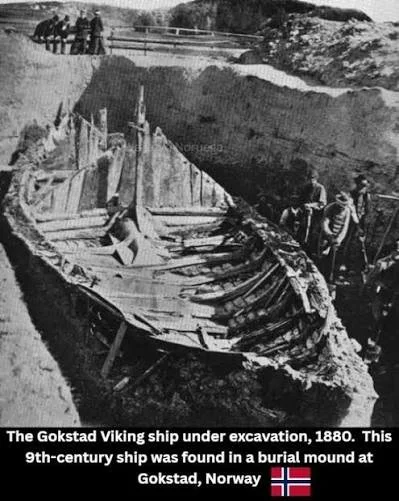
The Discovery

The Gokstad mound attracted attention during the nineteenth century.

Archaeological excavation revealed the remains of a large clinker-built ship beneath the burial mound.

Although the burial had been disturbed and robbed in antiquity, enough survived to reconstruct the vessel and identify important aspects of the burial.

The discovery dramatically expanded scholarly understanding of Viking ships.

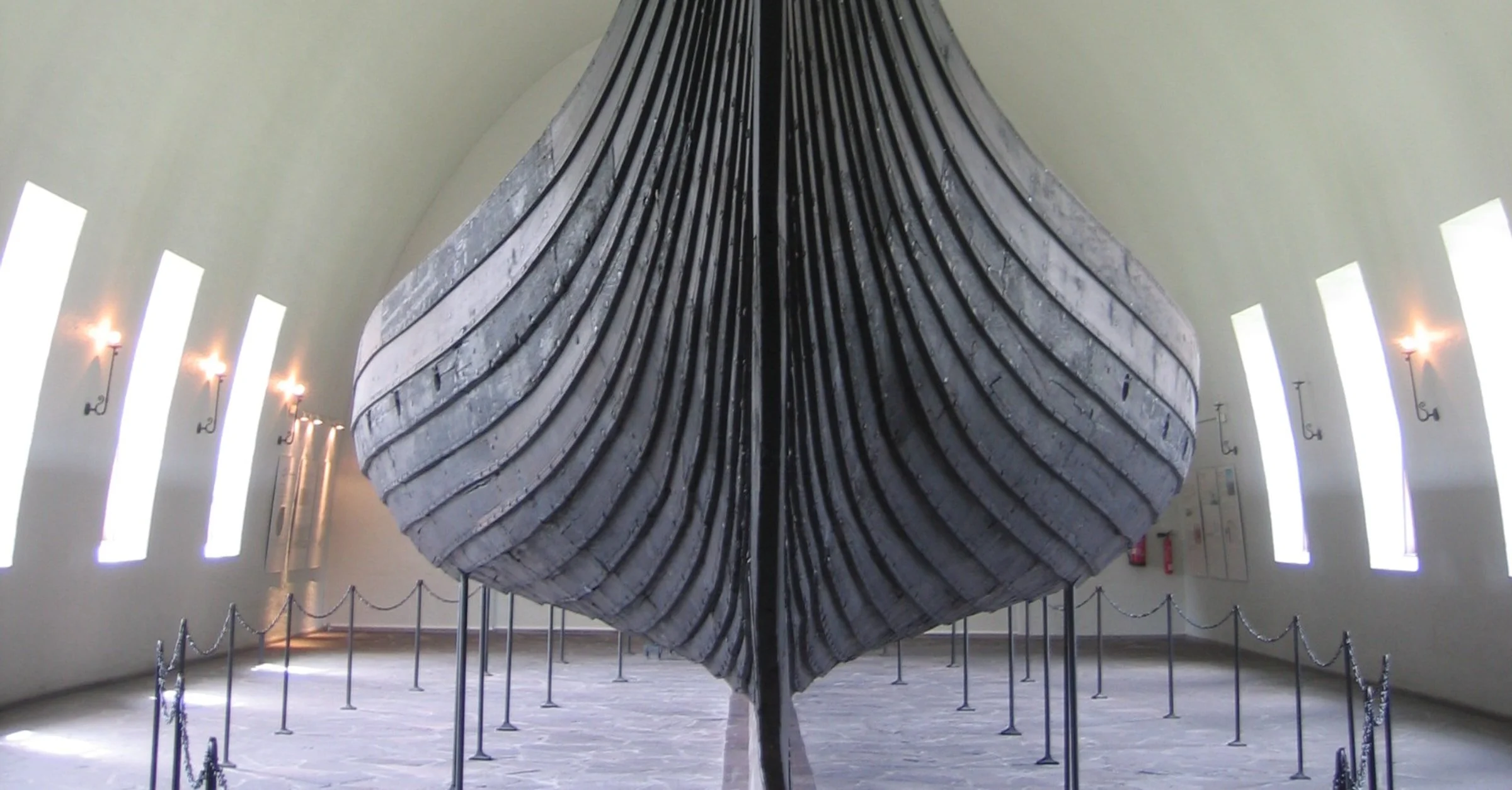
Construction of the Gokstad Ship

The Gokstad vessel demonstrates the classic Scandinavian clinker-building tradition.

Its hull consisted of overlapping wooden planks attached to a structural framework.

The design created a relatively light and flexible vessel.

The ship could be propelled using both oars and sail.

Its dimensions indicate that it was capable of carrying a substantial crew while maintaining considerable speed and maneuverability.

The Ship's Design

The hull was carefully shaped to balance several competing requirements.

A vessel needed to be stable enough to carry people but light enough to move efficiently.

It needed sufficient freeboard for open water while maintaining a relatively shallow draft for coastal and riverine environments.

The ship's design reflects generations of accumulated maritime knowledge.

There was no modern naval architecture software.

Instead, shipwrights relied on proportional systems, templates, experience, and knowledge passed between generations.

The Burial

The ship was placed within a burial mound.

The deceased was positioned inside the ship, accompanied by grave goods.

Although many objects were removed by grave robbers, archaeologists recovered enough evidence to demonstrate that this was an elite burial.

The ship itself was an extraordinary offering.

Constructing such a vessel required enormous resources.

Who Was Buried at Gokstad?

The identity of the individual has been debated.

Scientific examination of the skeletal remains indicates that the person was a mature adult male who had suffered serious injuries during his lifetime.

These injuries have contributed to interpretations concerning his status and possible military activity.

However, archaeology cannot establish every aspect of his identity with certainty.

The burial demonstrates high status, but the precise political position of the individual remains a subject of scholarly discussion.

Ship Burials and Status

Ship burials were powerful statements.

A ship could symbolize travel, power, wealth, and social identity.

In a funerary context, it may also have represented transportation into another realm, although interpretations of Viking afterlife beliefs must be treated cautiously.

Not every ship burial necessarily carried exactly the same symbolic meaning.

Nevertheless, the enormous investment involved indicates that the deceased belonged to an elite social group.

The Gokstad Ship and Viking Warfare

The Gokstad ship has often been described as a warship.

Its design would certainly have made it suitable for military activity.

The vessel was fast, maneuverable, and capable of carrying a considerable number of people.

However, Viking ships were multifunctional.

The same vessel could potentially support warfare, transportation, trade, political travel, or exploration.

It is therefore better understood as a highly adaptable maritime platform.

Oars and Sailing

The ship possessed numerous rowing positions.

This provided propulsion when wind conditions were unfavorable.

The large sail, meanwhile, could dramatically increase speed under suitable conditions.

The combination of both systems was one of the major strengths of Viking vessels.

Crews could switch between rowing and sailing depending on conditions.

The Broader Viking World

The Gokstad Ship emerged during a period of increasing Scandinavian mobility.

Viking Age Scandinavians established connections throughout northern Europe and the North Atlantic.

They traded with communities across enormous distances, raided coastal settlements, established colonies, and founded political centers.

The ship was the technological foundation of this mobility.

Archaeological Reconstruction

Modern scholars have learned enormous amounts from the Gokstad vessel.

The surviving timbers reveal how planks were shaped and joined.

The dimensions of the ship provide information about hull design.

Experimental archaeology has gone further by constructing replicas based on Viking ship discoveries.

Such replicas have demonstrated that reconstructed Viking ships can achieve impressive speeds and seaworthiness.

Legacy

The Gokstad Ship became one of the defining symbols of Viking archaeology.

Its survival transformed modern understanding of medieval Scandinavian technology.

It also challenged older stereotypes of Vikings as technologically primitive warriors.

The ship demonstrates a sophisticated engineering tradition based on careful observation of materials and water behavior.

Conclusion

The Gokstad Ship is one of the most important surviving monuments of the Viking Age.

Its construction reveals extraordinary expertise in timber engineering and maritime design, while its burial context provides evidence for social hierarchy and elite funerary practices.

The vessel also represents something larger: the technological foundation of Viking mobility.

Without ships capable of crossing open water, navigating fjords, reaching shallow coastal areas, and transporting people and goods efficiently, the extraordinary geographical expansion of Viking Age Scandinavia would have been impossible.

The Gokstad Ship therefore stands as both a funerary monument and a technological masterpiece—a wooden vessel that preserves the story of one of medieval Europe's most remarkable maritime cultures.

Hoprekstad Ship: Norway's 9th-Century Viking Vessel

September 14, 2026

Introduction

The Viking Age is often remembered for spectacular ships such as the Oseberg and Gokstad vessels, but our understanding of Viking maritime culture depends on a much larger archaeological record. Among the lesser-known examples associated with Norway's Viking ship tradition is the vessel from Hoprekstad, representing the sophisticated shipbuilding culture that allowed Scandinavian sailors to travel across coastal waters and beyond.

Viking ships were not simply transportation devices. They were technological systems that combined woodworking, hydrodynamics, sailing knowledge, navigation, logistics, and social organization.

The development of such ships transformed Scandinavian mobility during the early medieval period.

Why Ships Were So Important

Norway's geography encouraged maritime transportation.

Mountains, fjords, islands, and rugged coastlines made overland travel difficult. Boats could provide a faster and more efficient method of moving people and goods.

A capable vessel could carry cargo, livestock, warriors, and supplies.

This maritime infrastructure contributed directly to the expansion of Viking Age trade and warfare.

Clinker Construction

The characteristic Scandinavian technique was clinker construction.

Instead of beginning with a thick solid hull, shipbuilders arranged overlapping planks along the sides of the vessel.

These overlapping boards created a flexible but strong hull.

The technique had several advantages.

It reduced weight, allowed controlled flexibility, and produced a hull capable of operating in rough water.

The planks could be fastened with iron rivets or other appropriate connections, while internal frames and crossbeams provided additional structural strength.

Selecting Timber

Ship construction began with the forest.

Builders needed suitable trees for different components.

Straight-grained timber was particularly valuable for planking, while naturally curved pieces could be useful for structural elements.

The shape of a tree could influence the shape of a component.

This meant that shipbuilding depended on careful observation of natural materials.

Medieval shipwrights effectively designed vessels around the properties of the timber available to them.

The Viking Sail

The introduction and widespread use of large sails dramatically increased the capabilities of Scandinavian ships.

A sail allowed the wind to provide much of the vessel's propulsion.

This did not eliminate the need for oars.

Oars remained essential when maneuvering in harbors, rivers, narrow passages, or periods of calm weather.

The combination of sail and oar gave Viking ships exceptional flexibility.

The Human Element

A ship's performance depended on its crew.

Sailors had to coordinate steering, rowing, sail handling, anchoring, loading, and navigation.

Long-distance voyages required knowledge of coastlines, weather patterns, currents, winds, and seasonal conditions.

This knowledge was probably transmitted through practical experience and oral traditions.

Ships and Viking Society

Ships had social significance.

Owning, commissioning, or commanding a substantial vessel required resources.

A ship represented investment in timber, iron, labor, and skilled craftsmanship.

Consequently, ships could symbolize political power and social status.

They also facilitated relationships between distant communities.

Ships and Warfare

The image of the Viking longship as an unstoppable war machine is somewhat simplified.

Viking vessels were effective because of their combination of speed, shallow draft, and flexibility.

A shallow-draft ship could approach beaches and travel into waterways that larger vessels could not easily reach.

This allowed warriors to choose landing locations quickly.

Mobility was therefore a major military advantage.

Ships and Trade

The same characteristics that made Viking vessels useful for warfare also made them valuable for commerce.

Merchants could transport commodities along Norway's coast and across the North Atlantic.

Viking trade networks connected Scandinavia with Britain, Ireland, continental Europe, the Baltic, and beyond.

The archaeological record demonstrates that Viking maritime activity was not exclusively raiding.

It involved trade, migration, diplomacy, exploration, and settlement.

Archaeological Importance

Ship remains are unusually valuable archaeological evidence because they preserve construction details that are rarely visible in written sources.

A vessel can reveal:

  • plank dimensions;

  • timber selection;

  • fastening techniques;

  • hull shape;

  • repair history;

  • construction sequence;

  • evidence of use.

These details allow archaeologists to reconstruct technological traditions.

Conclusion

The Hoprekstad ship belongs to the broader technological world that made the Viking Age possible.

Its significance lies not simply in being an old vessel but in representing a sophisticated maritime tradition developed through generations of experimentation.

Viking shipbuilders understood how to manipulate timber, design flexible hulls, balance sail and oar propulsion, and construct vessels suited to Norway's challenging waters.

These technologies transformed the possibilities of movement across the medieval North Atlantic.

The Viking Age was therefore, in many respects, an age of maritime engineering—and ships such as the Hoprekstad vessel provide the archaeological foundation for understanding that transformation.

Kaupanger Stave Church: Norway's Sogn Region

September 14, 2026

Introduction

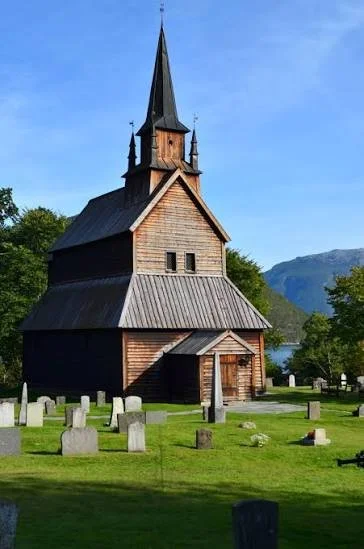
Kaupanger Stave Church is one of the most important surviving medieval timber churches in Norway. Situated in the Sogn region of western Norway, the church occupies a landscape historically shaped by fjords, agriculture, maritime transportation, and long-distance communication.

Its survival provides an extraordinary opportunity to examine the architectural and technological achievements of medieval Norwegian builders.

Kaupanger is particularly valuable because its construction and later history preserve evidence of the evolution of stave architecture. The church demonstrates that medieval timber architecture was not primitive or improvised. It was a highly developed construction system requiring careful planning, specialized craftsmanship, and extensive knowledge of wood.

Kaupanger and the Sogn Landscape

Sogn is characterized by dramatic fjords and mountainous terrain.

Travel through such a landscape historically depended heavily on water.

The fjords functioned as transportation corridors, allowing people and goods to move between settlements. This gave communities along the waterways strategic and economic importance.

Kaupanger developed in this broader environment as an important settlement and trading location.

A substantial church in such a location therefore had significance beyond its immediate religious function.

The Stave Construction System

Kaupanger belongs to the stave church tradition.

Its principal structure consists of vertical timber staves connected by horizontal beams and supported by additional structural components.

The system is remarkably sophisticated.

Instead of depending primarily on thick masonry walls, builders created a timber framework capable of carrying substantial roof loads.

This was particularly advantageous in Norway, where forests provided abundant construction material.

Medieval Carpentry

Constructing a large stave church required skilled carpenters.

Trees had to be selected carefully, transported to the construction site, shaped, and assembled.

The craftsmen worked with hand tools such as axes, chisels, and woodworking planes.

Without modern measuring equipment, builders relied on geometric principles, practical experience, standardized proportions, templates, and repeated construction knowledge.

The accuracy visible in surviving medieval timber buildings demonstrates the effectiveness of these methods.

A Church Within a Christianizing Society

Kaupanger's church emerged within the broader transformation of Norwegian society following the adoption of Christianity.

Christianization changed religious practices, burial customs, festivals, social institutions, and political relationships.

Churches became permanent physical expressions of the new religious system.

They also provided communities with spaces for rituals marking important stages of life.

Architectural Continuity

One of the most fascinating aspects of stave churches is their combination of innovation and continuity.

Christian architecture introduced new forms and spatial requirements. Yet local builders continued using traditional Scandinavian techniques.

This created buildings that were unmistakably Christian but also distinctly Nordic.

Carved animal motifs and interlaced decoration demonstrate how Scandinavian artistic vocabulary survived within Christian contexts.

The Importance of Timber

Timber was more than a convenient building material.

It shaped Norwegian architecture.

Stone was available in Norway, but transporting and shaping large quantities of masonry could be expensive and difficult, especially in remote regions.

Wood could be harvested locally.

The challenge was ensuring durability.

The survival of Kaupanger demonstrates that medieval builders were able to protect timber from many of the environmental conditions that normally cause wooden buildings to deteriorate.

Archaeological Information From Wooden Buildings

Wooden buildings can provide unusually detailed chronological evidence.

Annual growth rings record environmental conditions during the life of a tree. When these sequences can be matched with regional tree-ring chronologies, researchers can sometimes determine when particular timbers were felled.

This makes dendrochronology an important tool in the study of stave churches.

Researchers can also examine tool marks and construction joints to understand how medieval craftsmen worked.

The church therefore preserves technological evidence as well as architectural evidence.

Changes Through Time

Kaupanger was not preserved because history stopped.

Like other long-lived churches, it experienced repairs, alterations, and changing functions.

Each generation inherited the building and made decisions about how to maintain it.

These changes reveal changing attitudes toward architecture, worship, and practical requirements.

Modern conservation therefore seeks to preserve both the medieval structure and evidence of its later history.

Why Kaupanger Matters

Kaupanger Stave Church is particularly important for understanding western Norway because it connects architecture with a landscape dominated by maritime communication.

Its existence demonstrates how Christianity became embedded within communities connected by fjord networks.

The church also illustrates the high level of engineering achieved by medieval Norwegian carpenters.

Conclusion

Kaupanger Stave Church is a remarkable survival from medieval Norway.

Its timber framework, architectural proportions, and long history demonstrate the sophistication of stave construction. Its location in the Sogn region places it within a landscape where fjords served as major transportation routes and settlements depended upon maritime communication.

The church also tells a larger story about cultural transformation.

Christianity brought new religious institutions to Norway, but local craftsmen expressed those institutions through traditional woodworking technologies and Scandinavian artistic traditions.

Kaupanger therefore stands as a monument to both religious change and technological continuity—a building in which the Christian Middle Ages of Norway remain visible in timber.

Ringebu Stave Church: Norway's Gudbrandsdal Valley

September 14, 2026

Introduction

Ringebu Stave Church stands in the historic Gudbrandsdal valley of central Norway and is one of the country's best-known surviving medieval wooden churches. Its location is significant because Gudbrandsdal was an important inland communication corridor, linking communities, agricultural settlements, and routes across the Norwegian interior.

The church represents the remarkable stave-building tradition that flourished in medieval Norway. Constructed primarily from timber, it demonstrates how Scandinavian builders developed structural techniques capable of producing tall and durable religious buildings from a material that was abundant in the Norwegian landscape.

Although the present church incorporates modifications made during later centuries, its medieval core provides valuable evidence for the development of Norwegian Christian architecture.

The Medieval Timber Tradition

Stave churches developed from Norway's extensive woodworking tradition.

Long before Christian churches were constructed, Scandinavian societies had mastered timber architecture. Houses, halls, boats, storage buildings, bridges, and defensive structures were commonly built from wood.

Christianity introduced a new architectural requirement: permanent buildings dedicated to communal worship.

The stave church provided an effective solution. Rather than copying stone churches directly, Norwegian builders adapted Christian architectural concepts to their own construction traditions.

Structural Design

The defining feature of a stave church is its internal timber framework.

Vertical posts known as staves provide the primary structural support. These are connected with beams and reinforced with additional timber members.

The walls are not simply piles of horizontal logs. Instead, the building resembles a carefully engineered wooden skeleton.

This construction method allowed builders to create substantial vertical structures while keeping the weight manageable.

The structural system also made extensive use of carefully designed joints. Medieval carpenters relied on wooden connections, pegs, braces, and interlocking components rather than modern metal hardware.

Such construction required extensive practical knowledge.

Ringebu's Distinctive Form

Ringebu Stave Church is particularly interesting because of its architectural development.

Unlike some smaller stave churches, Ringebu possesses a substantial appearance and has undergone changes reflecting later requirements.

The church demonstrates that stave architecture was not a single rigid design. Builders could modify the basic system according to local conditions, available resources, congregation size, and changing liturgical needs.

The result is an architectural form that combines medieval foundations with later historical layers.

Christianity in Gudbrandsdal

Gudbrandsdal played an important role in the Christianization of inland Norway.

The valley contained agricultural communities that were connected through local and regional networks. As Christianity became established, churches became permanent centers of religious life.

The construction of a church represented a major investment.

Large quantities of timber had to be obtained and transported. Skilled craftsmen were required to shape structural elements. Communities had to support the building economically and maintain it over generations.

The church therefore represented not merely religious belief but also collective organization.

The Church and Medieval Society

A medieval church was a central institution.

People came to church for worship, but the building was also associated with baptisms, marriages, funerals, seasonal festivals, and community gatherings.

The Christian calendar influenced agricultural and social rhythms.

Major feast days created recurring occasions when religious and social life intersected.

The church also represented authority. Its presence demonstrated that Christianity was not simply a personal belief but a social institution embedded in the landscape.

Architecture as Cultural Evidence

Ringebu provides evidence for the cultural adaptation of Christianity.

The basic purpose of the building was Christian, yet its construction belonged to a distinctly Scandinavian tradition.

This distinction is important.

Medieval Europe is often imagined as being dominated by standardized stone churches. In reality, architecture varied enormously according to geography, climate, resources, and local craftsmanship.

Norway's stave churches demonstrate that Christian architecture could take radically different forms while serving similar religious purposes.

Timber and Environmental Knowledge

The construction of Ringebu also reveals medieval knowledge of natural resources.

Timber quality mattered enormously.

Builders had to select trees that were sufficiently strong and suitable for large structural components. They also needed to understand how wood behaved when exposed to moisture, temperature changes, and prolonged loading.

The survival of medieval timber buildings indicates that these craftsmen possessed sophisticated empirical knowledge even without modern structural engineering.

Later Modifications

Ringebu Stave Church, like many surviving medieval churches, should not be treated as a completely untouched monument.

Buildings that remain in use must adapt.

Doors may be replaced. Windows may be enlarged. Interior arrangements may change. Structural elements may be repaired. New architectural components may be added.

These changes are historically significant because they reveal how later generations interacted with medieval heritage.

The church is therefore both a medieval monument and a record of centuries of continued use.

Preservation

Preserving a timber church presents challenges that differ from those encountered with stone architecture.

Wood can be damaged by moisture, fungi, insects, temperature fluctuations, and structural stress.

Conservation therefore requires careful monitoring.

Modern preservation seeks to protect historical material while avoiding unnecessary replacement. Where original timber survives, it represents irreplaceable archaeological evidence.

Historical Significance

Ringebu Stave Church contributes to our understanding of:

  • medieval Norwegian Christianity;

  • timber engineering;

  • Scandinavian craftsmanship;

  • rural community organization;

  • medieval landscape settlement;

  • architectural adaptation;

  • long-term heritage preservation.

Its value lies not in a single feature but in the combination of these elements.

Conclusion

Ringebu Stave Church is one of the enduring monuments of Norway's medieval landscape.

Its timber framework reflects the ingenuity of Scandinavian carpenters, while its position in Gudbrandsdal connects it to the agricultural and communication networks of inland Norway.

Most importantly, the church illustrates how architecture can preserve evidence of cultural change. Christianity transformed Norway's religious world, but it did not erase local traditions of woodworking and artistic expression. Instead, those traditions became part of the country's Christian architectural heritage.

Ringebu therefore stands as both a religious building and a historical document—one whose timbers preserve nearly a millennium of Norwegian architectural and social history.

Lom Stave Church: Norway's 12th-Century Timber

September 14, 2026

Lom Stave Church is one of Norway’s most remarkable surviving examples of medieval timber architecture. Located in the village of Lom in Innlandet, within the historic Gudbrandsdal region, the church represents a period when Christianity was becoming firmly established in Norway while older Scandinavian traditions continued to influence artistic expression, construction techniques, and decorative motifs.

The church belongs to the distinctive architectural tradition known as the stave church, named for its massive vertical timber posts, or staves, that form the structural framework of the building. Unlike ordinary wooden buildings in which walls carry much of the structural load, stave churches were constructed around a sophisticated timber skeleton. This technique permitted medieval Scandinavian builders to create tall, complex wooden structures without relying on masonry.

Lom Stave Church is generally dated to the 12th century, although it has undergone numerous alterations and repairs over the centuries. Its present appearance therefore represents not simply a frozen medieval monument, but the accumulated history of a living religious building that continued to serve its community long after the Middle Ages.

The Origins of the Stave Church Tradition

Stave churches emerged during the Christianization of Scandinavia. Norway converted gradually rather than through a single event, and Christianity interacted with an existing society that possessed highly developed traditions of woodworking and monumental construction.

Wood was an especially important material in medieval Norway. Dense forests supplied enormous quantities of timber, while Scandinavian craftsmen had generations of experience constructing houses, halls, boats, bridges, and other structures from wood.

The stave church represented a remarkable combination of these skills with Christian architectural requirements.

Builders needed to create spaces suitable for Christian worship while adapting them to local materials and construction traditions. The result was an architectural form that had no exact equivalent in stone-built continental churches.

How Lom Stave Church Was Constructed

The fundamental feature of the building is its stave construction. Large vertical wooden posts formed the principal framework. These posts were connected by horizontal beams and strengthened by additional structural members.

Rather than simply stacking logs horizontally, as in traditional log construction, stave builders created a rigid framework that could support walls and roof structures.

The technique required carefully prepared timber. Trees were selected for suitable dimensions and qualities, and the wood was shaped using axes and other hand tools. Medieval carpenters had no modern sawmills, cranes, or power tools, yet their knowledge of timber behavior was highly sophisticated.

The builders understood that different parts of a tree possessed different structural properties. Large timbers could be selected for major load-bearing components, while smaller pieces could be used for secondary structures.

Joints were also crucial. Medieval Scandinavian carpenters developed sophisticated methods for joining wooden elements without relying heavily on metal fasteners. Pegs, mortise-and-tenon joints, braces, and carefully fitted beams allowed structures to remain stable for centuries.

The Importance of the Roof

One of the most visually impressive features of Lom Stave Church is its complex roof structure.

Stave churches frequently developed multiple roof levels, creating a distinctive upward movement. From a distance, the building can appear almost like a wooden mountain rising above the surrounding landscape.

The steep roofs were practical as well as aesthetic. Norway experiences substantial snowfall, and steeply pitched roofs allow snow to slide away rather than accumulating indefinitely.

The roof also provided opportunities for decorative expression. Dragon-like forms and other carved details associated with Scandinavian artistic traditions appear on several Norwegian stave churches.

These motifs are particularly interesting because they demonstrate how Christianity did not immediately eliminate all elements of pre-Christian artistic culture.

Christian Architecture and Scandinavian Artistic Traditions

The decoration of Norwegian stave churches reflects an important cultural transition.

Christianity introduced new religious imagery, architectural requirements, and liturgical practices. At the same time, Scandinavian craftsmen continued to employ visual traditions that had developed before conversion.

Animal ornamentation, interlaced patterns, serpentine forms, and stylized creatures are characteristic of Scandinavian medieval art. Some decorative forms resemble motifs associated with the Viking Age.

This does not necessarily mean that the church preserved pagan religious beliefs. Rather, it demonstrates how artistic traditions can survive changes in religion.

A craftsman trained in traditional Scandinavian carving did not suddenly abandon centuries of artistic knowledge when Christianity became dominant. Instead, those skills were redirected toward Christian buildings.

Lom as a Medieval Community

The importance of Lom Stave Church cannot be separated from the surrounding landscape.

Lom lies within Gudbrandsdal, an important valley system connecting different parts of inland Norway. Agriculture, travel, trade, and seasonal movement shaped life in the region.

A medieval church served numerous functions beyond worship. It was a gathering place, a marker of community identity, and a physical symbol of the Christian order.

The church calendar structured time through religious festivals, feast days, and ceremonies. Baptisms, marriages, funerals, and other important events connected the building to major transitions in people's lives.

Consequently, a stave church should not be understood simply as an architectural object. It was part of the social infrastructure of medieval Norway.

The Church Through the Centuries

One of the most significant characteristics of Lom Stave Church is that it survived because it remained useful.

Many medieval wooden churches disappeared because they were demolished, replaced, burned, abandoned, or substantially rebuilt. Lom's continued use helped preserve the structure while also leading to modifications.

Over the centuries, changing religious practices and population needs resulted in additions and alterations.

This means that archaeologists and architectural historians must distinguish between original medieval elements and later interventions.

A building that appears medieval at first glance may actually contain components from several historical periods.

Preservation and Archaeological Importance

Stave churches are exceptionally valuable sources for understanding medieval Scandinavian society because they preserve information about woodworking technology that would otherwise be difficult to reconstruct.

Timber can reveal evidence about:

  • tree selection;

  • woodland management;

  • carpentry techniques;

  • construction sequencing;

  • tool marks;

  • building repairs;

  • changes in architectural design.

Scientific analysis of wood can also provide information about when trees were cut. Techniques such as dendrochronology, which examines annual growth rings, can help researchers establish construction dates and identify later repairs.

The surviving timber therefore acts almost like a historical document.

Why Lom Stave Church Matters

Lom Stave Church is important for several interconnected reasons.

First, it demonstrates the sophistication of medieval Norwegian timber construction.

Second, it provides evidence for the development of Christianity in rural Norway.

Third, its decorative traditions illustrate the interaction between Christian symbolism and Scandinavian artistic culture.

Finally, its survival demonstrates how medieval buildings could remain meaningful through centuries of religious and social transformation.

Conclusion

Lom Stave Church is far more than an old wooden church. It is a surviving record of medieval Norway's technological abilities, religious transformation, artistic traditions, and community life.

Its massive timber framework demonstrates the ingenuity of medieval carpenters, while its decorative features reveal a culture negotiating the transition from Viking Age traditions to Christian Europe.

The church also reminds us that medieval architecture was not static. Buildings evolved as communities changed. Repairs, additions, alterations, and continued use transformed the structure while preserving its essential identity.

Today, Lom Stave Church stands as one of the clearest demonstrations of how Norway's medieval builders turned timber into monumental architecture—and how a building constructed nearly a millennium ago can continue to tell the story of the society that created it.

Heddal Stave Church: Norway's Largest Wooden Church

September 14, 2026

Heddal Stave Church is widely regarded as the largest surviving stave church in Norway and is one of the most impressive examples of medieval Scandinavian timber architecture. Its monumental scale, complex structure, and survival through centuries of change make it an especially important source for understanding medieval construction, Christianization, and Norwegian heritage.

The Scale of Heddal

Unlike a small rural timber chapel, Heddal was built on a substantial scale.

Its multiple roof levels create a dramatic vertical silhouette, while the internal structural system demonstrates the sophistication of stave construction.

The church was designed to accommodate a community and to project a strong visual presence within the landscape.

How Stave Construction Worked

The word "stave" refers to the large vertical structural posts forming the building's framework.

These posts support horizontal beams and connect to other structural elements.

Walls are inserted between the framework, while the roof structure transfers loads through a carefully organized system.

This allowed medieval builders to create relatively tall timber structures.

Medieval Craftsmanship

Constructing Heddal required highly skilled craftsmen.

Trees had to be selected carefully, particularly for structural components. Timber needed to be shaped with axes, adzes, chisels, and other woodworking tools.

Joints had to be accurately fitted.

The resulting structure demonstrates that medieval carpentry was a sophisticated engineering discipline rather than merely rough timber construction.

Christianity and Local Society

Heddal belonged to the Christian landscape of medieval Norway.

Churches were central to religious life, providing locations for Mass, baptism, marriage, burial, confession, and major festivals.

The church also reinforced community organization.

Its size indicates that the building served a substantial local population or had an important regional role.

Decorative Traditions

Stave churches often incorporate carved wooden details.

These can include geometric ornament, vegetal forms, interlaced designs, and animal motifs.

Such decoration reflects the interaction of Christian symbolism with Scandinavian artistic traditions.

The result is a distinctive architectural language that differs from both continental Romanesque stone churches and later Gothic architecture.

Preservation and Restoration

Heddal has undergone significant restoration and conservation.

This is important because surviving medieval buildings rarely remain completely unchanged.

Timber deteriorates, roofs require replacement, structural components weaken, and later generations modify buildings to meet changing needs.

Restoration therefore involves a difficult balance between preserving genuine historical fabric and ensuring structural stability.

Why Heddal Matters

Heddal is significant because it demonstrates what medieval Norwegian timber architecture could achieve at its largest scale.

It represents engineering knowledge, woodworking expertise, religious devotion, community organization, and cultural continuity.

The church also helps correct the common misconception that medieval monumental architecture was synonymous with stone.

In Norway, forests supplied the raw material for a remarkable architectural tradition. Builders transformed timber into churches that could rise several stories into the landscape and survive for centuries.

Heddal therefore stands not merely as a religious building but as a monument to medieval Norwegian craftsmanship and the enduring cultural importance of wood.

Urnes Stave Church: Norway's Romanesque Wood

September 14, 2026

Urnes Stave Church is one of Norway's most important medieval architectural monuments and is particularly famous for the artistic style now known as the Urnes style. The church demonstrates how Scandinavian woodworking traditions interacted with the broader Romanesque culture of medieval Christian Europe.

Its significance extends far beyond its physical beauty. Urnes provides evidence for religious change, artistic exchange, timber engineering, and the transformation of Scandinavian visual culture.

The Urnes Style

The Urnes style developed in Scandinavia during the eleventh and twelfth centuries.

Its most recognizable features include slender animal figures, flowing bodies, intertwined forms, and elegant ornament.

The animals are often elongated and arranged within complex compositions.

This artistic vocabulary is distinctly Scandinavian while also participating in wider European developments in medieval ornament.

A Christian Building With Scandinavian Artistic Heritage

Urnes illustrates an important feature of medieval cultural transformation.

Christianization did not erase earlier artistic traditions overnight. Instead, Scandinavian craftsmen adapted familiar visual forms to new religious contexts.

The resulting architecture combined Christian function with local artistic traditions.

This makes Urnes particularly important for understanding cultural transition.

Timber Engineering

The church's structure relies on traditional stave construction.

Vertical posts carry the principal loads, while beams, braces, and other components stabilize the building.

Wooden churches required continuous maintenance because timber was vulnerable to moisture and biological decay.

The survival of Urnes is therefore remarkable.

Romanesque Connections

Urnes was built during a period when Norway became increasingly integrated into European Christian networks.

Church institutions, religious texts, clerics, artistic styles, and architectural ideas moved across Europe.

The church's Romanesque character reflects these connections.

Yet the building remained unmistakably Scandinavian in its construction and decorative traditions.

The Medieval Religious World

A church such as Urnes was part of a larger religious system.

Christian worship structured the calendar, burial practices, marriage ceremonies, and community identity.

The church connected local society with bishops, monasteries, royal authority, and the wider Christian world.

Archaeological Importance

Urnes is particularly valuable because it preserves elements from different phases of church construction.

Earlier structural and decorative components were incorporated into the surviving building.

This creates a layered archaeological record.

Rather than representing a single moment in history, the church embodies centuries of architectural and cultural development.

UNESCO and Global Significance

Urnes Stave Church is recognized as a major example of medieval Scandinavian architecture and forms part of Norway's internationally significant cultural heritage.

Its importance lies in the combination of engineering, art, religion, and cultural exchange.

Urnes demonstrates that medieval Norway was not culturally isolated. It participated actively in European Christianity while maintaining distinctive Scandinavian artistic traditions.

Borgund Stave Church: Norway's Viking Age Wood

September 14, 2026

Borgund Stave Church is one of Norway's best-preserved medieval stave churches and one of the most famous examples of Scandinavian timber architecture. Although the surviving church is medieval rather than literally a Viking Age building, its architectural tradition developed from a Scandinavian cultural environment shaped by the transition from the Viking Age to medieval Christianity.

Its extraordinary preservation allows historians and archaeologists to study medieval timber architecture in unusual detail.

Construction and Design

Borgund is built around a structural framework of massive wooden staves.

The walls are formed from vertical timber boards placed between the structural posts, while beams and braces reinforce the building.

The roof rises in multiple levels, creating the distinctive appearance associated with stave churches.

The complexity of the structure demonstrates that medieval Scandinavian builders possessed highly developed woodworking skills.

From Viking Age to Christianity

The architecture contains features that appear distinctly Scandinavian even though the building served Christianity.

Decorative elements include carved animal-like forms and interlaced patterns that resemble broader Scandinavian artistic traditions.

These motifs demonstrate that Christian architecture in Norway developed through cultural adaptation rather than complete rejection of earlier artistic vocabulary.

The Importance of Woodworking

Stone monuments often dominate discussions of medieval architecture because they survive more easily.

Borgund demonstrates why this can create a misleading picture.

Medieval Scandinavia possessed an extensive timber-building tradition. Builders understood timber selection, joinery, structural reinforcement, weather protection, and roofing.

The knowledge required was substantial.

Church and Community

A medieval church served many purposes.

It was a place for Mass and religious ceremonies, but it also represented the institutional presence of Christianity within the community.

The church calendar structured time through festivals, fasts, saints' days, and seasonal celebrations.

Churches also became places where legal, economic, and social relationships intersected.

Preservation and Archaeology

Borgund's survival is partly due to later conservation efforts and the replacement or protection of vulnerable components.

The building provides researchers with an unusually complete case study in medieval Scandinavian timber architecture.

It can be examined not only as a religious monument but also as evidence of engineering, forestry, craft organization, and social history.

Cultural Legacy

Borgund became an important model for understanding Norwegian stave churches.

Its distinctive appearance has influenced modern architectural reconstructions and scholarship concerning medieval Scandinavian building techniques.

The church stands as a reminder that medieval Europe was architecturally diverse. Monumental religious architecture was not restricted to stone cathedrals.

In Norway, wood itself became the medium for some of the most sophisticated surviving medieval architecture.

Røldal: Norway's Medieval Stave Church Site

September 14, 2026

Røldal is associated with one of Norway's important medieval stave church traditions. Stave churches are among the most distinctive architectural achievements of medieval Scandinavia, combining Christian religious functions with sophisticated timber construction techniques that developed within northern European building traditions.

The church at Røldal is particularly famous for its medieval crucifix and traditions surrounding its miraculous powers.

What Is a Stave Church?

A stave church is a timber church constructed around vertical load-bearing posts known as staves.

Unlike simple timber buildings in which walls bear much of the structural weight, stave churches use a sophisticated timber framework.

Horizontal beams, vertical posts, braces, and roof structures work together to create a strong architectural system.

Christianization of Norway

Stave churches emerged during the centuries following the Christianization of Norway.

Christianity gradually became established as the dominant religion, replacing or transforming earlier religious practices.

Church construction became an important expression of the new religious order.

Yet the architecture did not simply copy continental stone churches. Norwegian builders adapted Christian architecture to local materials and construction traditions.

Timber as Architecture

Wood was abundant in Norway, making it a practical building material.

However, constructing a large timber church required considerable expertise.

Builders had to select appropriate trees, season timber, shape structural components, and create joints capable of supporting large roofs.

The survival of stave churches demonstrates the high level of medieval Scandinavian woodworking.

Røldal and Religious Tradition

Røldal became associated with a famous crucifix believed to possess healing powers.

Pilgrims traveled to the church seeking cures and spiritual assistance.

Such pilgrimage traditions demonstrate that medieval churches were not merely places where weekly worship occurred. They could become regional centers of pilgrimage, commerce, storytelling, and social interaction.

Architecture and Belief

The physical structure of a stave church shaped religious experience.

Dim interiors, carved wooden details, monumental roofs, and sacred images created a dramatic environment.

The combination of architecture and ritual helped communicate Christian teachings to communities in which literacy was limited.

Images, relics, processions, and ceremonies therefore played an important educational role.

Preservation

Stave churches are exceptionally vulnerable to fire, weather, insects, and structural deterioration.

The survival of Røldal's medieval church traditions therefore represents a significant heritage achievement.

The building provides evidence not only for medieval Christianity but also for the technological history of Scandinavian woodworking.

Vingen: Norway's 6,000 Rock Figures

September 14, 2026

Vingen is one of Norway's most extraordinary prehistoric rock-art landscapes. Located in western Norway, the site contains thousands of carved figures, creating an archaeological record of exceptional scale.

The concentration of imagery makes Vingen particularly important for understanding the symbolic culture of Stone Age hunter-gatherer communities in Scandinavia.

A Landscape Filled With Images

Unlike a single isolated petroglyph, Vingen consists of numerous rock surfaces containing large numbers of figures.

The carvings include animals, particularly deer, as well as human and abstract representations.

The sheer quantity indicates that the location had significance over an extended period.

Deer and the Prehistoric Economy

Deer imagery dominates much of Vingen's visual tradition.

This is understandable because deer were important resources for prehistoric northern communities. They provided meat, hides, bones, antler, and other materials.

However, the abundance of deer images also suggests that the animals possessed symbolic importance.

In many hunter-gatherer cultures, animals are not simply resources. They may be understood as powerful beings with agency and spiritual significance.

The Human-Animal Relationship

The repeated depiction of animals provides an opportunity to examine prehistoric concepts of nature.

Rather than treating humans and animals as entirely separate categories, prehistoric communities may have understood them through reciprocal relationships.

Hunting was therefore potentially both an economic and spiritual activity.

The rock art may have been associated with rituals intended to maintain these relationships.

Why Choose This Location?

The placement of Vingen's carvings is significant.

The rock surfaces form part of a distinctive natural environment, and access to the site may have required deliberate movement through the landscape.

This raises the possibility that visiting Vingen itself was meaningful.

The journey to the site, the act of carving, and the resulting images may all have formed parts of a ritual process.

The Meaning of Rock Art

No written explanation survives.

Consequently, interpretations remain hypotheses.

Some scholars have connected Scandinavian hunter-gatherer rock art with shamanic practices, altered states of consciousness, hunting rituals, or cosmological beliefs.

These interpretations can be useful, but they should not be treated as proven explanations.

The evidence demonstrates symbolic activity; it does not provide a complete prehistoric theology.

Vingen's Importance

Vingen is valuable because it preserves evidence of a sophisticated symbolic tradition among Stone Age communities.

The people who created the carvings were hunters and gatherers, but their societies were capable of producing large-scale artistic landscapes.

Their lives involved technology, environmental knowledge, social relationships, ritual practices, and complex understandings of animals.

Vingen therefore challenges simplistic ideas about prehistoric societies and provides a rare window into the intellectual world of northern Europe's early inhabitants.

← Newer Posts Older Posts →
Featured
image_2026-09-15_213233600.png
September 18, 2026
Kaloko-Honokohau: Hawaii's Ancient Salt Pans
September 18, 2026
Read more →
September 18, 2026
image_2026-09-15_213313883.png
September 18, 2026
Anasazi Chacoan Outliers: New Mexico's Road Network
September 18, 2026
Read more →
September 18, 2026
image_2026-09-15_213356305.png
September 18, 2026
Salmon Ruins: New Mexico's Chaco Colony
September 18, 2026
Read more →
September 18, 2026
image_2026-09-15_213433098.png
September 18, 2026
Aztec West: New Mexico's Great House Community
September 18, 2026
Read more →
September 18, 2026
image_2026-09-15_213526907.png
September 18, 2026
Casamero Pueblo: New Mexico's Chaco Outlier
September 18, 2026
Read more →
September 18, 2026
image_2026-09-15_214058824.png
September 18, 2026
Chimney Rock: Colorado's Astronomical Great House
September 18, 2026
Read more →
September 18, 2026
read more

Powered by The archaeologist